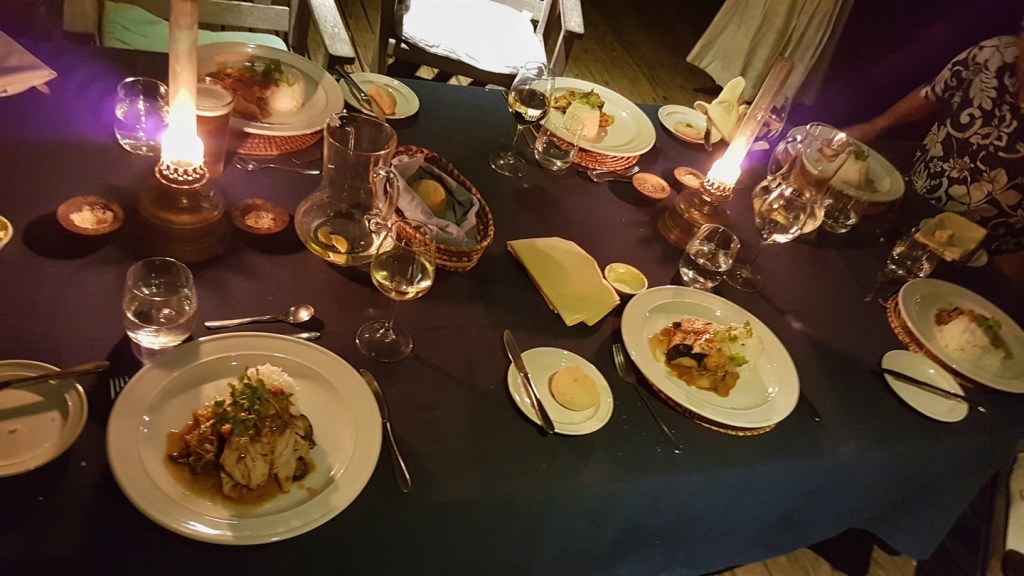
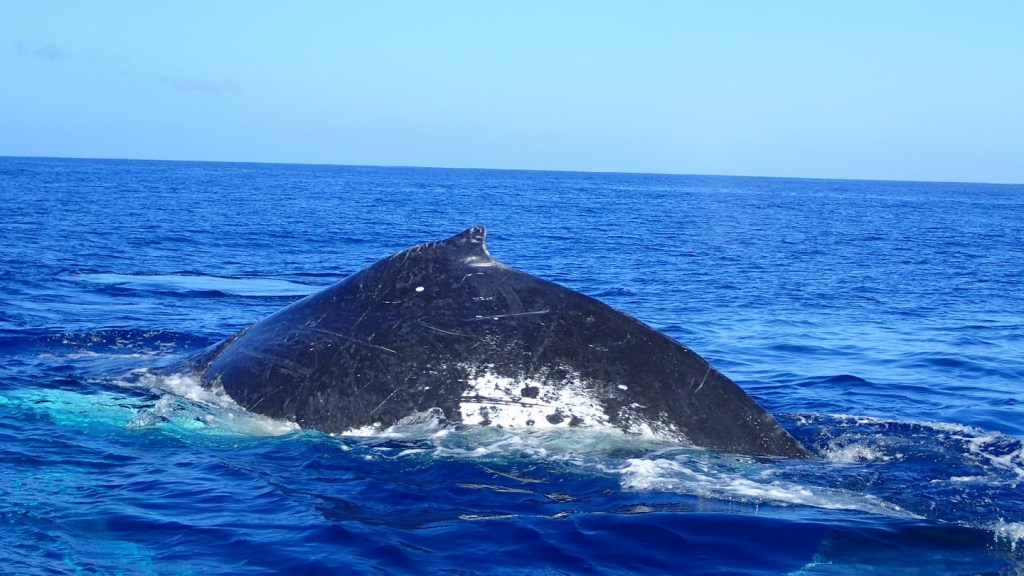
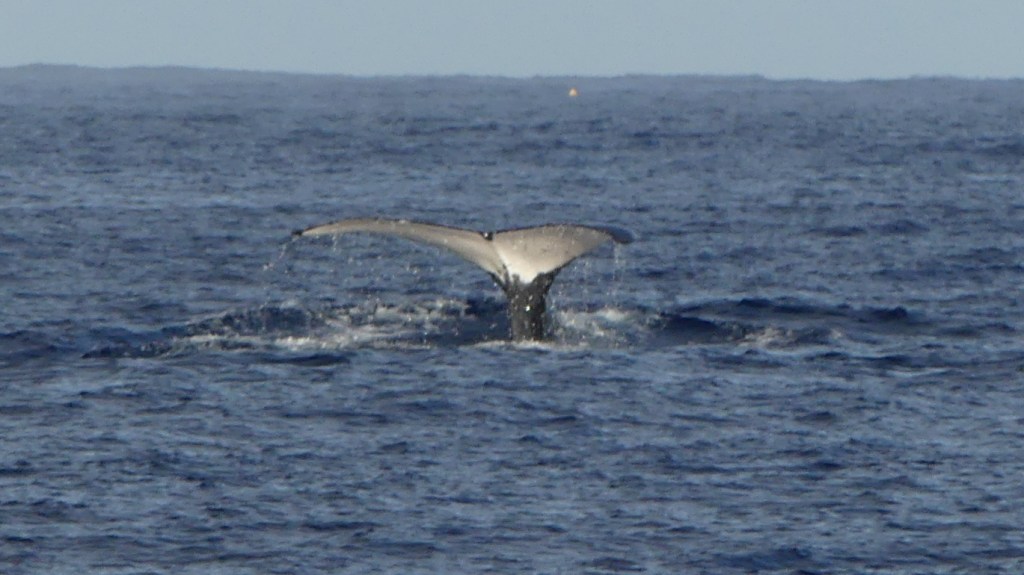
Every year , from June to October, the humpback whales migrate from Antarctica to the warmer waters of the Pacific to have their calves and to mate. Tonga is one of the few places in the world where it is possible to swim or snorkel with whales. We did not want to miss this opportunity. Although the end of July is still early in the season, we really hoped to have this unique experience. We checked the weather and saw that monday July 24th would be a good day, not a lot of wind, calm seas and sun. We decided to go with Vava’u whale watch at Mounu resort together with our fellow cruisers from SY North (Milike and Nejat). We made reservations for dinner on sunday evening at the resort as I had read that the food was excellent there. And it was!
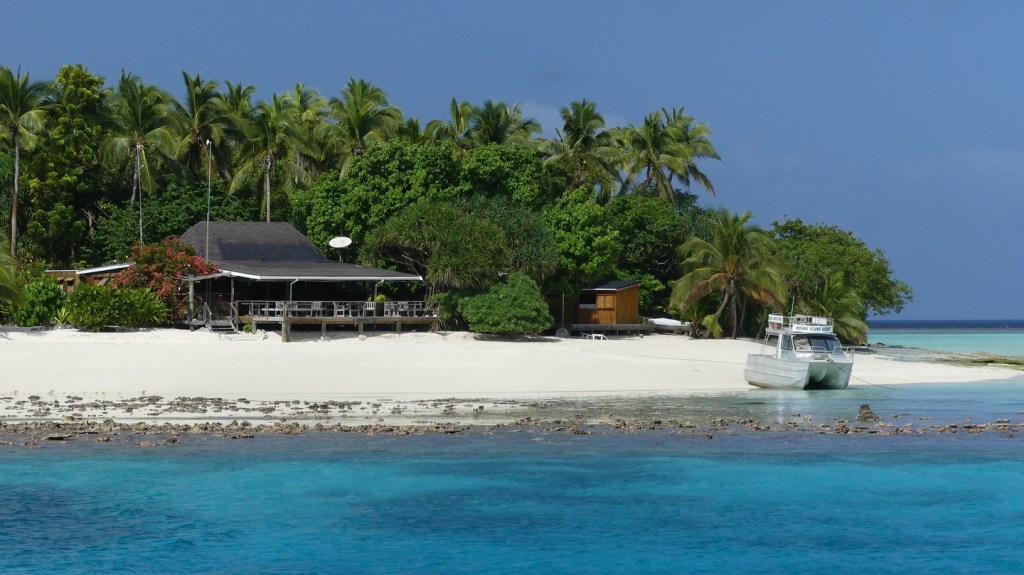
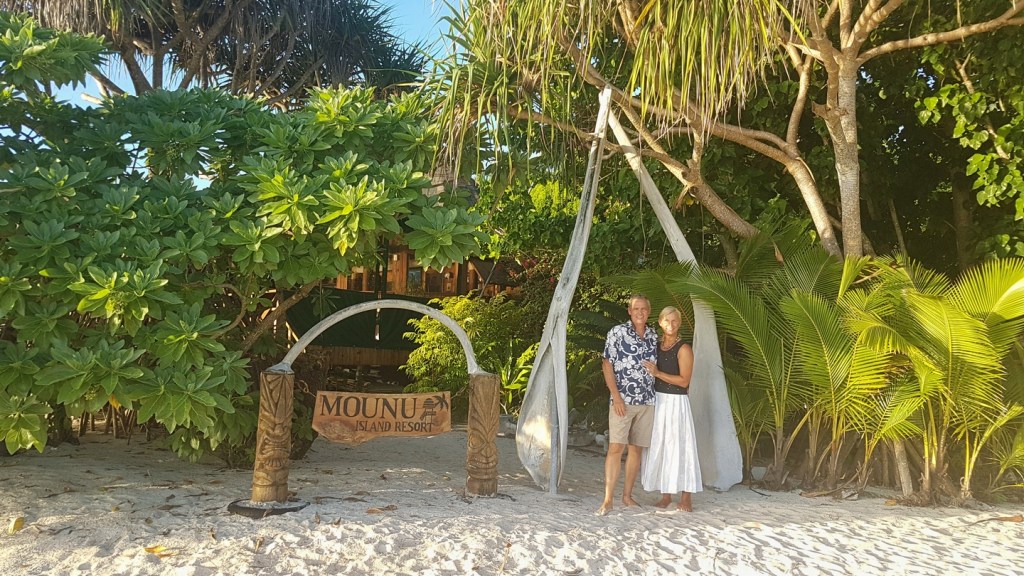
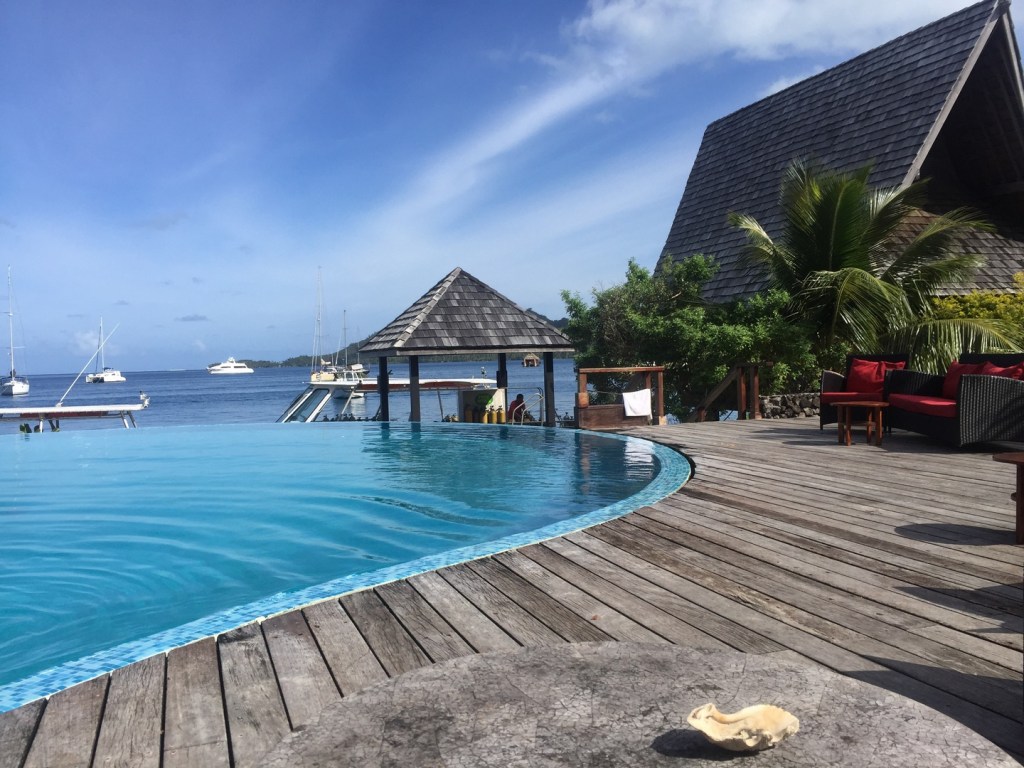
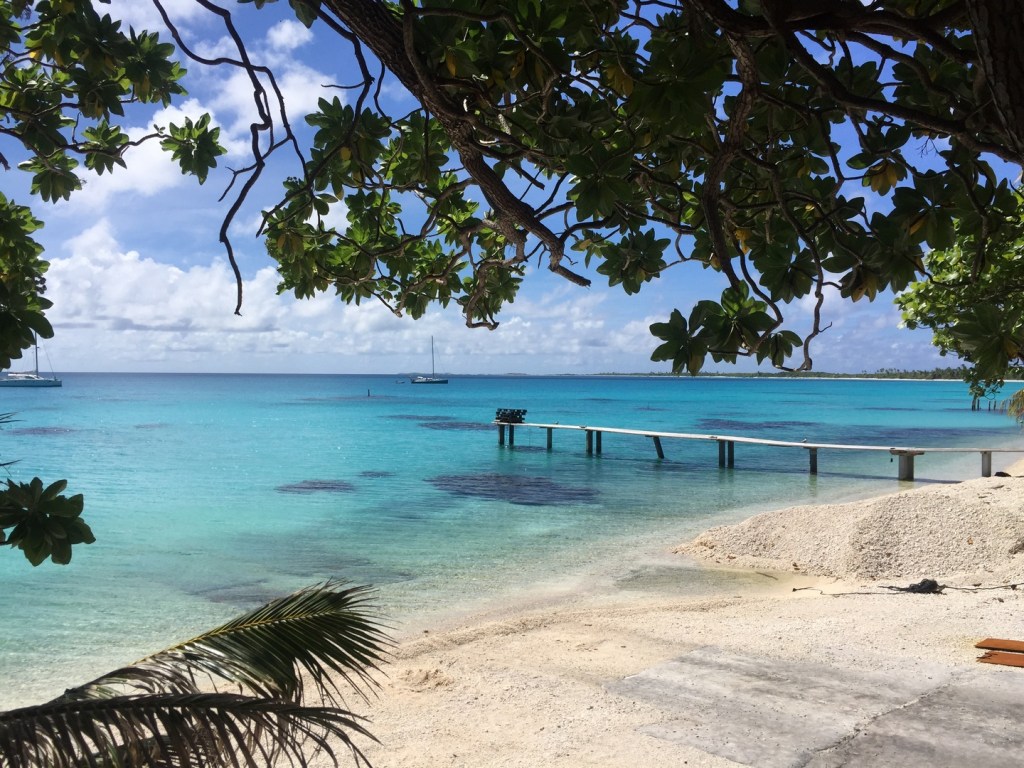
Mounu resort, really an idyllic place to relax and enjoy the water.
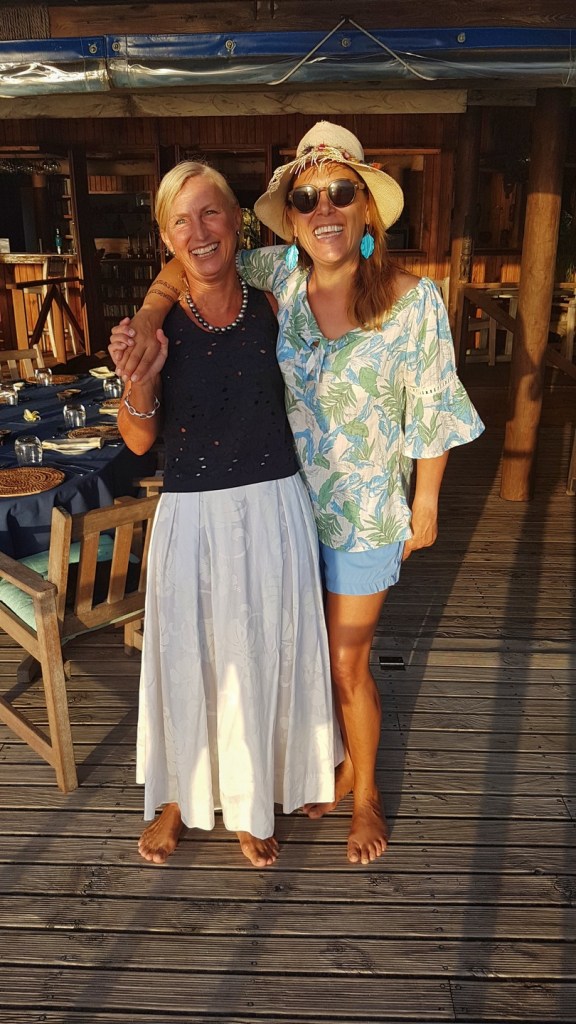
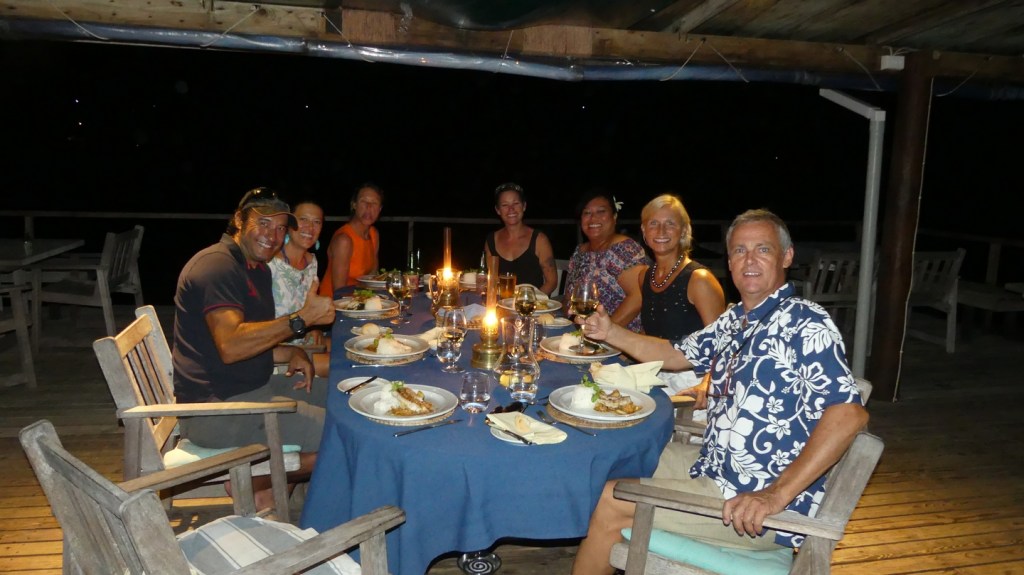
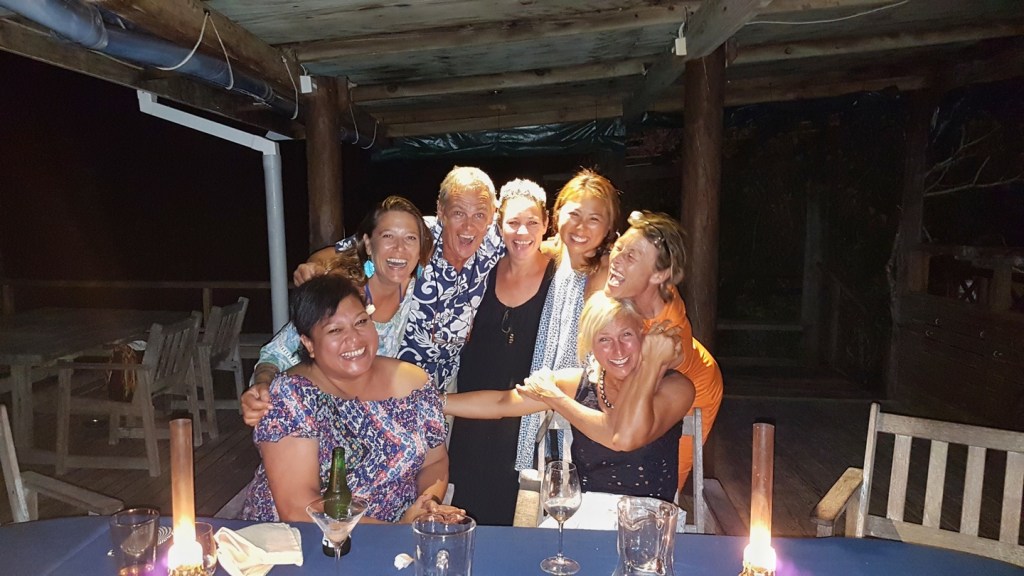
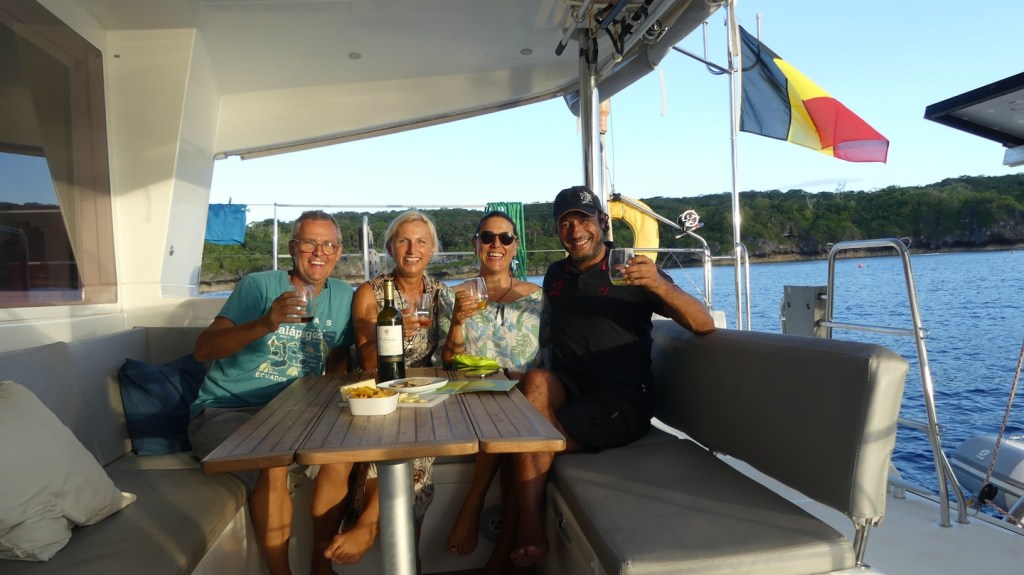
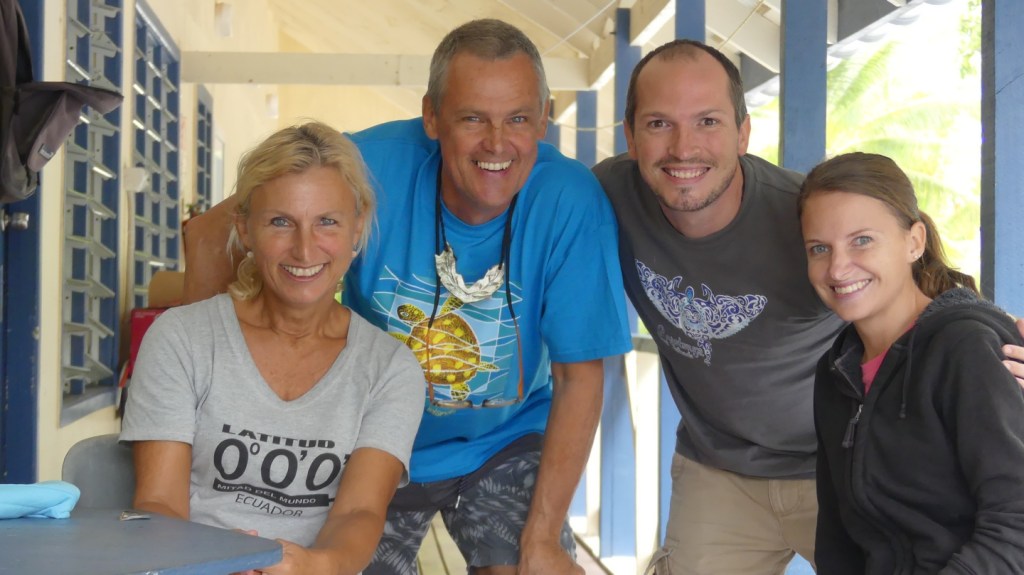
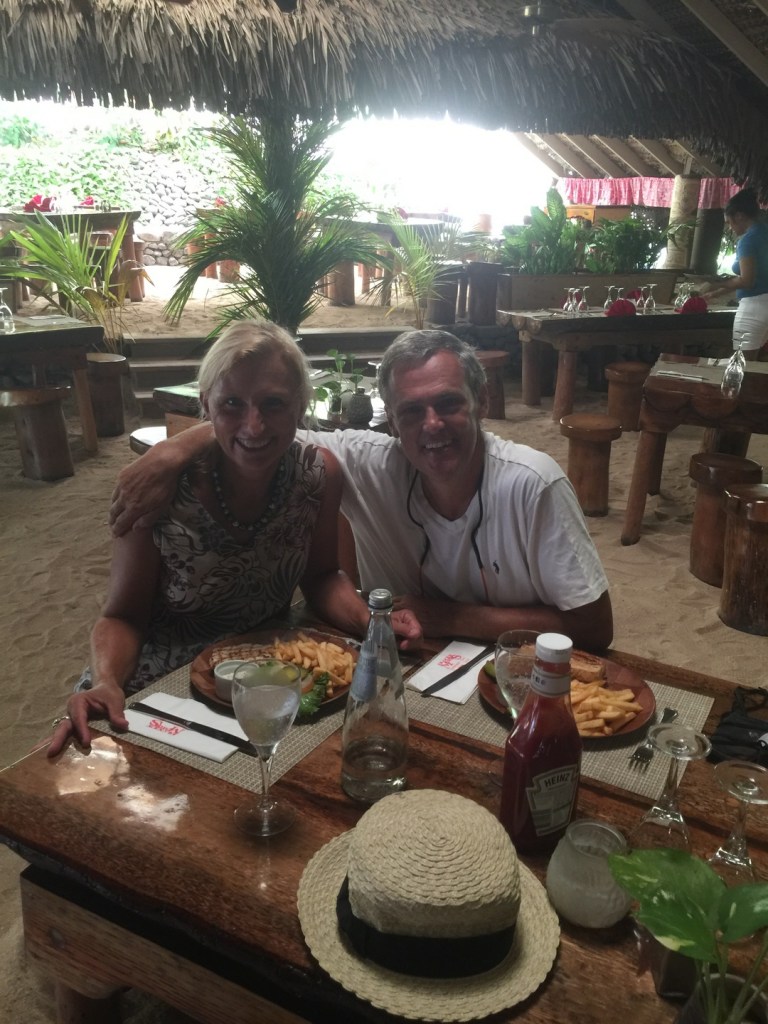
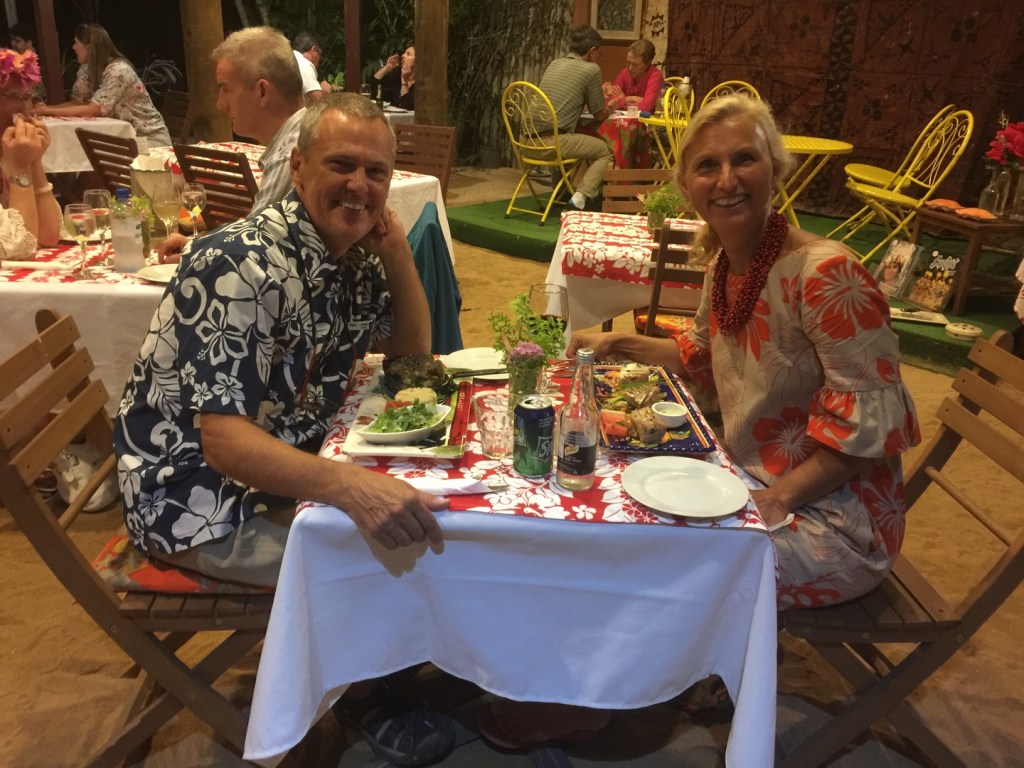
Ready to enjoy a great evening, underneath the cheekbones of a whale.Having great fun with Melike from SY North.Celebrating Amber’s (co-owner of Mounu resort) birthday with a fantastic meal. From left to right: Nejat (SY North), Melike(SY North), Kirsten (co-owner Mounu resort), Amber (birthday girl), Evelyne (great chef), Ilse and Stefan. Julia took the picture.We had carpaccio of tuna, a red snapper with rice and a great sauce and for dessert there was a soursop pudding. Everything was very yummy.From left to right : Evelyne, Melike, Stefan, Amber, Julia, Kirsten and Ilse..dancing was next.
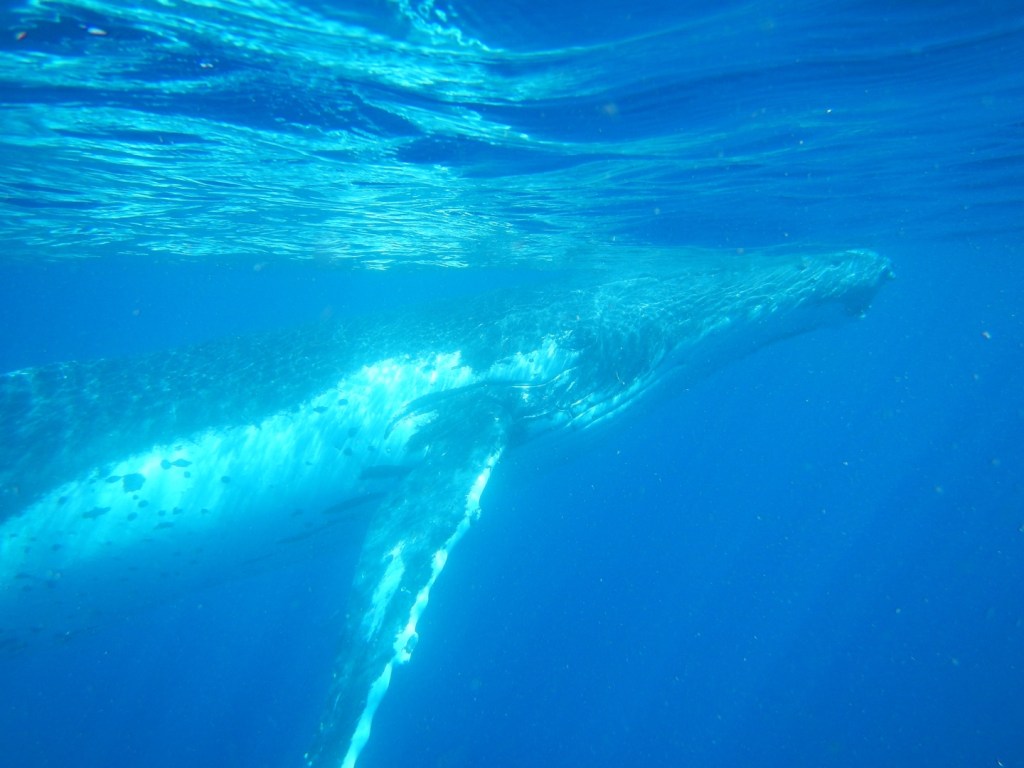
It was hard to get up the next morning at 6.30AM, but the anticipation of swimming with whales made it easier. No whale watch company will guarantee that you will swim with whales as it really depends if they can find a whale that will let you come close. There are many companies “fighting” for a whale. We were lucky to be out there very early and till about 10am did not see another whale watching boat. After about 45min motoring we encountered a mother whale with a calf. Yeah!! Before we could jump in the water Kirsten and Amber had to evaluate if this whale was going to stick around and let us swim with her and her calf. 45 minutes it was clear this would not be the case. This early in the season mothers are hesitant and nervous because their calfs are still little. For this reason it is better to do this end of August and early september when the calfs are already bigger and the mothers are more confident. A baby whale weighs about 1ton when it is born and is between 3 and 5m long. It drinks approximately 500 liters of mothermilk per day ! The milk consists of 60% fat so they can grow quickly ready to swim to Antartica in October.
Was this the most we would see of the mother?
Here are videos taken by Mileke and Stefan. We found a whale pod with 1 female and 5 males. They gradually got used to us, and the swimming experience was fantastic, judge for yourselves:
We left Niue on friday July 14th (Bastille day) late in the afternoon to the tunes of great French music. We crossed the international date line and lost the 15th completely in a flash and arrived early monday morning the 17th in Neiafu, the Vavau group of Tonga.
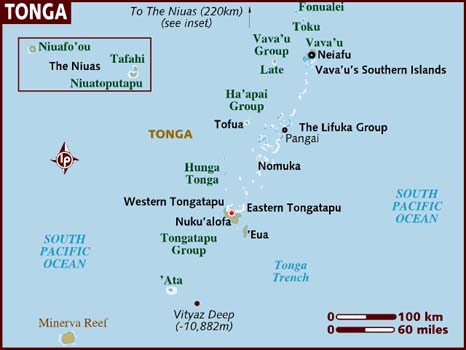
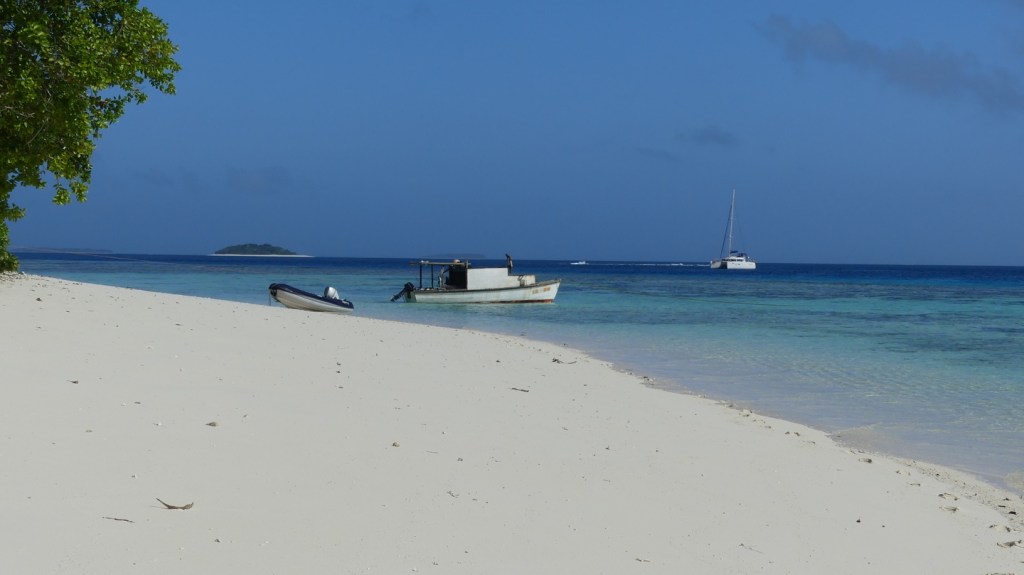
We only cruised the Vava’u group of Tonga (60 islands) as we did not have time enough to go more south.
After a visit from the health inspector, customs and immigration officials at the dock and paying our duties we were cleared in and free to take a mooring in Neiafu harbour.
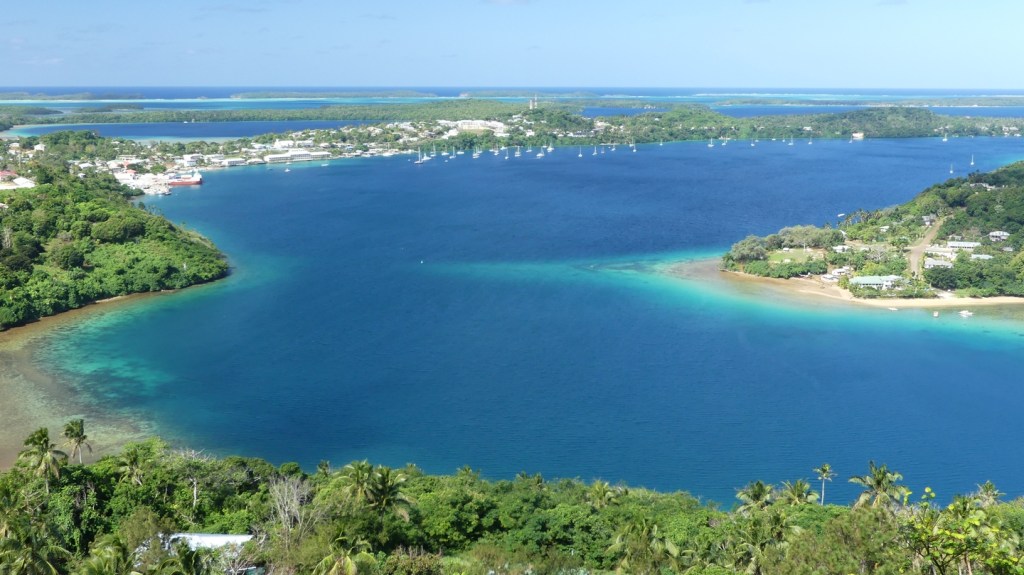
Neiafu harbour left, Nieafu town in the middle, mooring field on the right. Picture taken from Mt.Talau (130M)
The kingdom of Tonga is the oldest and last remaining Polynesian monarchy and the only Pacific nation never brought under foreign rule. It is the first country west of the International Dateline and they call themselves “the place where time begins”. They are a very Christian nation.
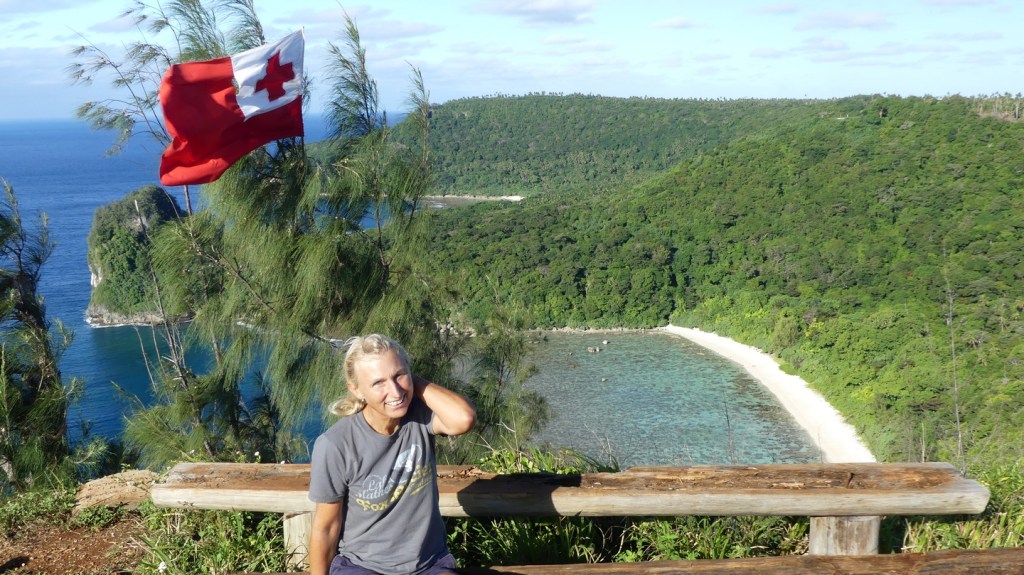
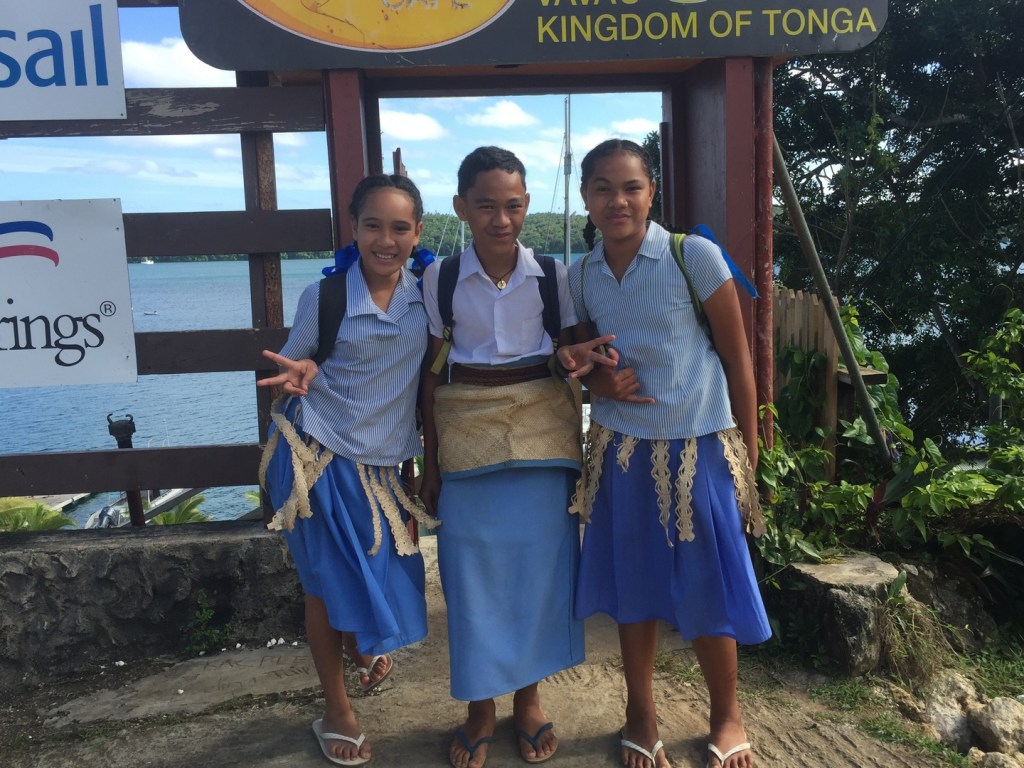
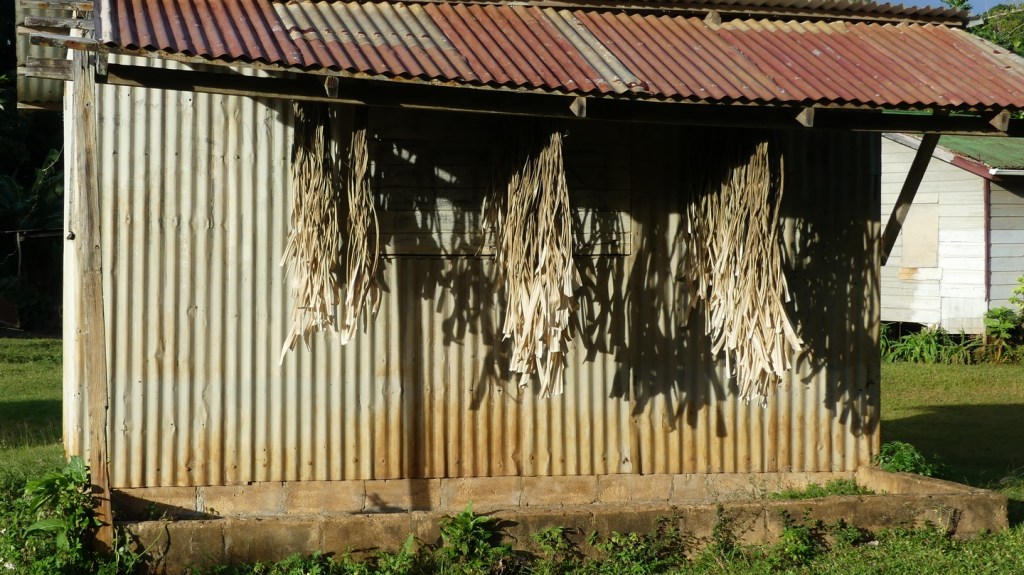
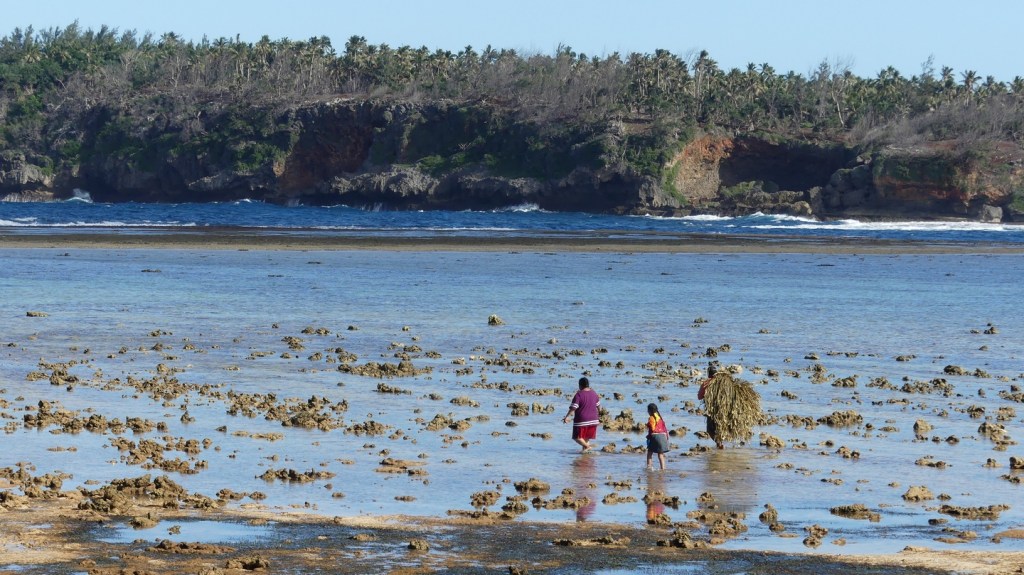
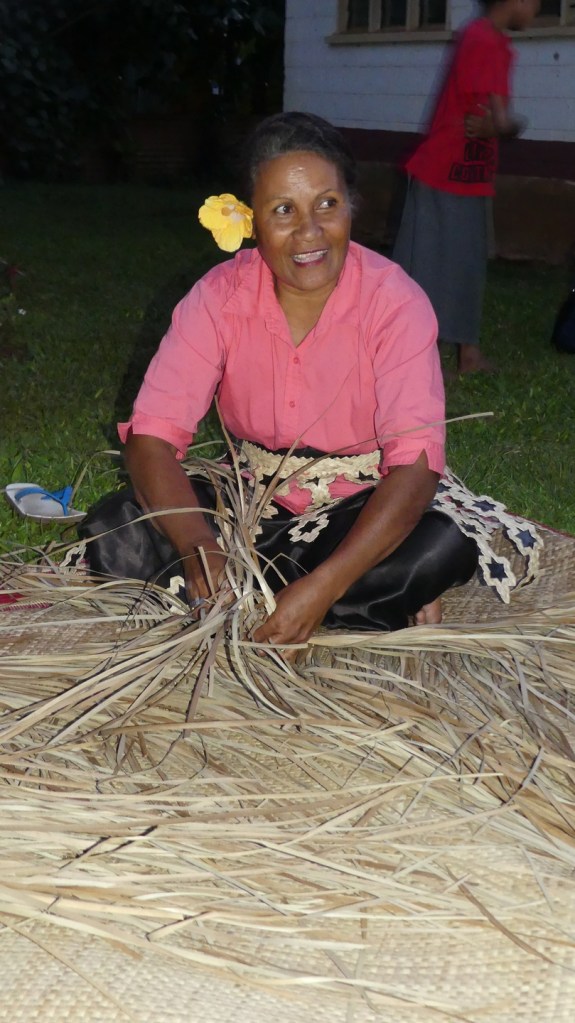
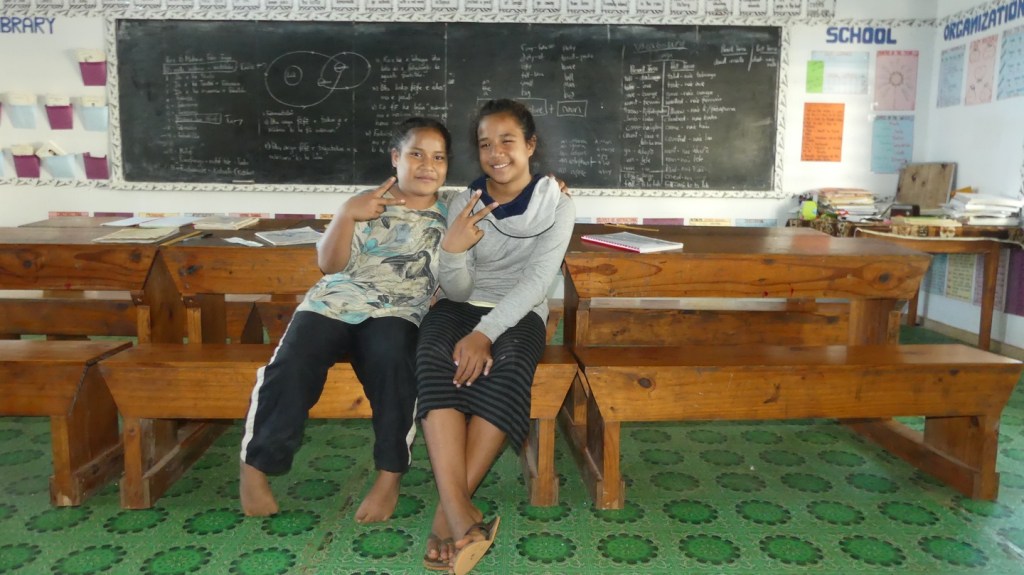
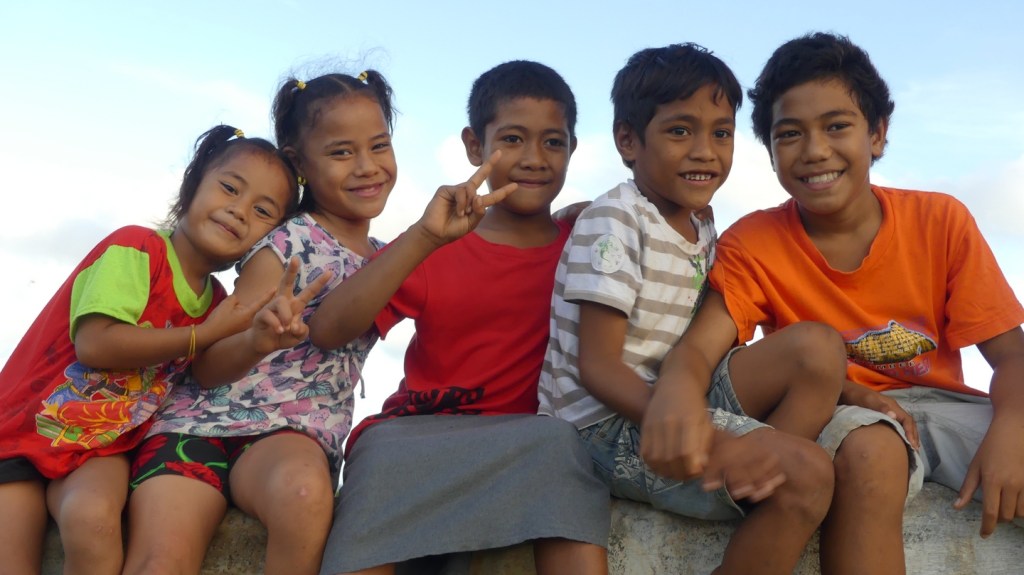
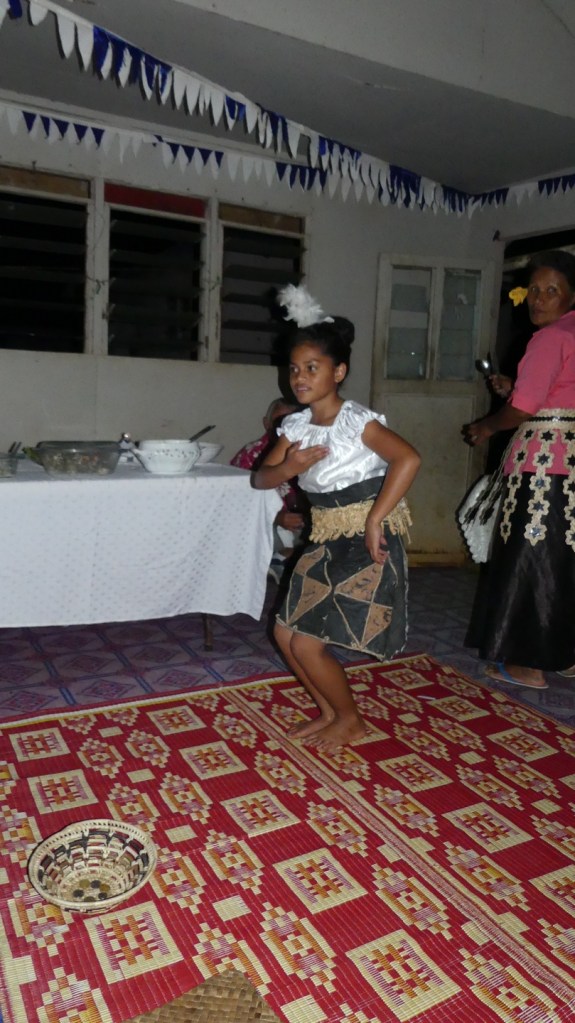
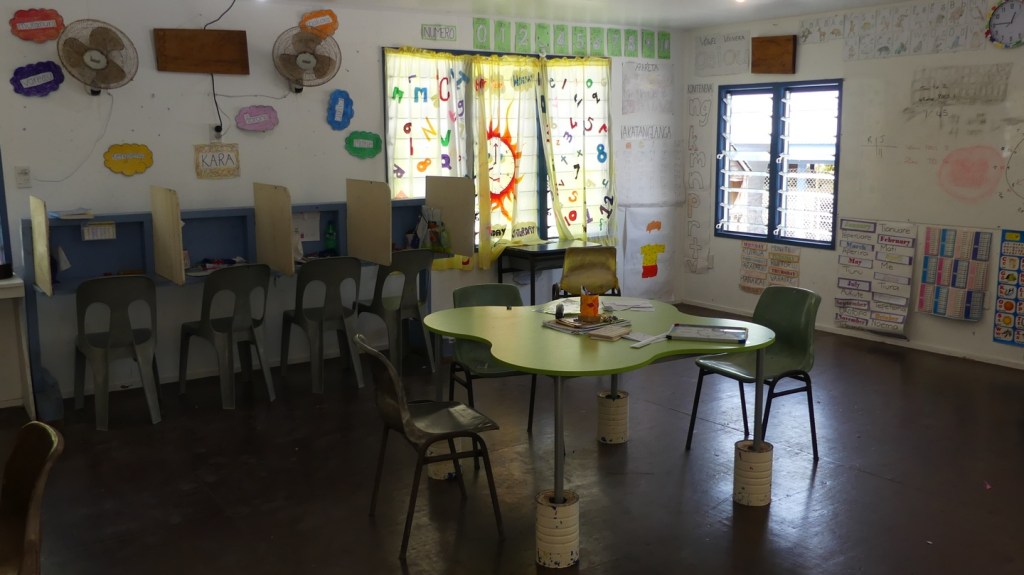
Utula’aina Point, with the Tongan Flag, a cross symbolizing Christianity (97% of the people are Christian), white colour is purity and the red colour symbolizes the sacrifice of the Blood of Christ.Typical schooluniform of girsl and boys is conservative, no knees are shown. The boys wear a wrap around skirt (tupenu) and a woven mat (ta’ovala) of pandanus leaf around the waist.Pandanus leaves drying in the sun before it is flattened to weave mats, hats, baskets etc.Tongans carrying pandanus to be washed and soften in the sea before it is dried.Weaving of a pandanus mat. Usually women will get together in a weaving house to make mats or other handicrafts.We went to a Tongan feast in the village of Matamaka and visited the school. There were 2 classrooms. One for ages 5 to 8 and one for 9 to 12 years old. This picture was taken in the class of the older group.Happy Tongan school kids.Typical Tongan dance, totally different from the Polynesian hip dancing we saw in French Polynesia. In Tonga the arm and hand gestures were important. During the dancing money gifts are collected in the basket on the floor. In some places Tongan dollar bills will be stuck in the belt of the dancers. The skirt is made from tapa.
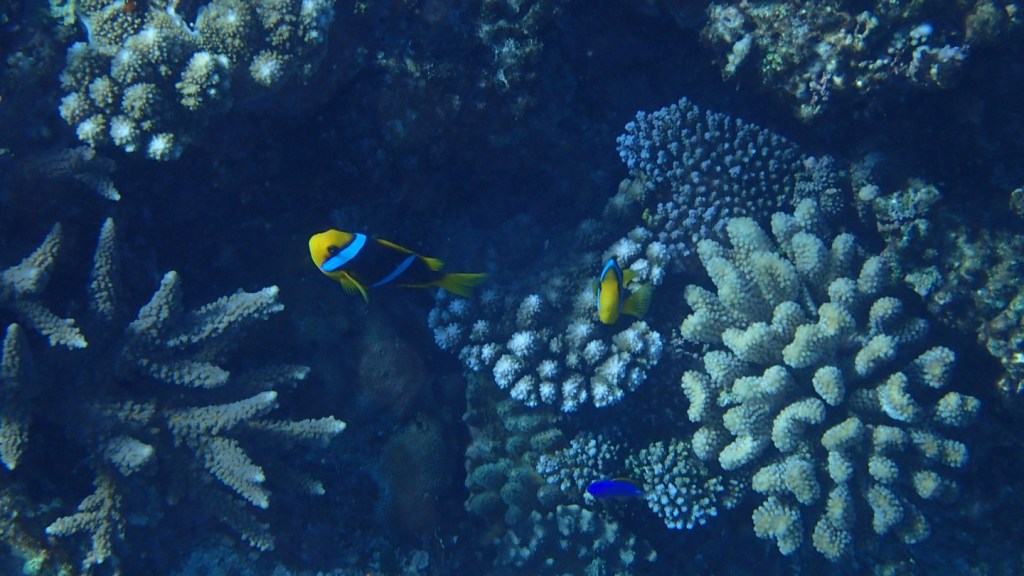
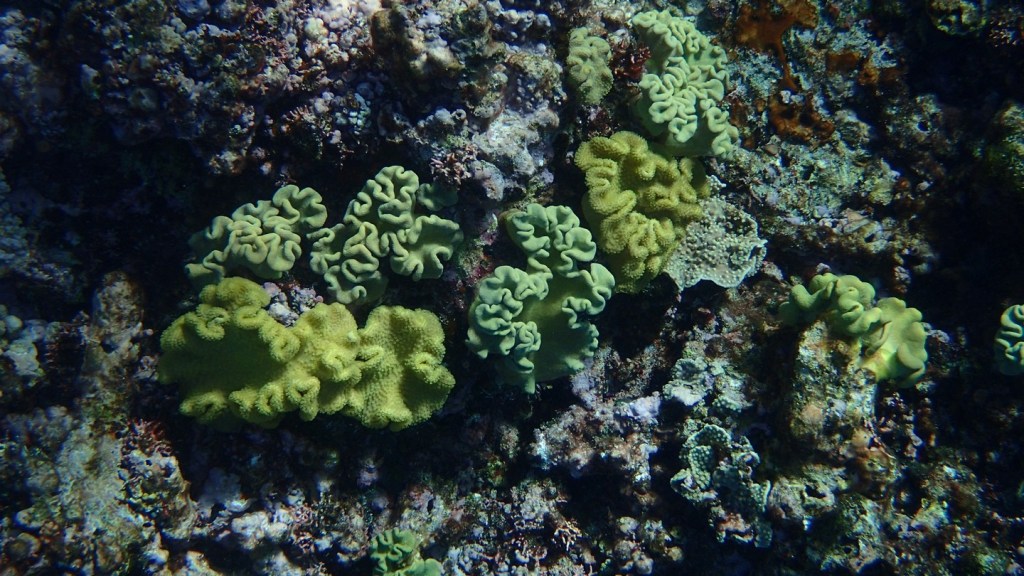
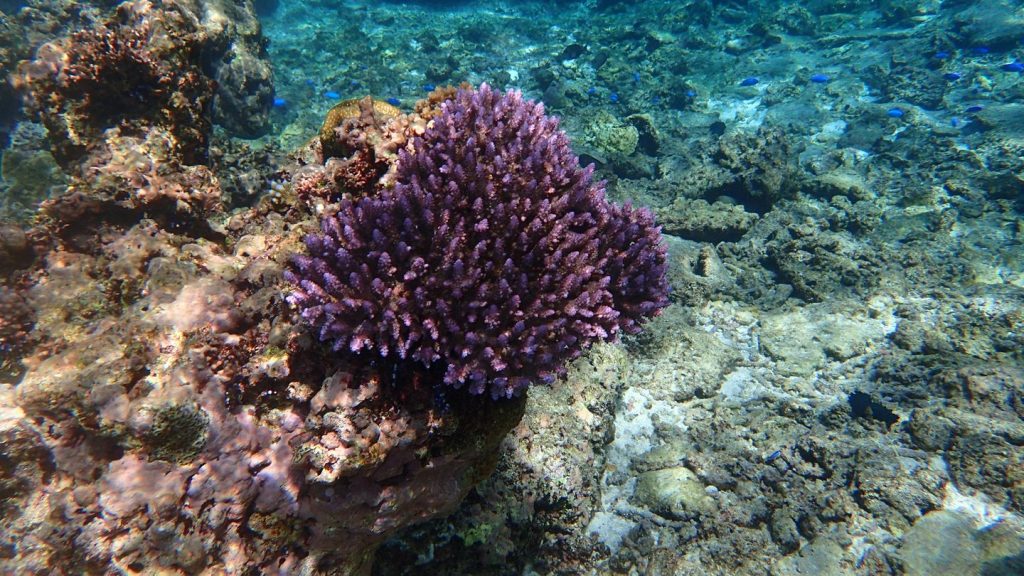
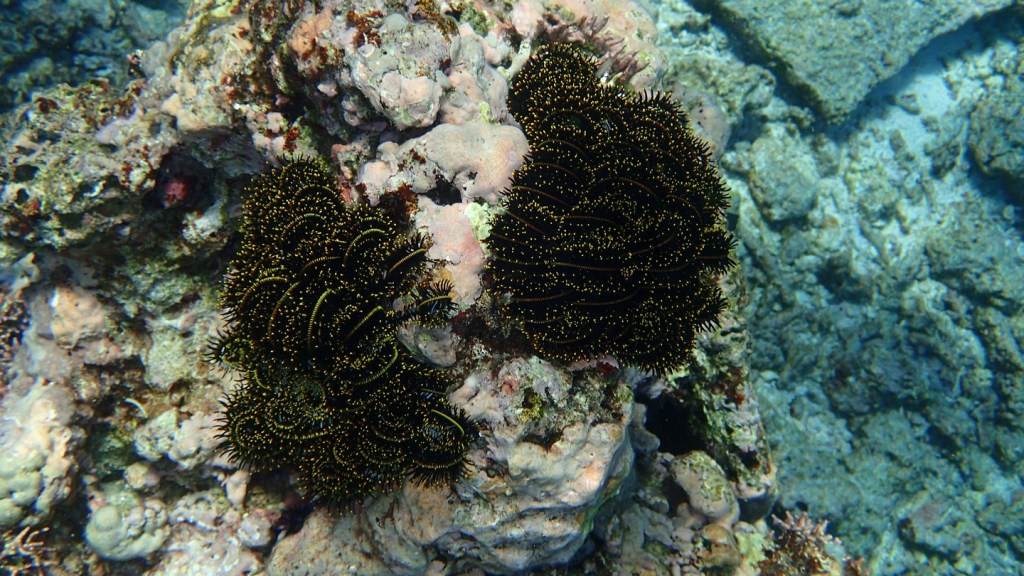
The next day we motorsailed to the Coral garden anchorage and snorkeled…
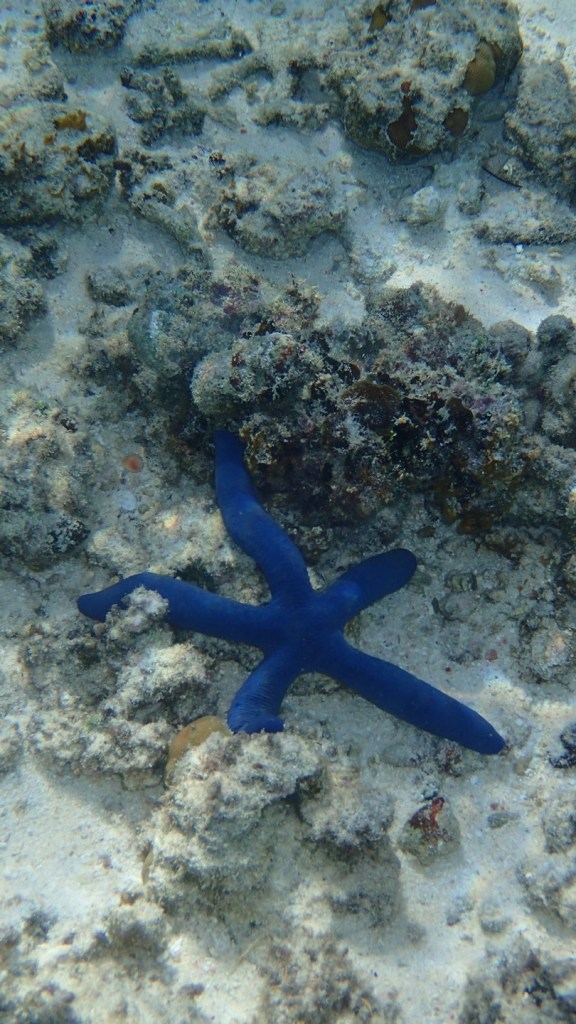
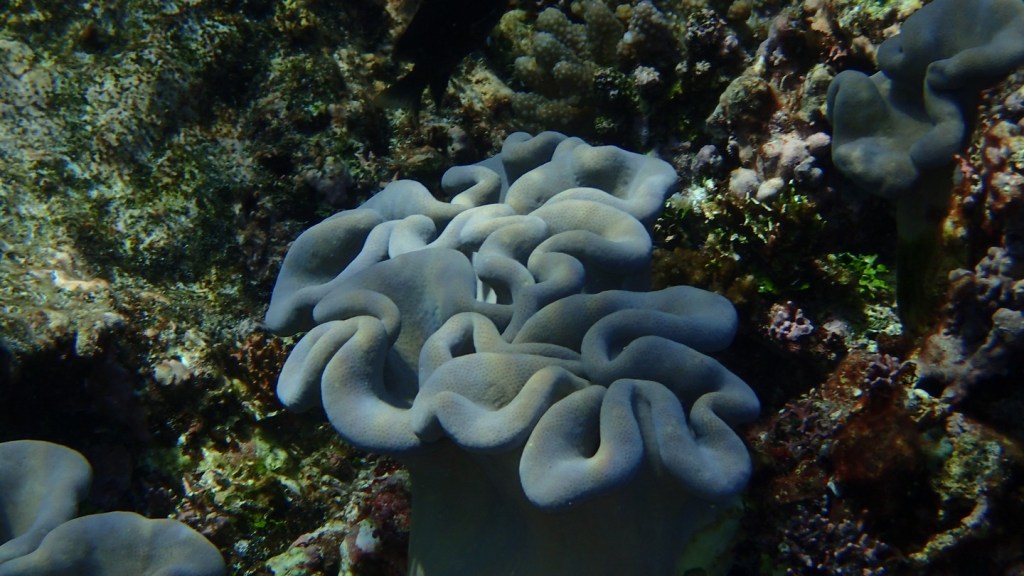
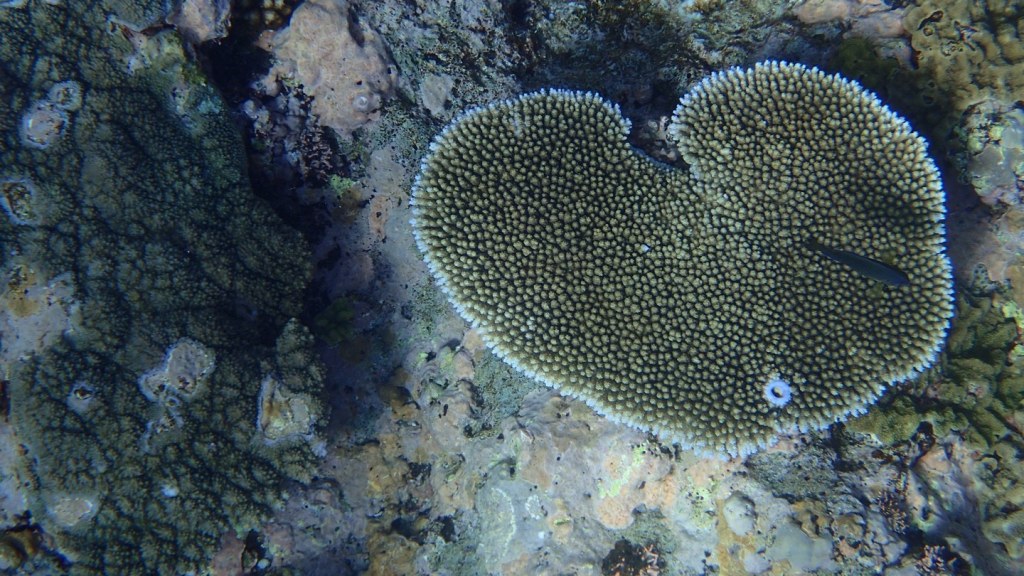
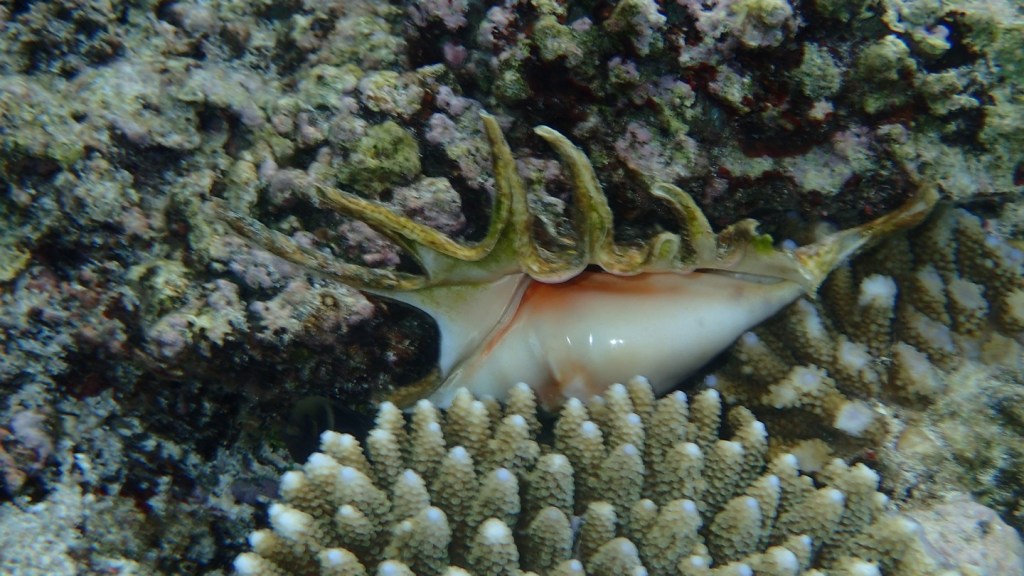
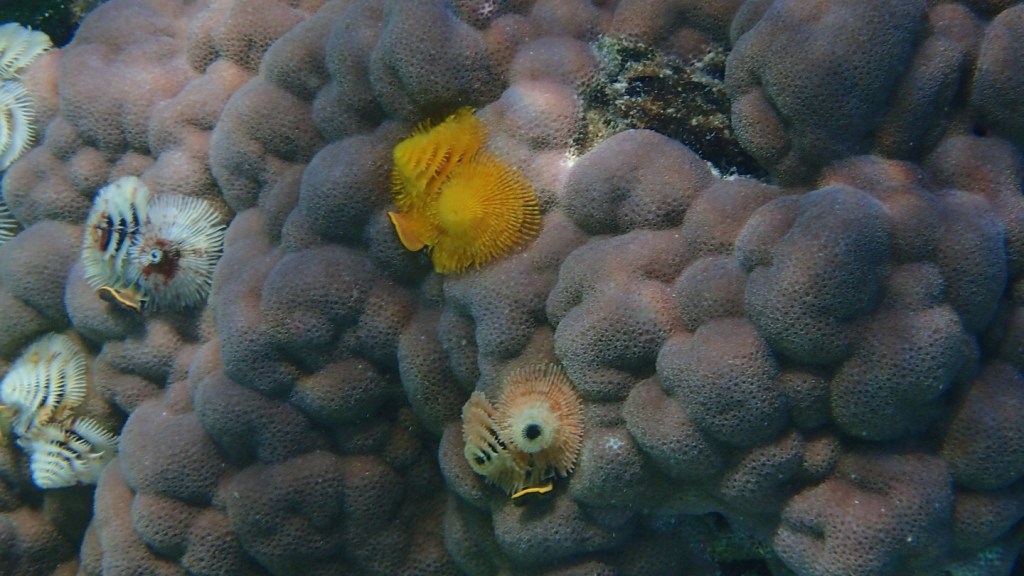
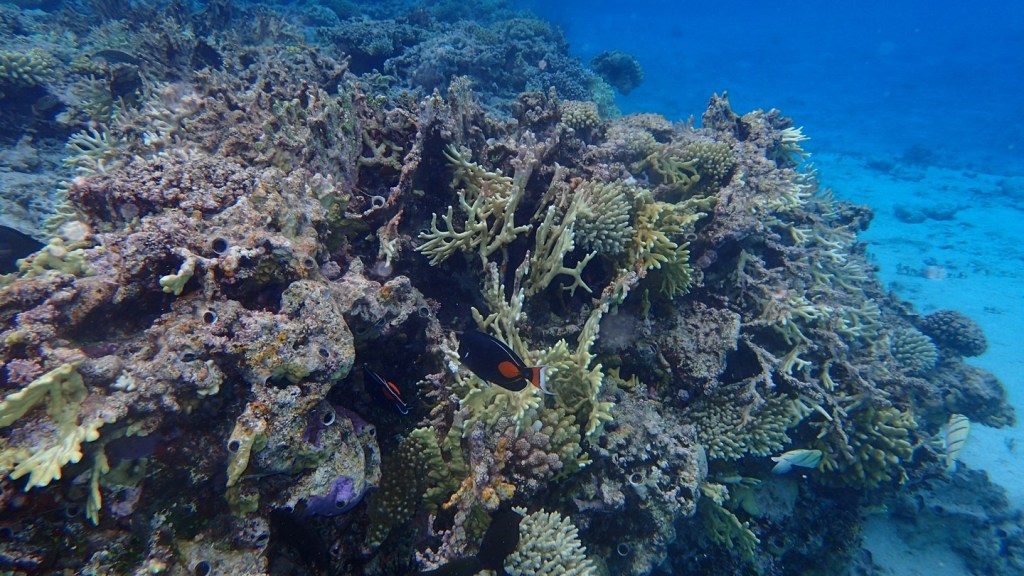
The Linckia laevigata. There were many of these blue seastars.Soft coral. It comes in very many different colours and shapes.Anemonefish trying to hide.Soft coral.It was almost like being in an underwater flowershop…Acropora sp hard coralFeather stars, they are animals! They like to be in a spot where there is a lot of current since they feed on passing plankton.A “heart shaped” coral, I think the Acropora hyacinthus, but I am not sure.A beautiful spider shell hiding between the coral. We did not take it with us since it was occupied.Sanuk and Flipper in another paradise like anchorage.
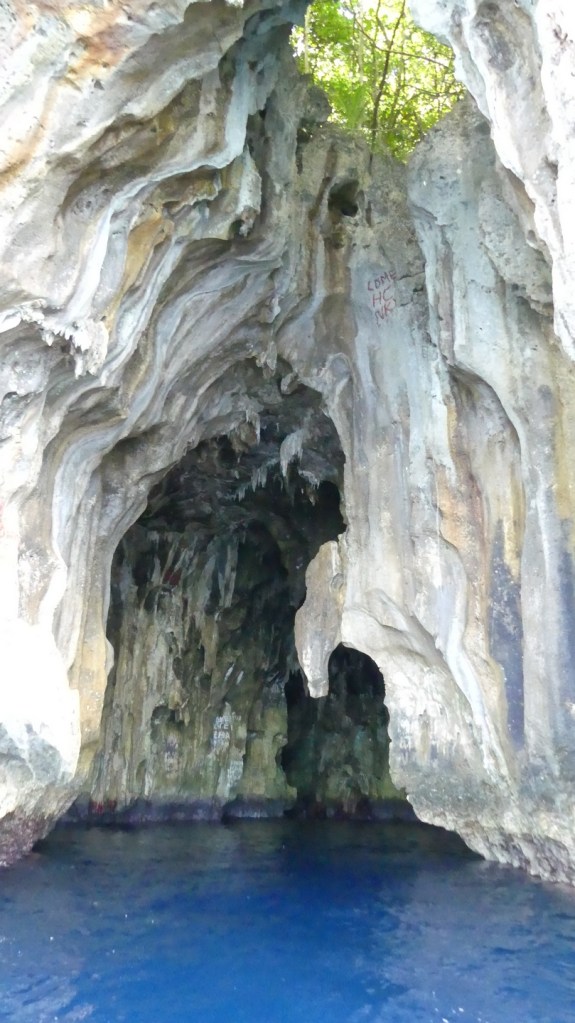
Coral with, I think, polyps on it. They look like eyes …Swallow cave. We went inside with Flipper but found only a lot of graffiti.
Stay tuned for our next blog post where we talk about our incredible whale encounter !
Tussen Palmerston en Niue ligt Beveridge Reef: ongeveer een cirkel van 2 zeemijl (3,6 km) doormeter, vanbinnen 7 meter diep koraal met daarrond een brede zandbank van 2 a 3 meter diepte en daarna het rif met zijn brekende golven… Vanop volle zee zie je enkel het opspattend witte schuim van brekende golven die vanuit het niets opduiken, uitgezonderd aan de westkant een 200 meter strook waar de golven niet breken: de pas.
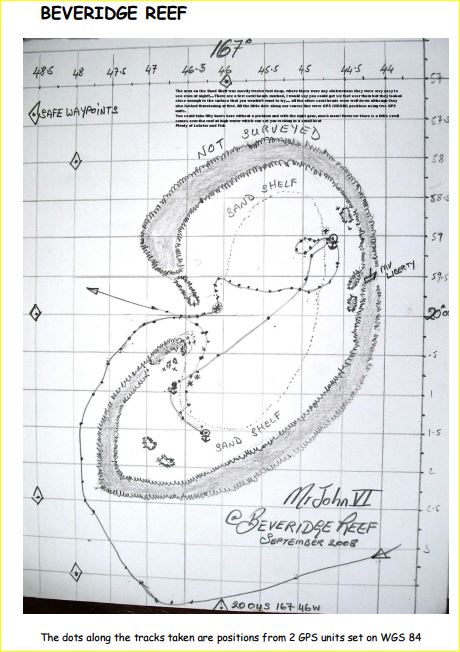
Onze GPS gaf aan dat we tegen 17:00 uur aan het zuiden van het rif zouden komen, en de zon ging onder om 18:20. Onze Navionics kaarten gaven het rif enkel aan als een ondiepe vlek zonder detail, hetzelfde voor OpenCPN (we hadden geen satellietfoto van het rif), maar we hadden wel een nauwkeurig verslag met tekening en gps coordinaten van ene zeker MrJohn VI.
Vanwege een wijde boog kwamen we aan de pas ongeveer bij zonsondergang, en hoewel er een driekwart maan stond was de zichtbaarheid slecht. In retrospectief hadden we moeten omkeren en doorvaren naar Niue – en nadien hebben we er ook een nieuwe regel van gemaakt: geen navigatie op nieuw terrein in de buurt van land na zonsondergang – en we vaarden dus enkel op gps een ons onbekend rif in. Ilse deed me beloven dat als er iets misging ik niet zou zeggen: het spijt me, ik kon er niets aan doen. Er stond weinig stroming, een 15 knopen wind met kleine deining, maar het bleef wel blind varen. Met drie knopen over de grond volgden we de koers van MrJohn, en eens binnen hebben we zo snel mogelijk het anker uitgegooid en gewacht op de zon van de volgende dag (zo ergens midden in de atol). Maar de weergoden waren niet met ons: zelden meegemaakt maar 360 graden rondom ons waren er grijze lage wolken waaruit af en toe een bui viel.
Toch was het water zo ontzettend helder dat we ons konden verleggen naar de zandbank aan de rand. We passeerden heel veel koraalkolommen en hoewel ze er benauwend hoog uitzagen in het heldere water bleven ze allemaal 2 tot 3 meter onder het oppervlak. Sanuk heeft 1m20 diepgang.
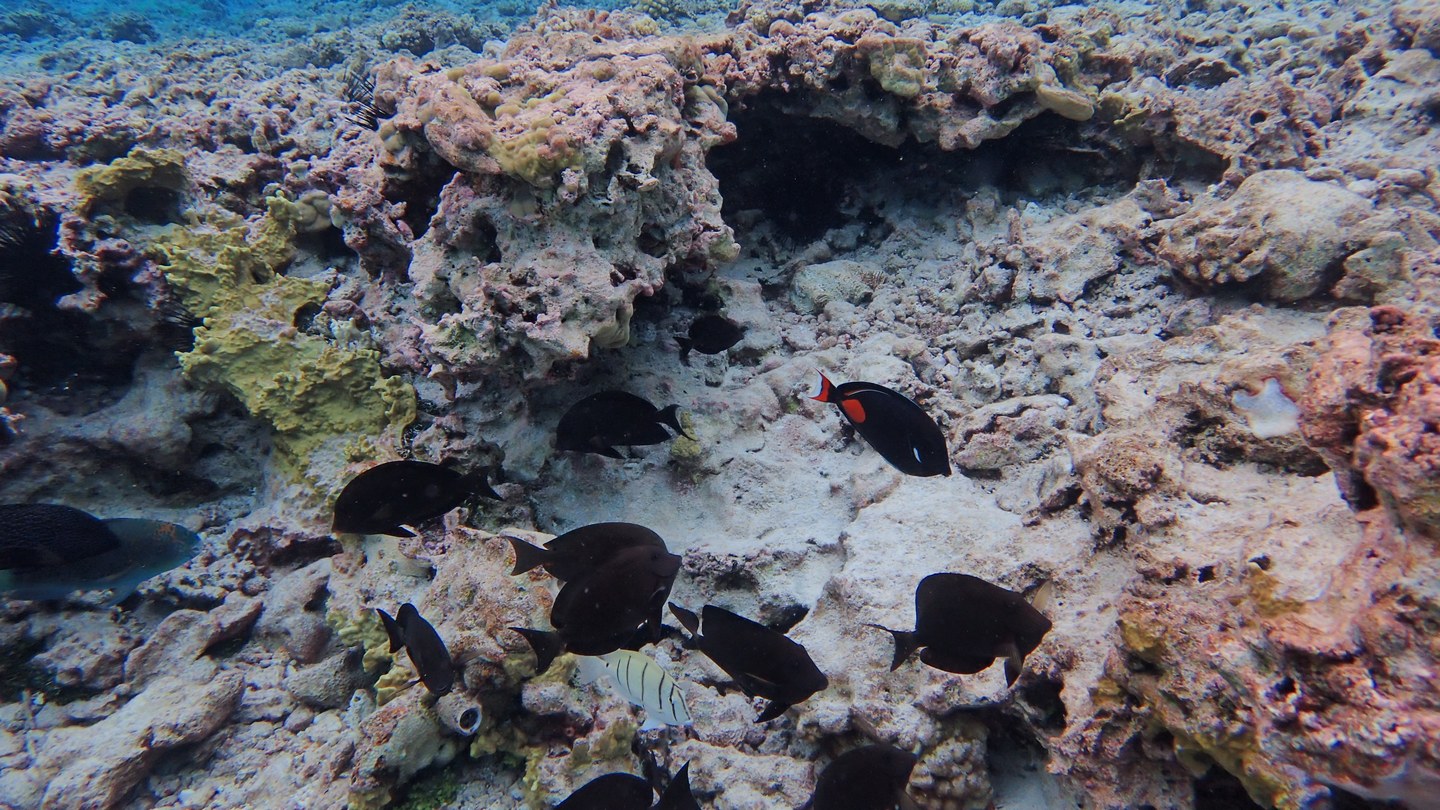
Op onze eenzame parkeerplek in de oceaan hebben we tijdens onze twee dagen ter plaatse toch eens een straaltje zon gehad zodat we spectaculaire foto’s hebben kunnen maken van deze heel speciale plek. Met Flipper zijn we naar de rif gevaren op zo een 300 meter, en hebben we massa’s vissen en mooi koraal gezien. Ondanks het slechte weer was het een van de beste snorkelingvaringen.
Maar het blijft toch wel een dubbele bedoening: heen en weer tussen Sanuk en het rif mag de motor van flipper niet uitvallen, want dan drijft de wind je weg, en met roeien kom je niet terug aan de boot. En er is ook geen andere boot in de wijde omgeving, enkel zee. Daarom dat Ilse toch wel opgelucht was toen we terug door de pas vaarden, op weg naar onze volgende bestemming op 150 zeemijl: Niue, een van de kleinste landjes van de wereld.
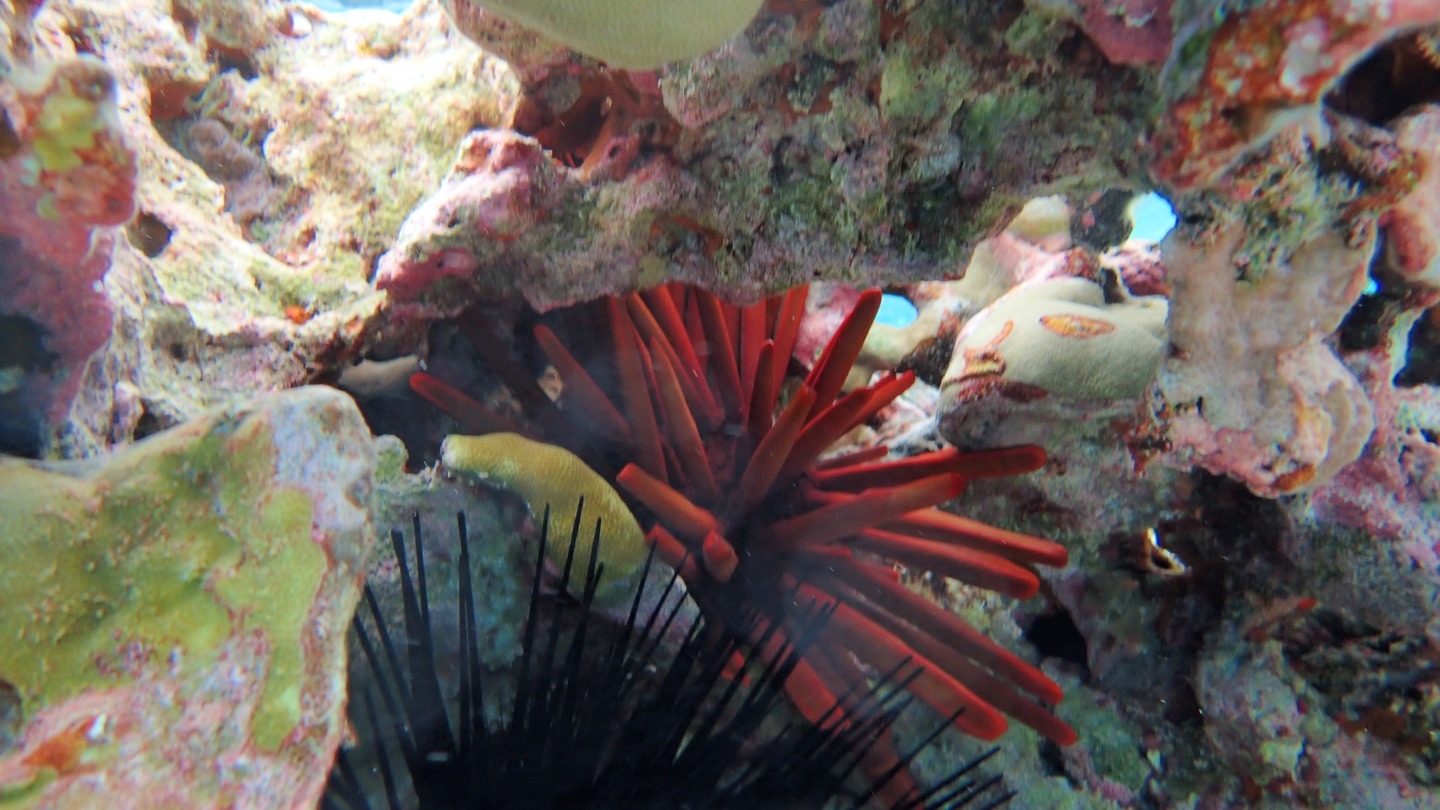
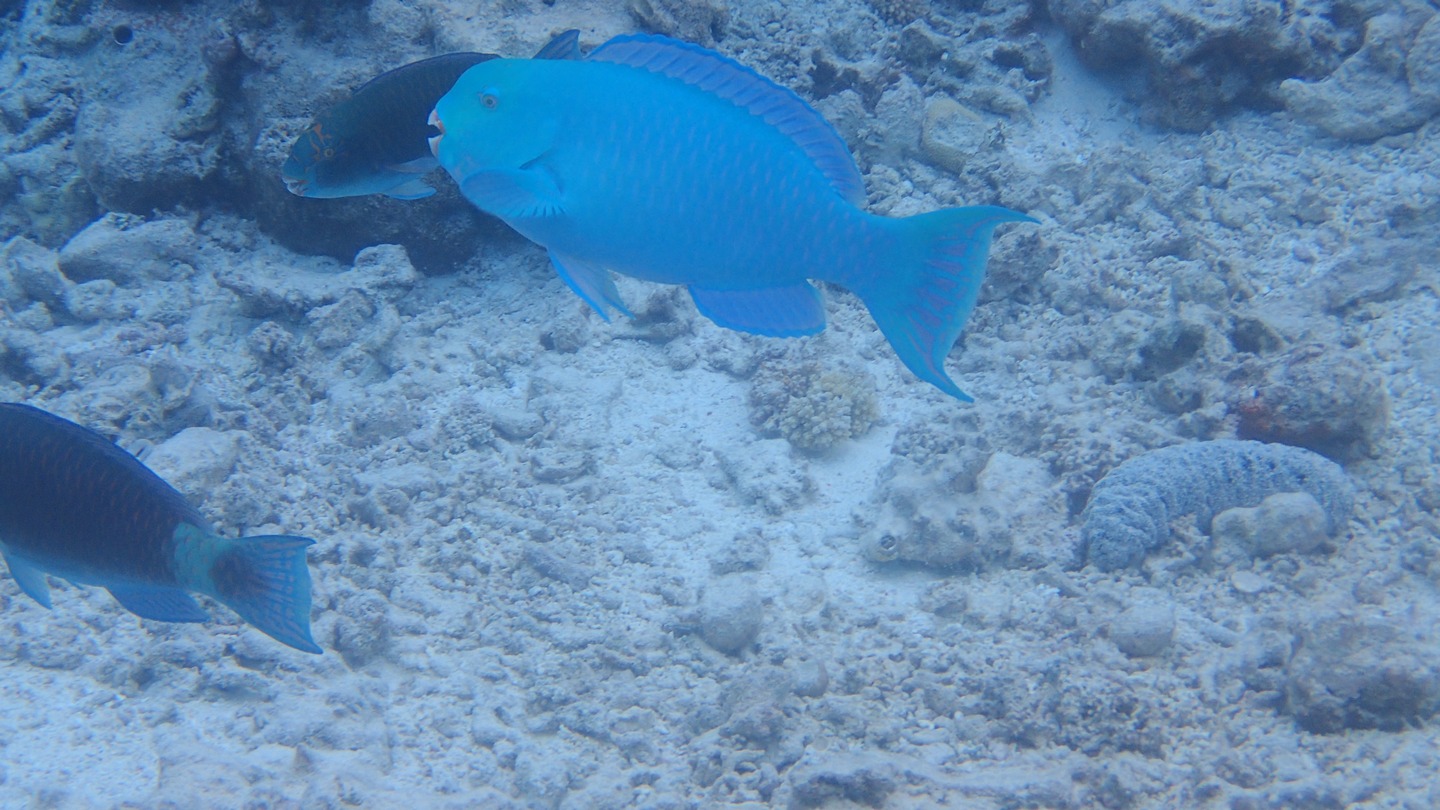
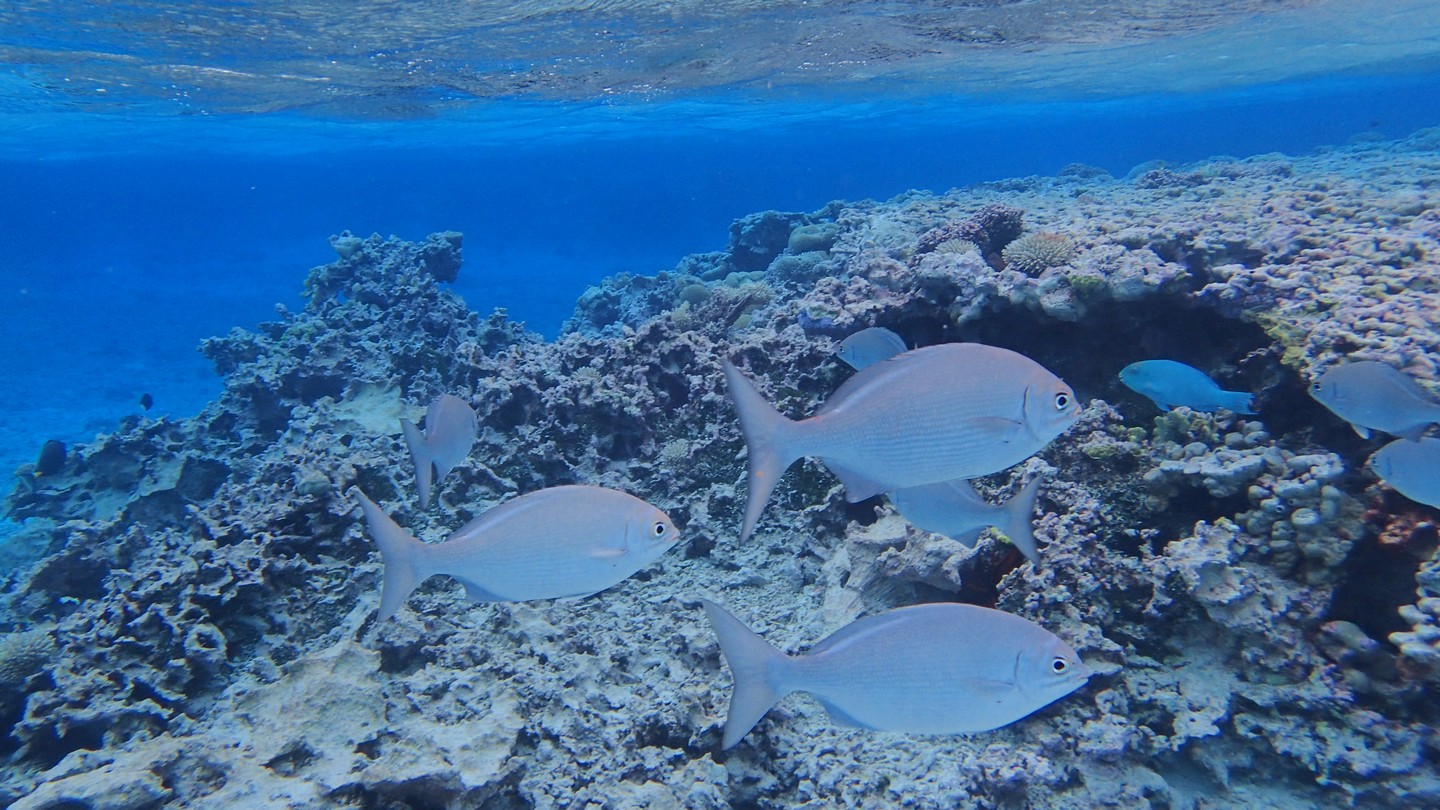
heel veel vis bij het rifOok deze nog niet eerder geziene soort rode zeeegelEen blauwe papegaaivisDeze bleekschijters (latijnse naam) zagen mij wel zitten
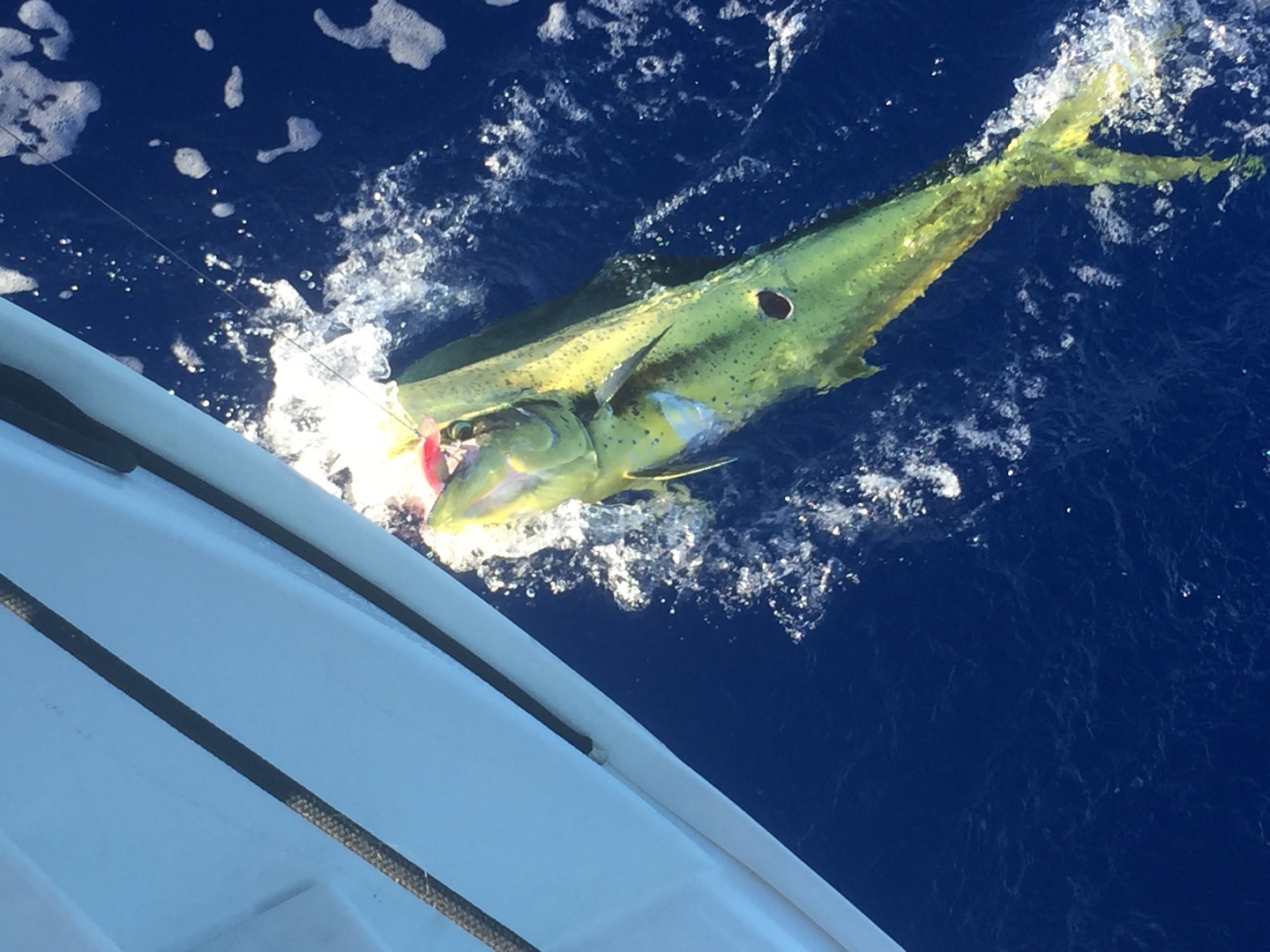
Palmerston bereikten we na exact 3 dagen varen. De tweede dag hadden we een kanjer van een MahiMahi mannetje aan de lijn, maar helaas wou hij wel even tot aan het trapje komen, maar niet verder. Hij schoot van de haak vooraleer ik de tijd had om de gaffe erin te slaan. Mijn strategie voor de volgende keer is bijgesteld: als een vis aan de trap is, schiet ik hem met mijn speerpistool door de kop, dan kan hij niet meer weg vanwege de weerhaak en is hij waarschijnlijk ook naar het vishiernamaals (in de visvolksmond den frigo). Ilse was er niet goed van, zo een schoon manneke, zeker 80 cm en 12 kilo, en toch liever naar de haaien dan bij haar!
Een dorado of mahi mahi of dolphin fish. Dichter dan dat is hij niet bij Sanuk gekomen
Enfin, we kwamen aan om 10 uur en we radiooten kanaal 16 : “This is sailing vessel Sanuk Sanuk Sanuk for Palmerston Yacht Club, Palmerston Yacht Club. Do you copy?”
We waren op zoek naar Bill, de eigenaar van de Palmerston Yacht Club want we hadden een vracht mee voor hem van zijn vrouw die we op Aitutaki waren tegen gekomen: 16 dozen met gerief, vooral bananen, papayas en watermeloen (denken we). Maar het was ene Bob die antwoordde dat hij ons ging opvangen en naar een meerboei begeleiden. Hij kwam een half uurtje later af met zijn bootje door de lagoon en de kleine pas naar ons, net buiten het koraalrif. Hij toonde ons aan welke boei we konden afmeren en ging daarna de douane halen.Ik gaf hem nog de boodschap mee dat we veel gerief hadden voor ‘deputy mayor Bill’. Nog een klein halfuurtje later kwam Bill zelf naar ons gevaren, met de Health Inspector, de Douane en de burgemeester. Omdat we reeds ingeklaard waren in de Cooks eilanden was het papierwerk snel geklaard en vertrok het gezelschap terug, samen met Bill en al de dozen. Eerst had hij ons nog meegegeven dat hij ons om terug 13:00 kwam halen voor de lunch.
Blij terug op vaste grond te staan
Op Palmerston word je de gast van een gastgezin. Bij ons was dit dus Bill, de eigenaar van de Yacht Club Palmerston.
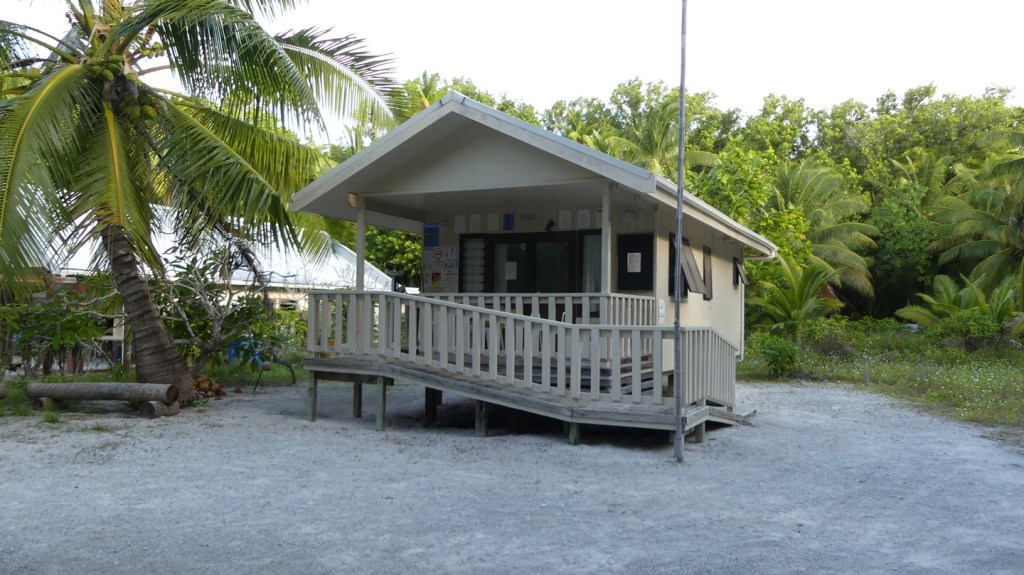
De yachtclub van Palmerston, naast het huis van de familie Bill Marsters
Hij had een stevige lunch voor ons klaarstaan: rijst, lamskoteletten, saus, tarotwortel en als toetje ijscreme van mango. Hij vertelde honderduit en om 2 uur kwamen de kinderen van de school toe: twee jongens, 10 (?) en 14 Ngariki, en een meisje van 16 Juliana. Zij aten ook, en namen ons achteraf mee op een bezoek van het eiland.
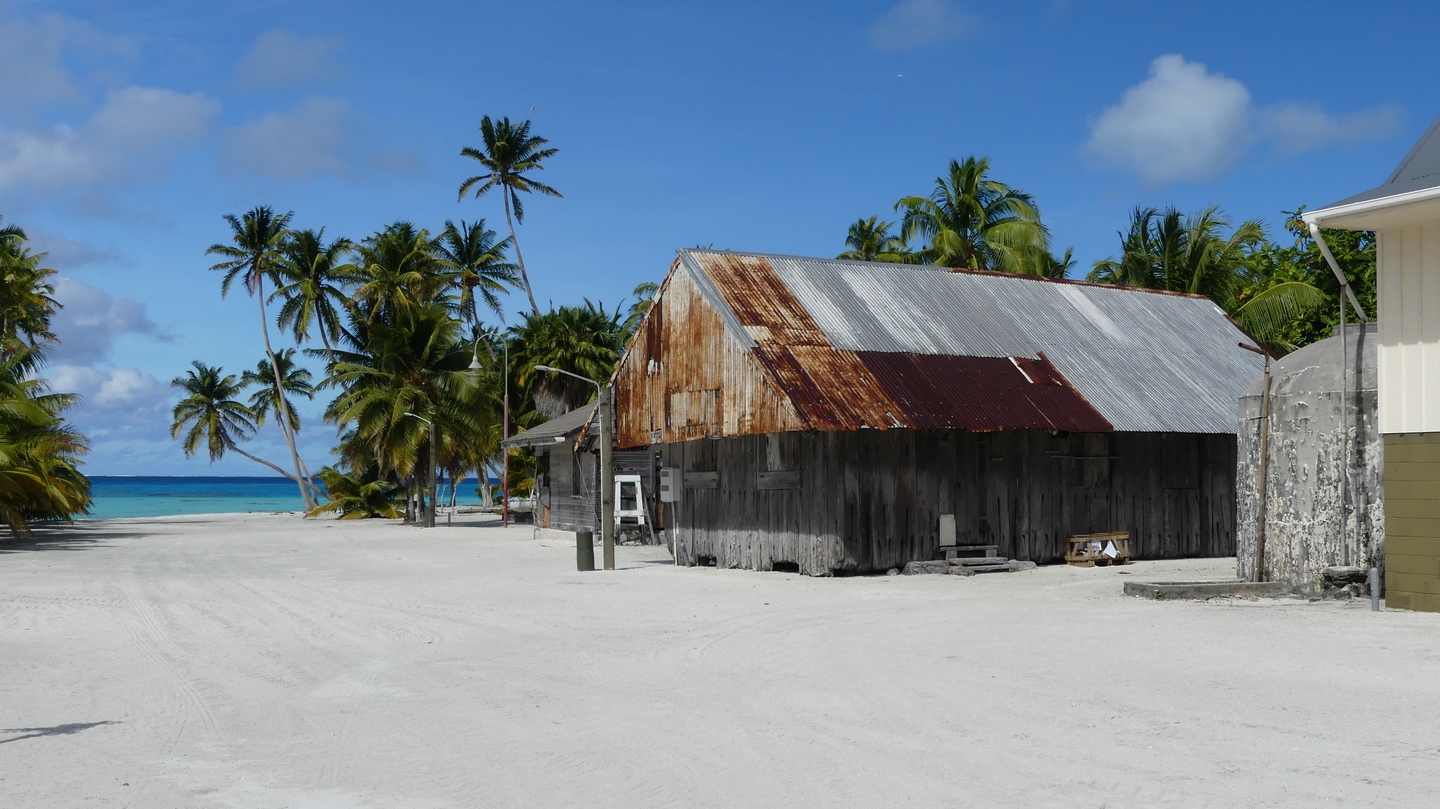
klas volksdansen voor alle leerlingen van de schoolIlse bij de muren van het originele huis van Bill Marsters, gemaakt uit aangespoeld wrakhoutDe hoofdstraat van Palmerston met het originele huis van stamvader Marsters
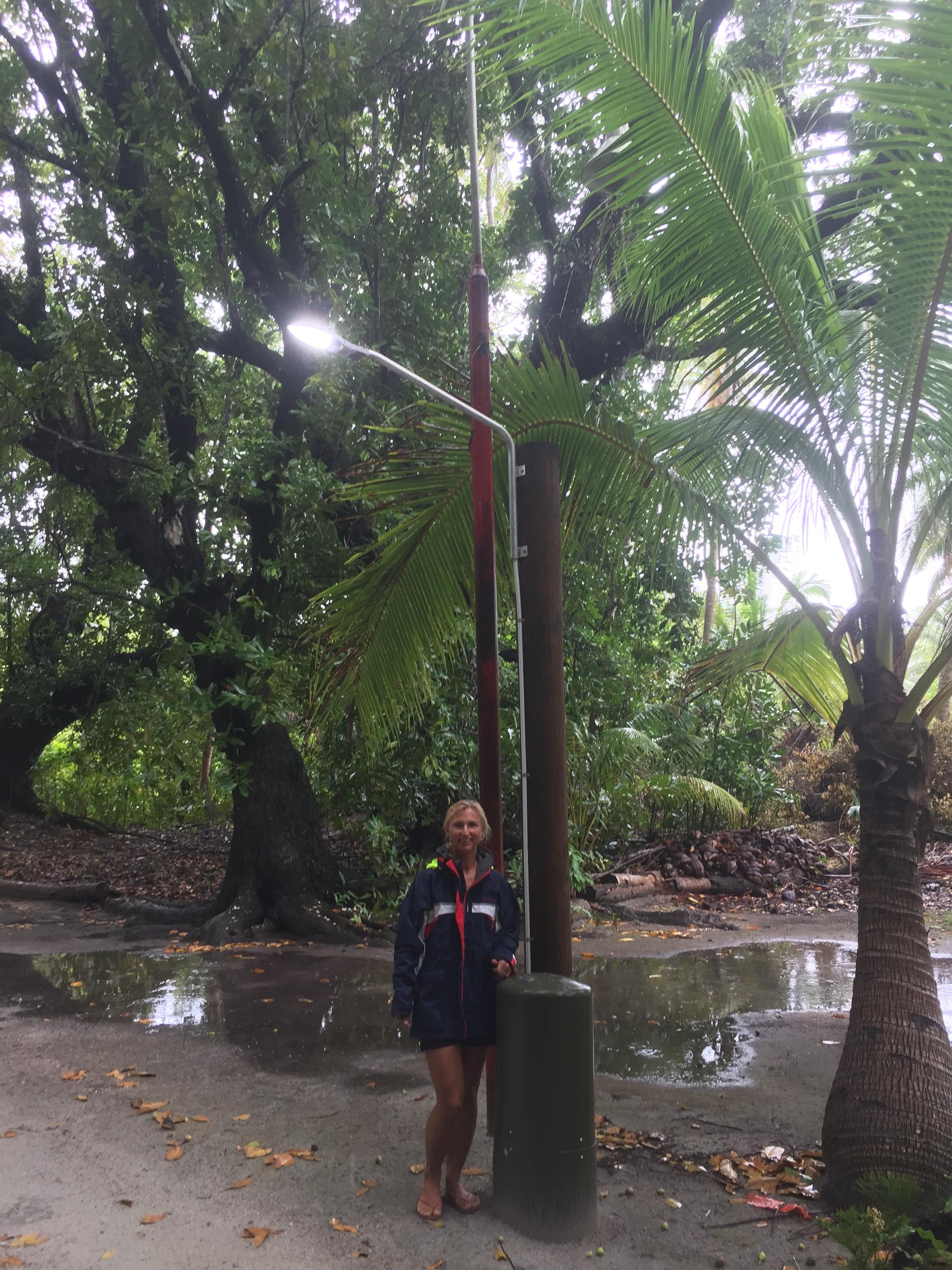
Er wonen 58 mensen, onderverdeeld in drie families. We waren snel rond op het eiland want het is ongeveer twee op een kilometer groot. Het is zeer verzorgd, met wegen in wit zand afgeboord met cocos boomstammen. Er staan zelfs lantaarnpalen met led lampen (ongetwijfeld het resultaat van een actie van een of andere NGO).
Een straat in Palmerston. Het had net stevig geregend, een welkome opvulling van de mensen hun regenwater voorraad.
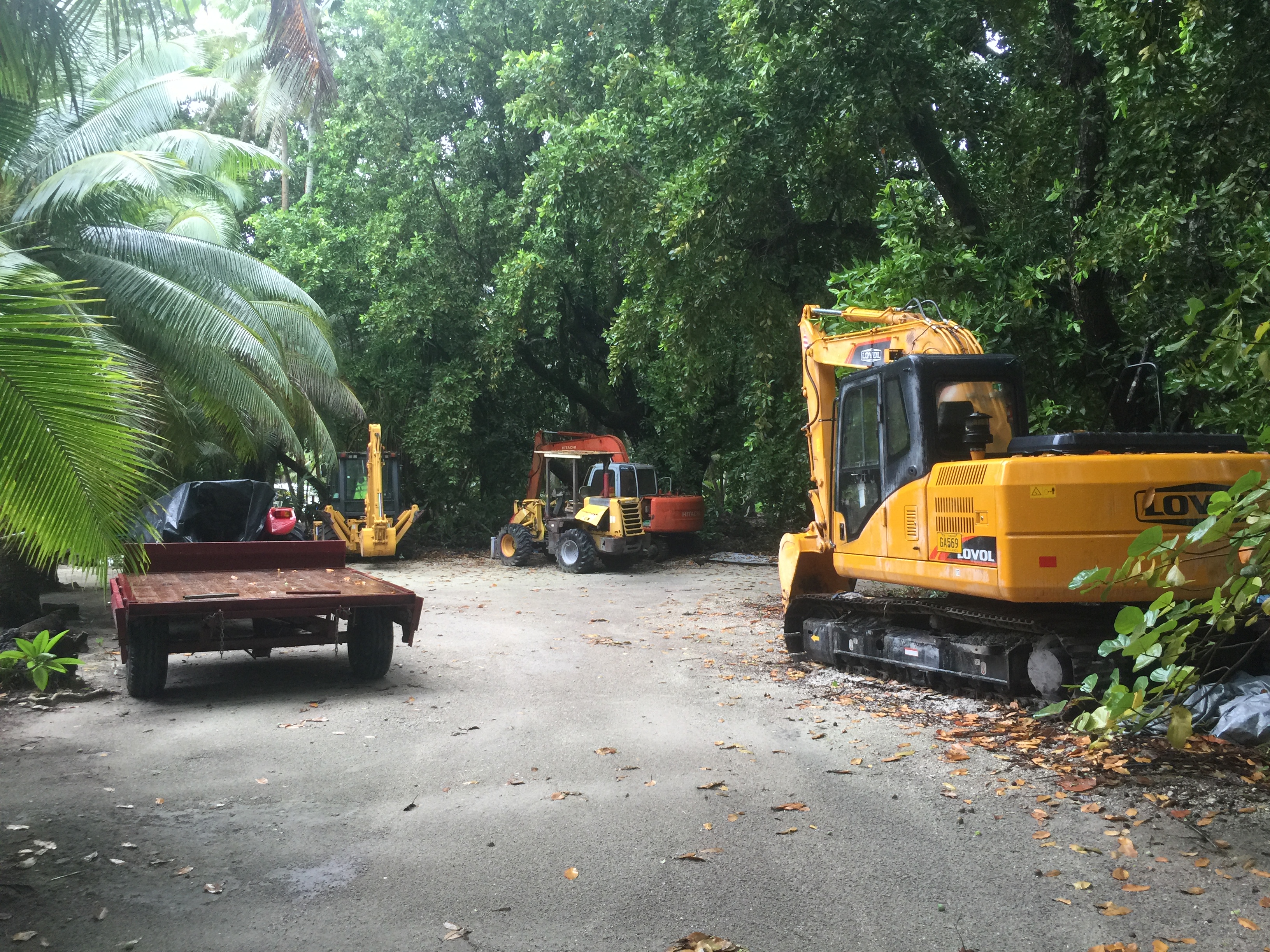
Er zijn geen autos op het eiland, wel een quad en nogal wat brommertjes. Het laatste heeft meer met status dan met noodzaak te maken want je bent echt in geen tel te voet op je bestemming. Ook de afdeling van openbare werken heeft een indrukwekkend machinepark staan, van een bulldozer tot een graafkraan. Zag er allemaal nogal nieuw uit.
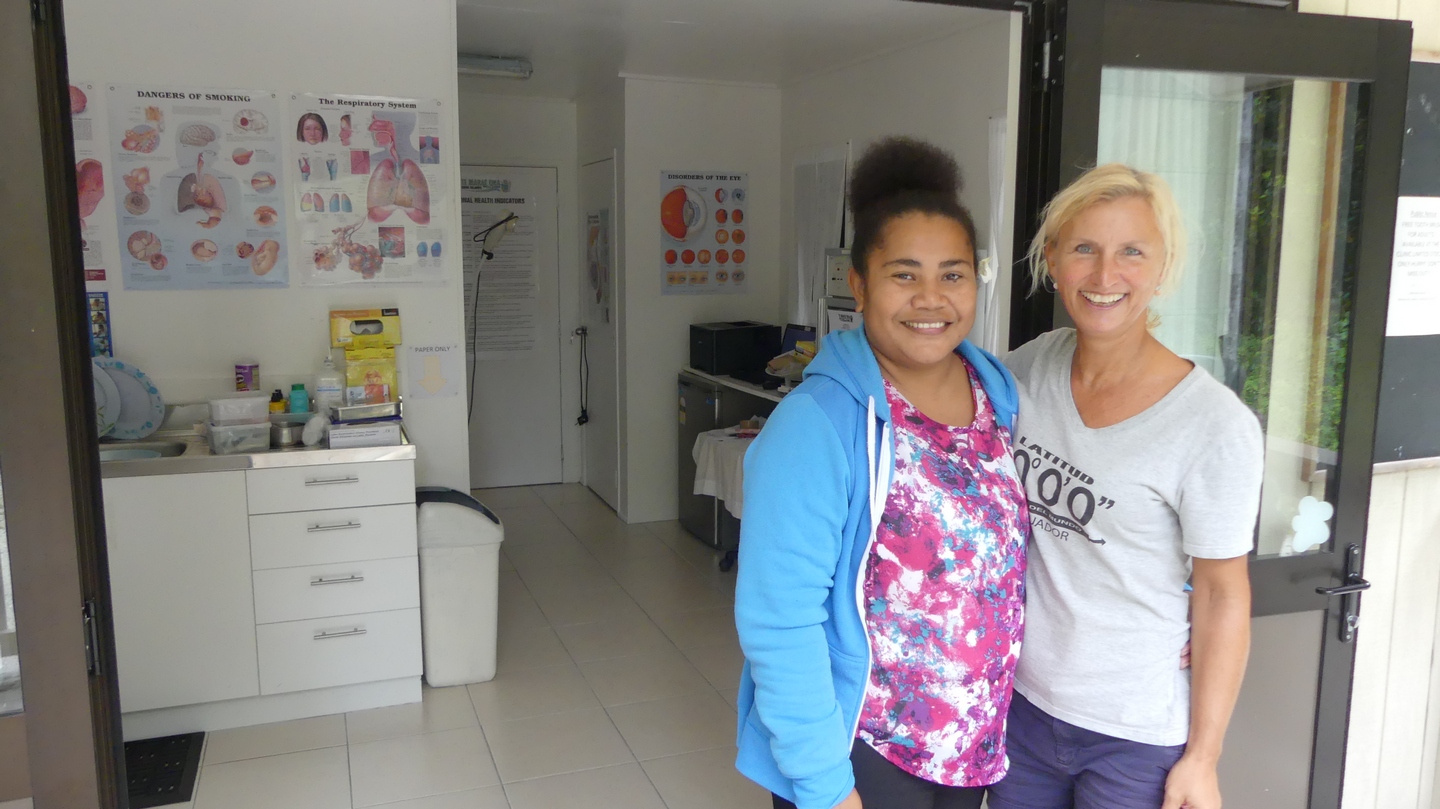
Een super sympatieke verpleegster ‘Mother’ voor haar wel uitgerust ‘hospitaal’
Dat brengt me meteen op een delicaat onderwerp, namelijk ontwikkelingssteun. Palmerston, en de Cook eilanden bij uitbreiding weten handig op de internationale hulpverlening in te spelen. Als er een project is dat in aanmerking komt voor steun, dan komt het erop aan om een voorstel in te dienen bij de juiste kanalen, en de kans is groot dat er een geldschieter gevonden wordt. Daar hebben we mooie voorbeelden van gezien, zoals de electriciteitscentrale met zonnepanelen park, de school, het hospitaaltje, de dienst openbare werken. Maar ook de bijna onvermijdelijke buitensporigheden zoals 4 leraren voor 15 leerlingen op school, de zeer royale voorraad gezondheidsmiddelen die gratis verdeeld worden, de gratis voedsel of kleren giften van de Cook administratie of vanuit Nieuw Zeeland, het feit dat niemand belastingen betaalt maar wel op een maandelijks pensioen van 400EUR kan rekenen… Zo zijn er nog wel meer voorbeelden maar dit doet niets af van de charme van de mensen die er wonen.
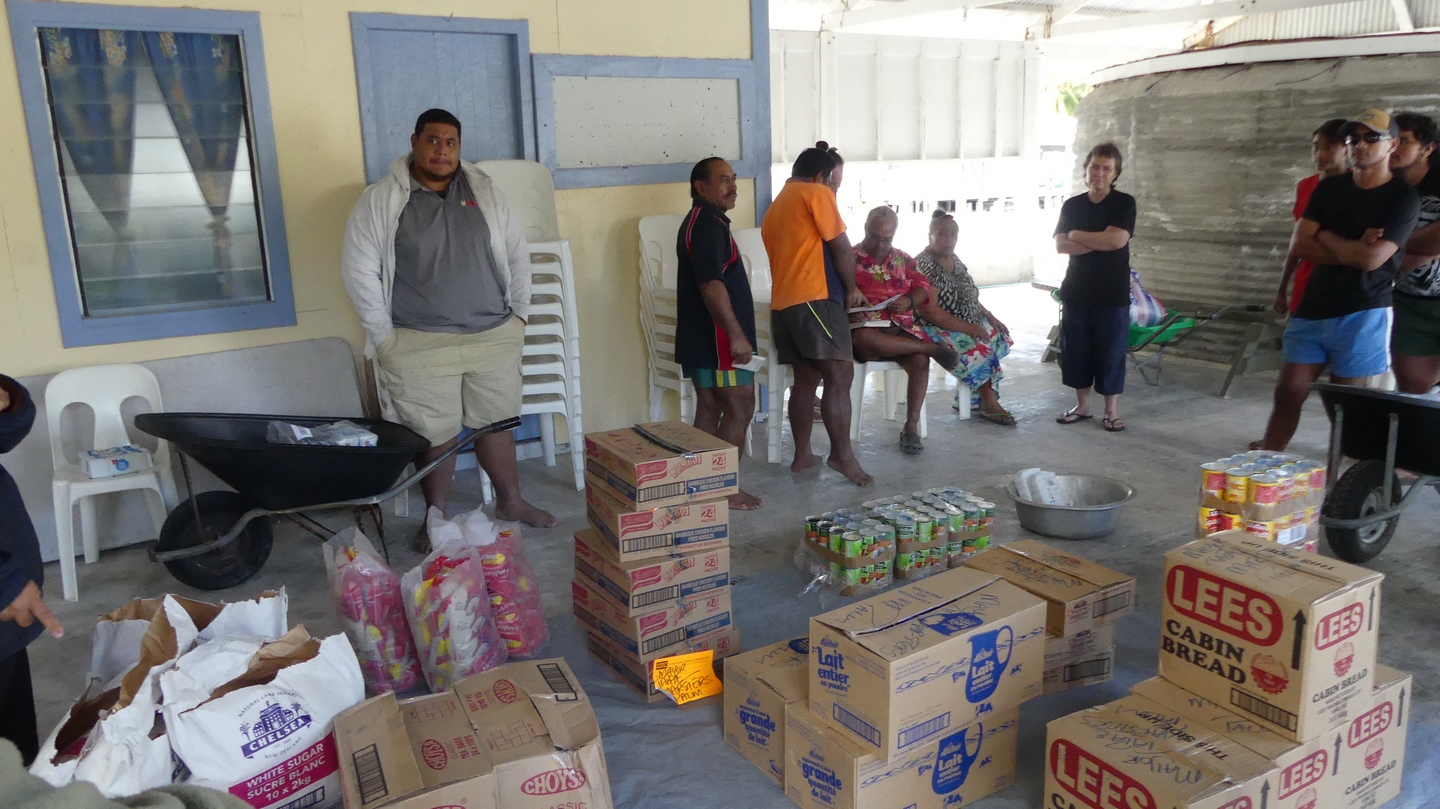
We woonden een vergadering bij waar een schenking van een parlementslid (nadat hij verkozen was) werd verdeeld onder de inwoners.
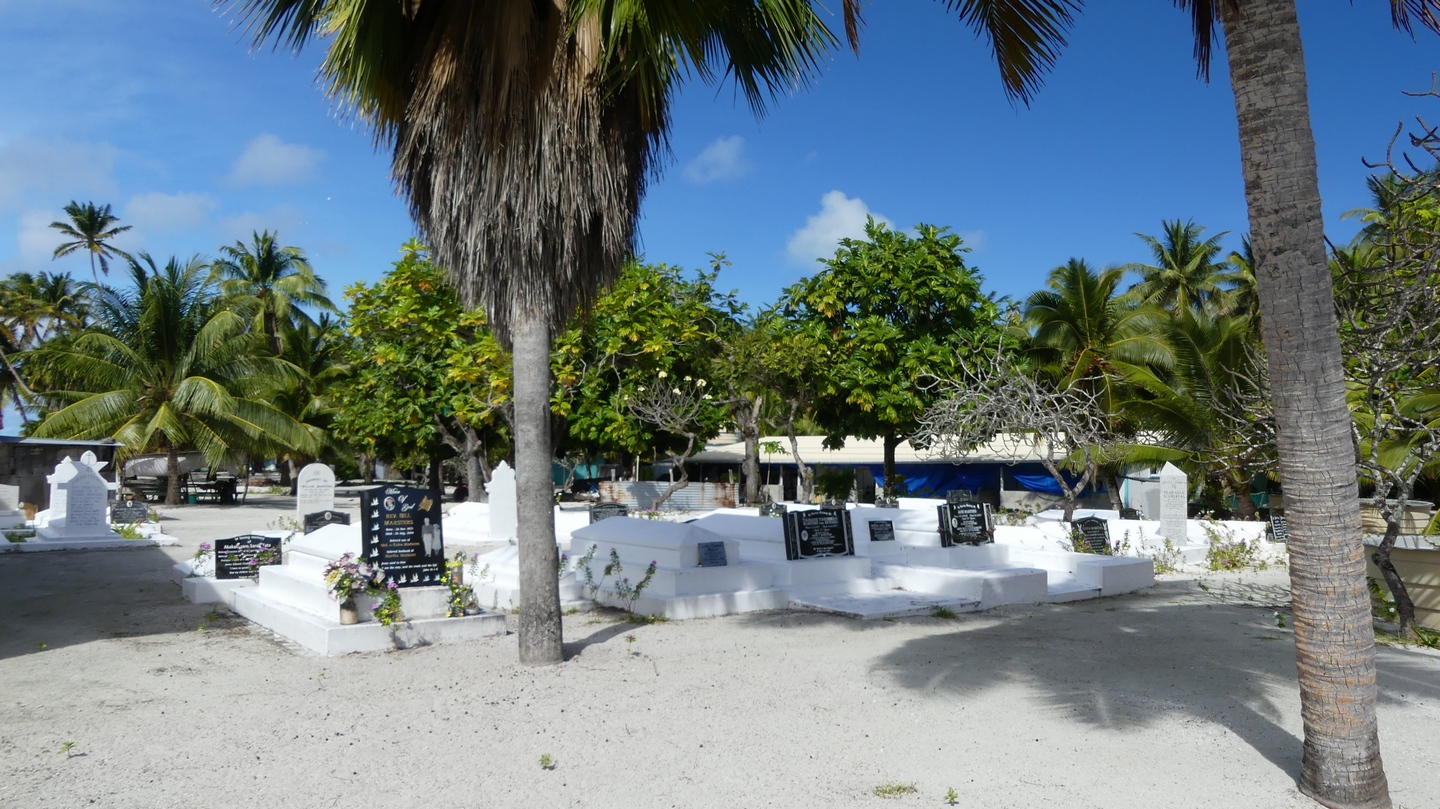
Zo werden we bijzonder hartelijk overal ontvangen waar we langs wandelden. We woonden een oefensessie bij van volksdansen door de leerlingen van de school (van 4 tot 18 jaar) , een les graveer vaardigheden, een vis-sessie op het rif, het bouwen van een nieuwe hut, we bezochten de begraafplaats van de allereerste Marsters (1894), en zijn eerste huis dat er nog steeds staat, ondanks verschillende orkanen die reeds over Palmerston zijn gepasseerd.
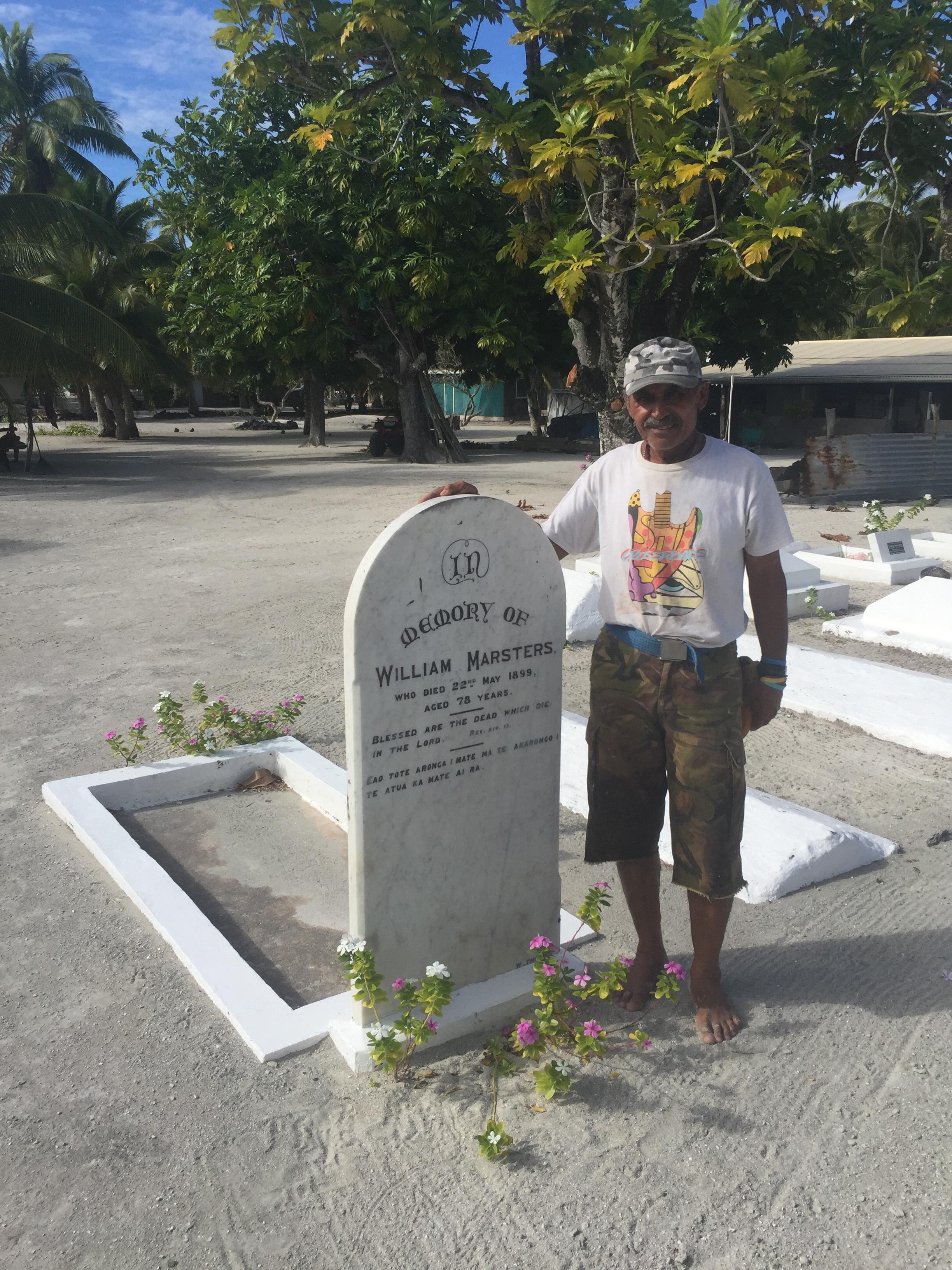
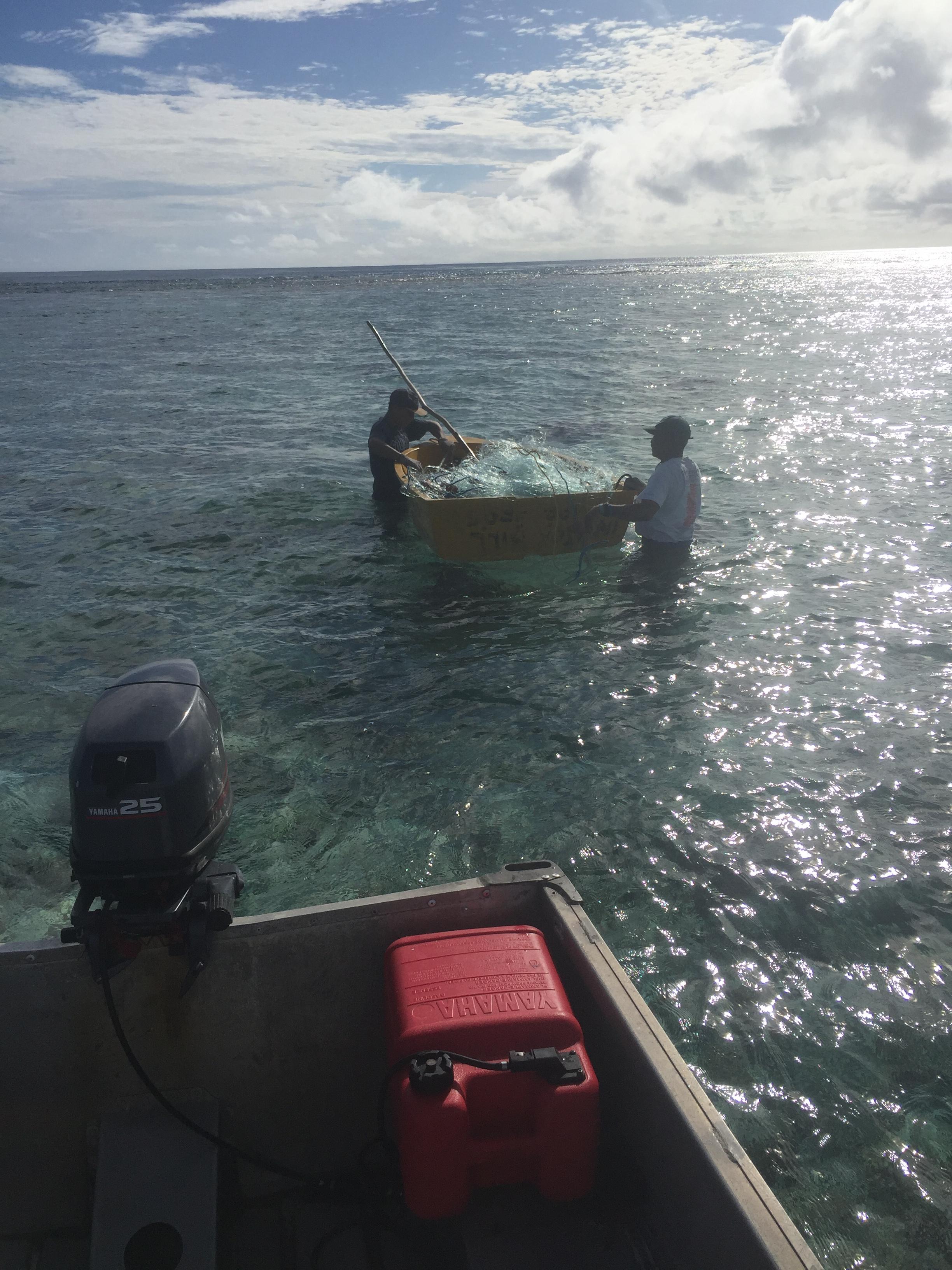
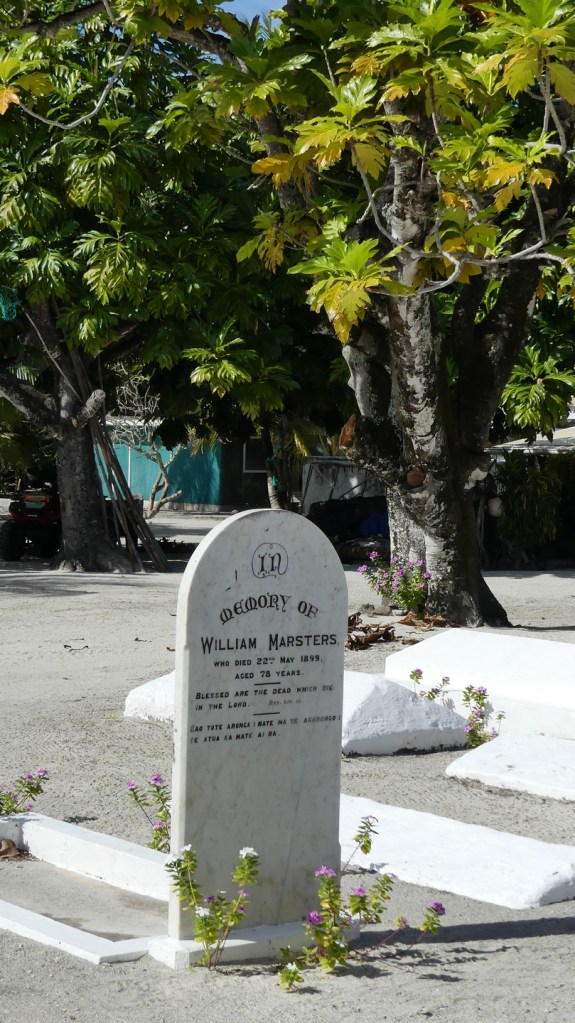
De graven van overal op het eiland zijn samengebracht naar een nieuw kerkhof achter de kerk.Bill bij het graf van de stamvader MarstersBill en zoon samen aan het vissen op het rif voor twee uur. Ik mocht niet mee het water in, want te gevaarlijk voor de hongerige haaien. Buit was twee grote papegaaivissenn (die we later meekregen voor op de boot)
Ik heb Bob ook geholpen door twee nieuwe moorings voor hem te leggen. In drie duiksessies (mijn fles en twee die Bill gevuld had liggen) ben ik erin geslaagd om op 16 meter diepte een ketting om en door een koraalblok te leggen, met een schakel vast te leggen en vervolgens de schakel met ijzerdraad te blokkeren. Aan de ketting vertrekt dan een drie centimeter dik touw naar boeitjes aan de oppervlakte, om een zeilschip toe te laten de mooring op te pikken.
Klinkt gemakkelijk, maar het was mijn eerste keer als mooring legger, en het uitzoeken van een geschikte blok koraal is moeilijker dan het er vanop de oppervlakte uitziet. Maar ik heb vertrouwen in mijn werk, en Sanuk heeft twee dagen aan de nieuwe mooring gelegen, bij een gematigde westenwind die ons met het achterschip het koraal liet zien. Ik zou immers niet graag moeten lezen op het internet dat er een schip aan een mooring is losgebroken en op het rif is versplinterd!
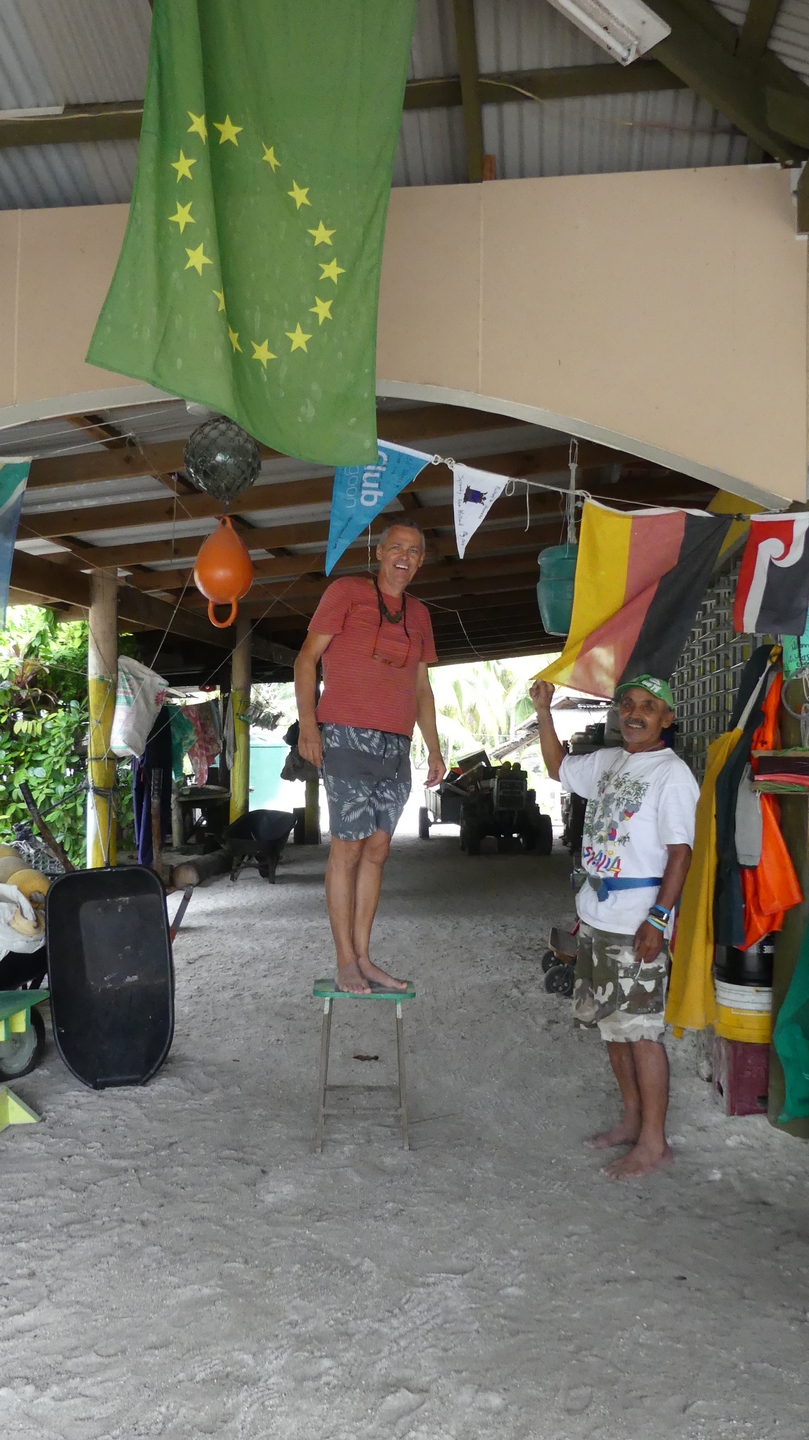
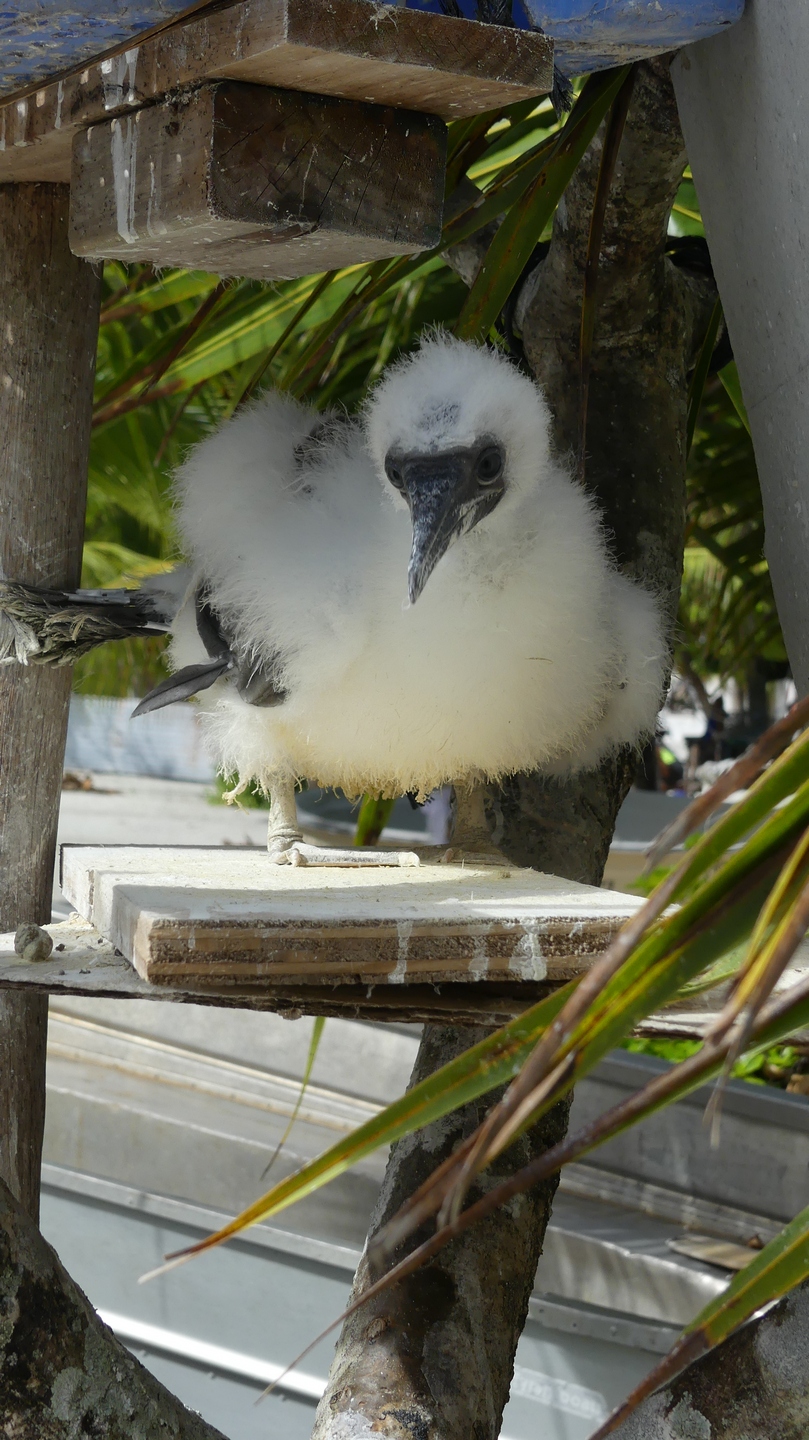
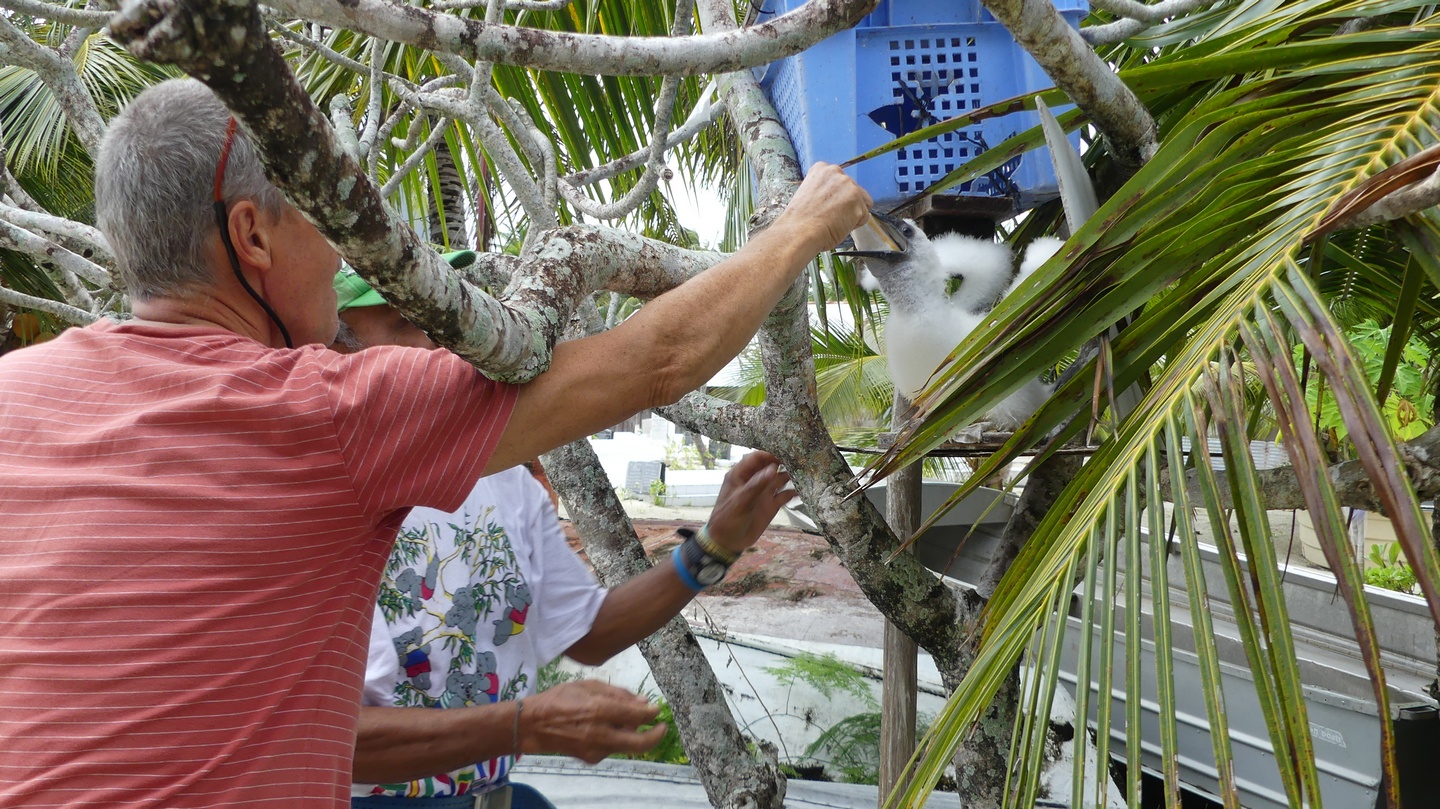
Boven mijn hoofd hangt onze herinnering aan SanukEen boobie wordt grootgebracht als huisdiertwee keer per dag krijgt hij een bevroren visje
Na vier dagen zijn we dan opnieuw vertrokken naar onze volgende bestemming: Niue.
Als bewijs van de vrijgevigheid van de Marsters kregen we visfilets mee van twee grote papegaaivissen, een stuk tuna, twee pakken diepgevroren spek, een versgebakken taart van Bill zijn dochter, 24 eieren, twee amuletten gemaakt door Bill zijn zonen en 2 sarongs gemaakt door zijn vrouw.Van ons kant waren we blij dat we hen ook kunnen helpen met wat steun aan de school en een lading nieuwe muziek, documentaires en films.
Ook al was ons bezoek kort, het is een stop die we niet snel zullen vergeten!
We arrived in Niue thursday, july 6th early in the afternoon. From a distance at sea, it looks like a dark and foreboding place. Unlike other coral islands, Nieu rises up from the sea as a black massive rock, hence it’s nickname ‘Polynesian rock’.
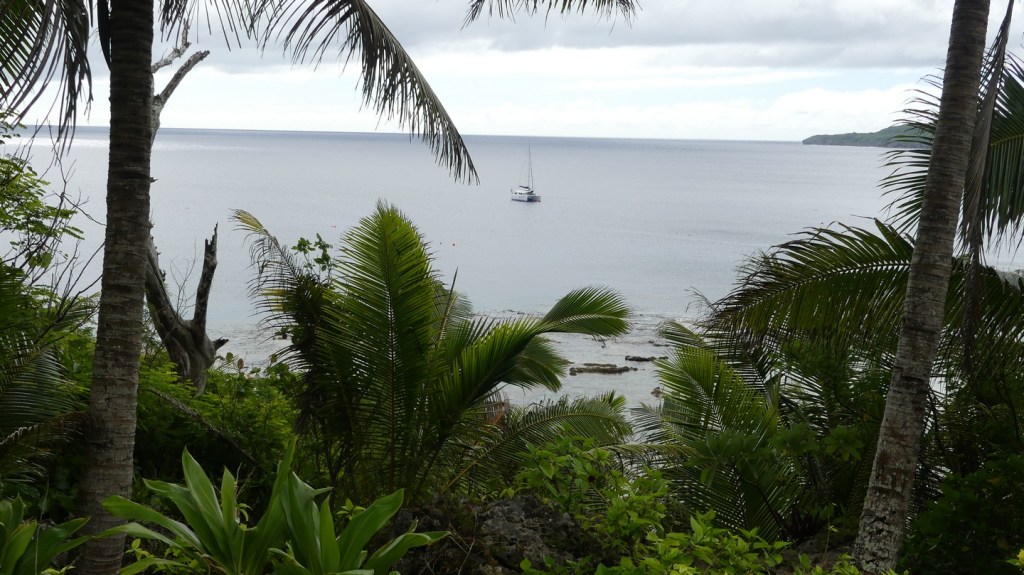
the rockLooking from ashore, Sanuk lies alone in the large bay, which is unprotected from westerly winds.
We took a mooring and radioed the Niue Yacht Club for customs and immigration. Stefan was picked up about an hour later at the dock and another hour later we were checked in.
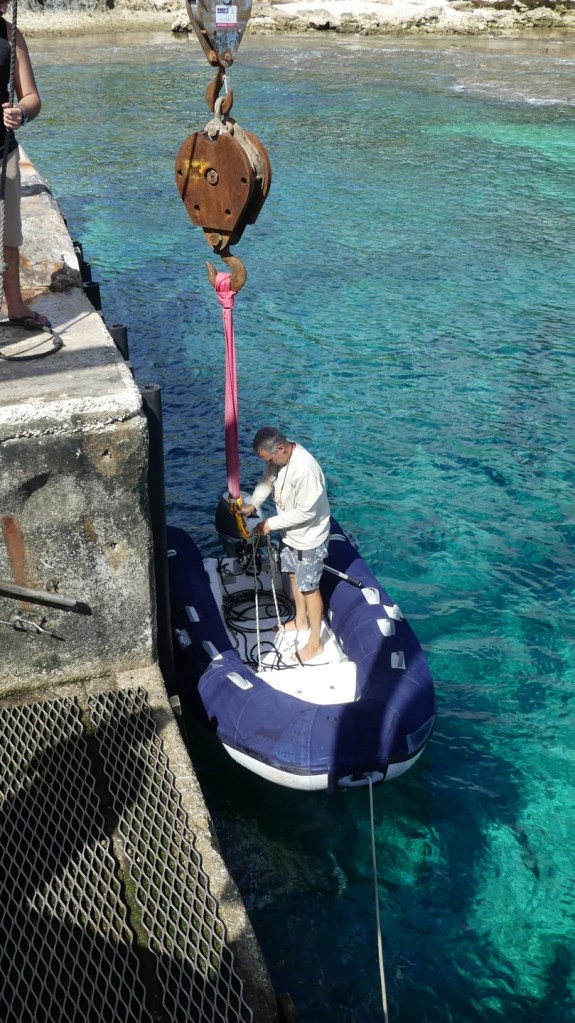
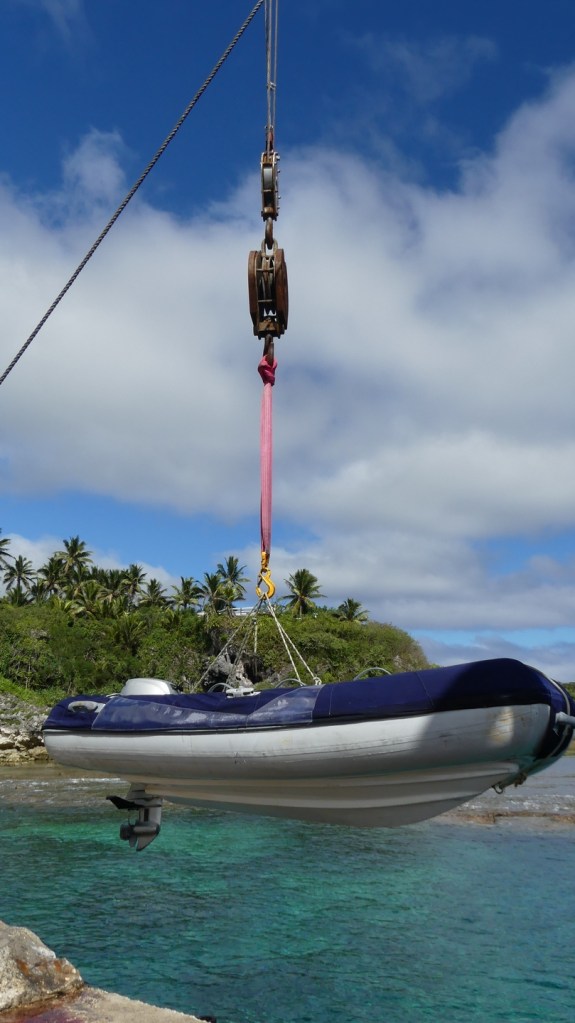
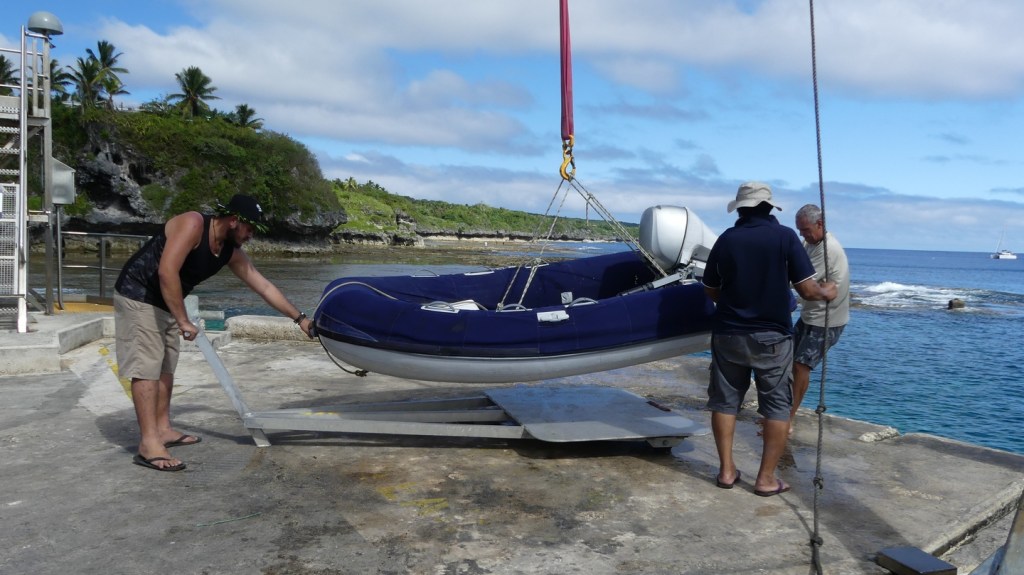
We immediately went ashore although this involves some work. You cannot just leave your dinghy at the dock because of the waves pounding against the unprotected harbor wall. This could cause damage if you would leave it there for some time. So Niue has engineered a system where the dinghy is hoisted out of the water by a crane to which you can attach to your boat. The 8 days we were in Niue this worked great although on some days it took some acrobatics to get in and out of the boat because of the large waves.
We were immediately charmed by the island. We had dinner at an Indian restaurant, good food for a small price. The Indian had wanted to immigrate into New Zealand but ended up in Niue and liked it so much that they decided to stay.
The captain attaching Flipper’s single point harnass to the crane at Niue dock.Flipper hoisted out of the water with the electric motor.and safely deposited on the dinghy cart at the dock. You try to make sure that you did not forget anything on the boat because it takes a while “parking” the dinghy.
It took Captain Cook in 1774 three tries to get on land in Niue. He was not welcomed by the natives who all had painted faces and red teeth and he therefore called it “Savage island” which stuck for centuries until it reverted to Niue. He was able though to plant the flag and claim “Savage Island” for the Queen.
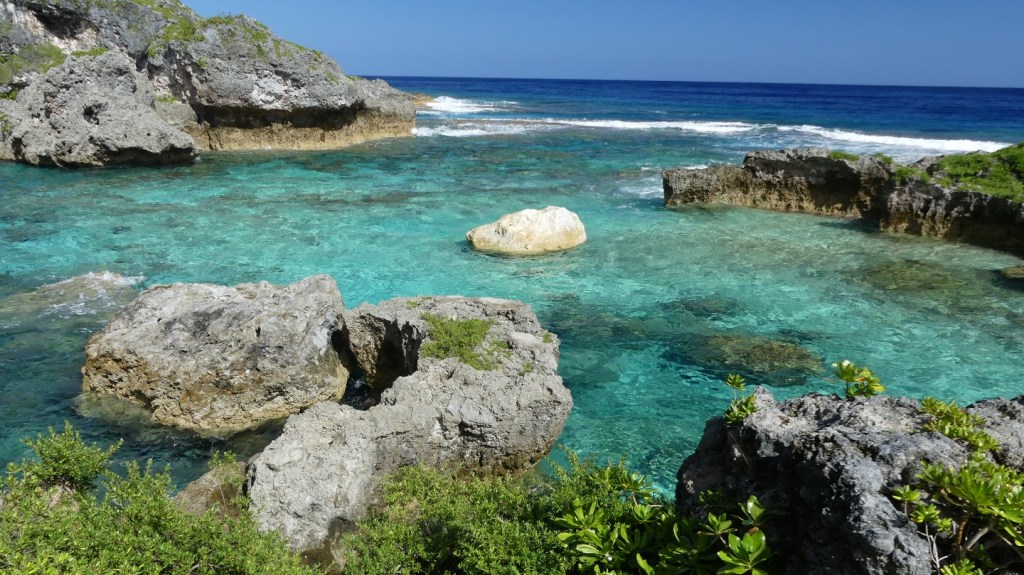
Niue (which means “behold the coconut”) is made up of limestone with cliffs rising up 30m from the sea. It is the largest raised coral island in the world. Niue was once ruled by kings but it became part of New Zealand in 1901. NZ is responsible for foreign affairs, defense and the necessary economic and administrative assistance. Just when we arrived the departure tax had gone up from 34NZD per person to 80NZD. This fee has to be paid by every person leaving Niue. Niueans are not happy with this increase imposed by NZ and fear that it will impact tourism. The future will tell.
Niue suffered a devastating blow in January 2004 by Cyclone Heta. Winds of up to 300km per hour damaged 90% of the buildings. The hospital was completely blown away… The population before Heta was about 2500 but declined to as low as 1100 and is now, 13 years later, 1900 souls. Niue tries hard to get its expatriates back, mostly from NZ and Australia.
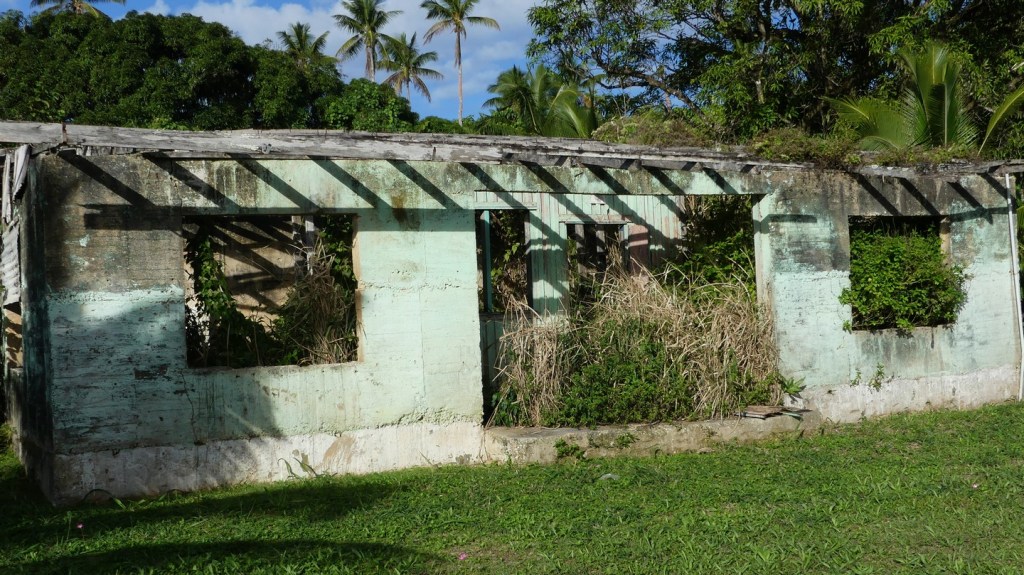
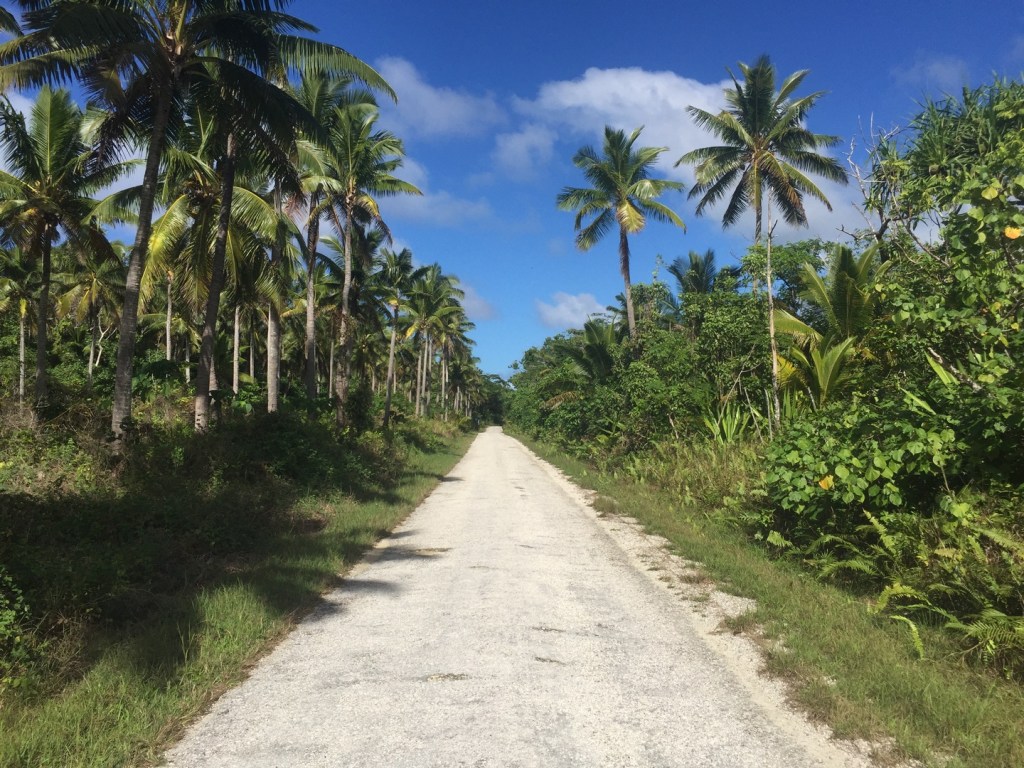
Lots of abandoned houses after Cyclone Heta hit Niue hard in 2004.well maintained roads
Niuean is the official language but most people also speak english, their second language. Besides fishing and agriculture, tourism is one of the main economic pillars of Niue. Niue is famous for its limestone caves and many chasms, crystal clear seawater (up to 50m visibility) and diving. We tried to do all ….
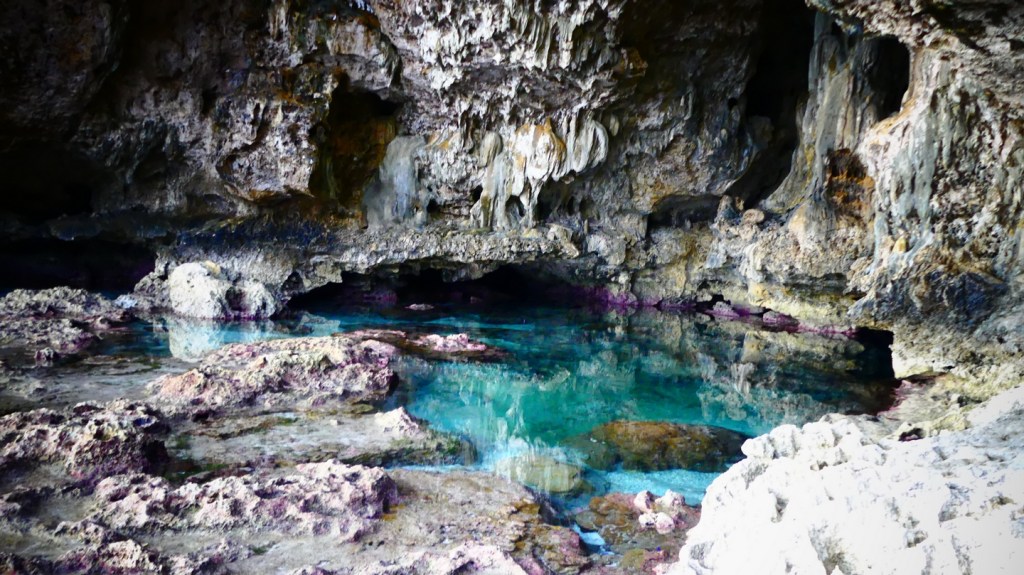
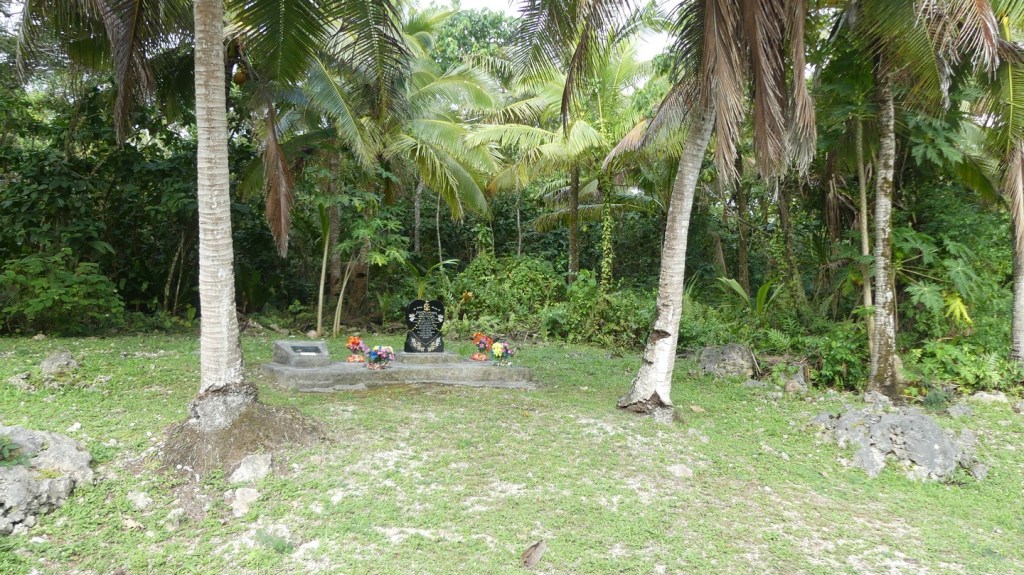
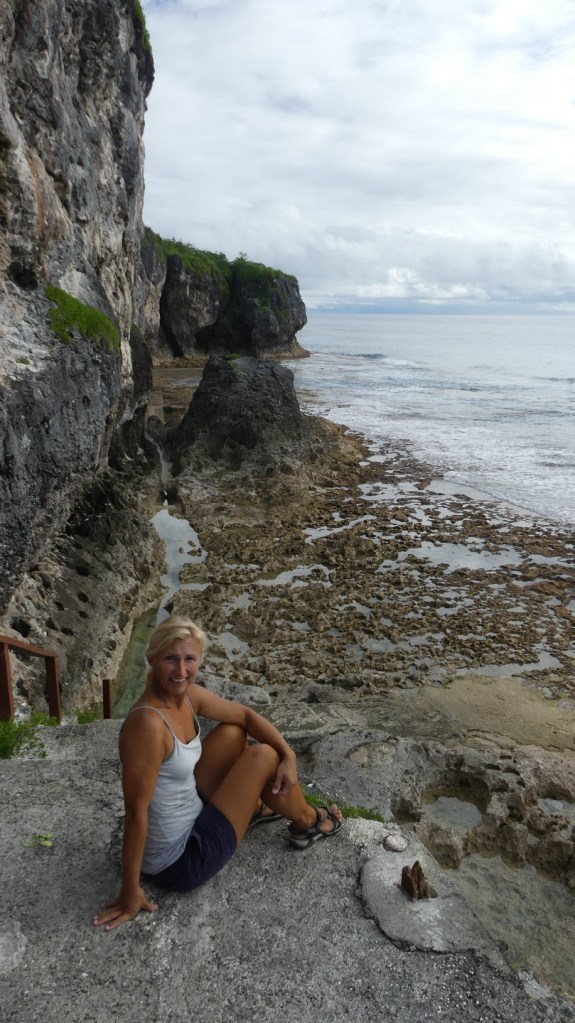
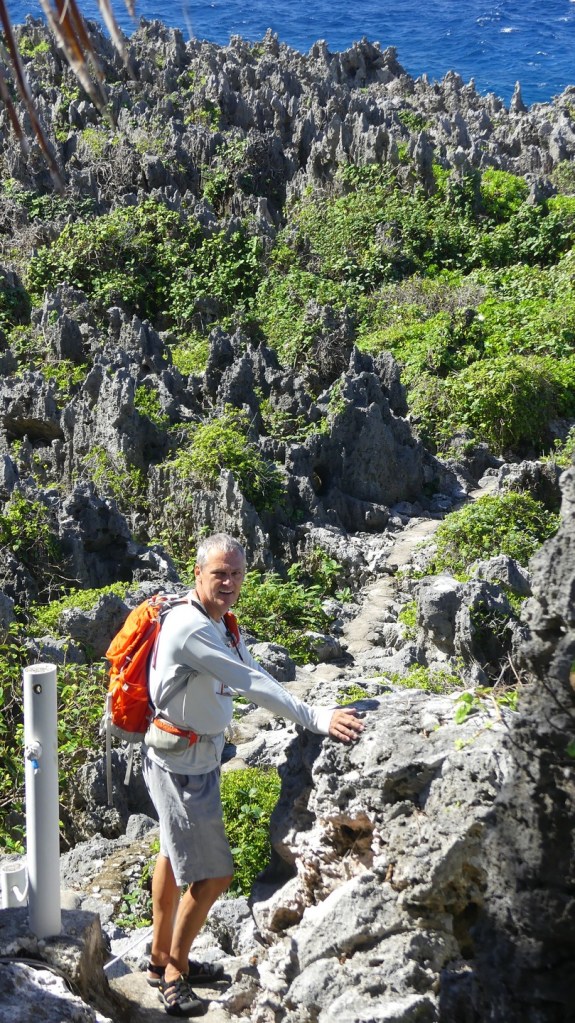
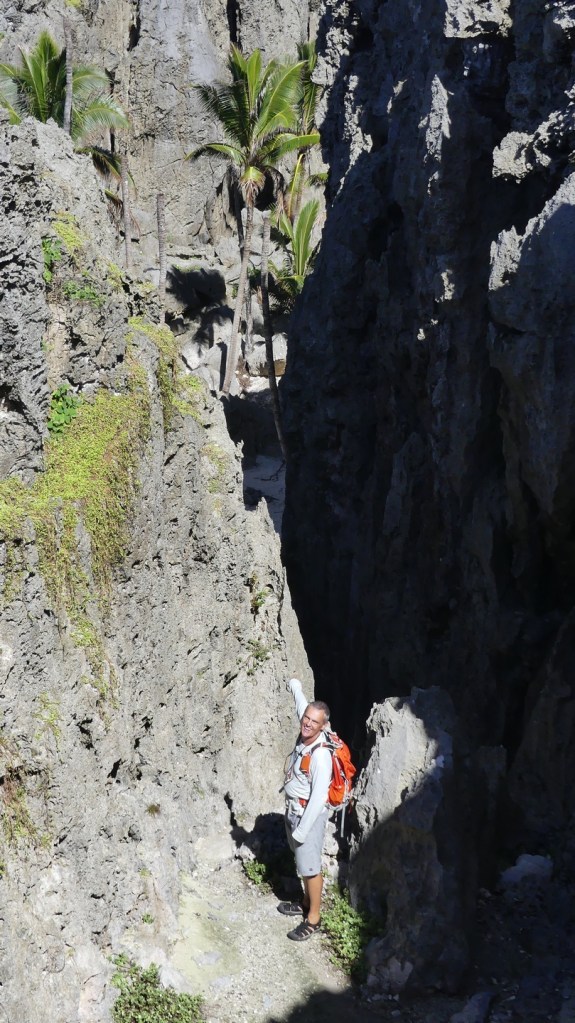
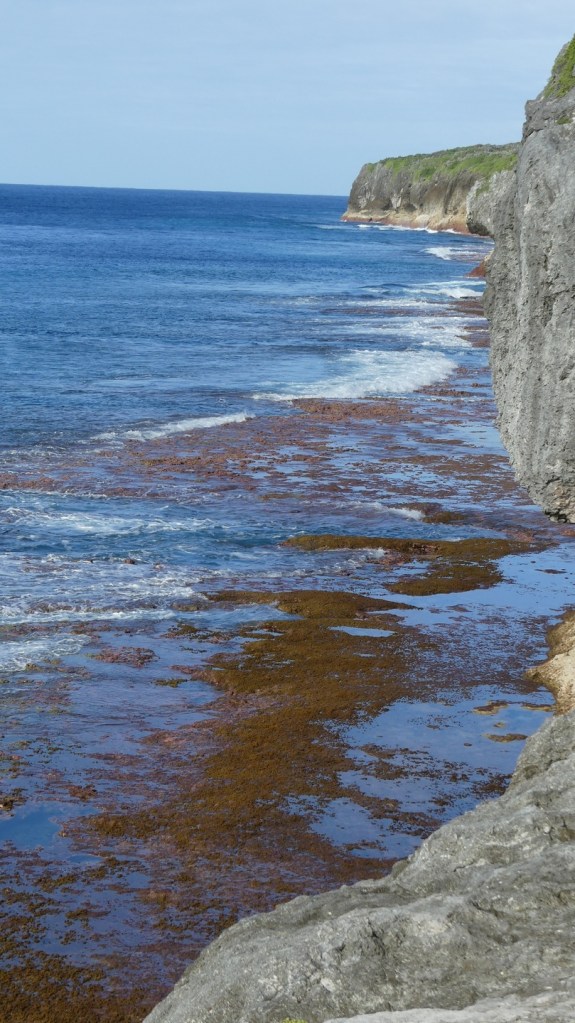
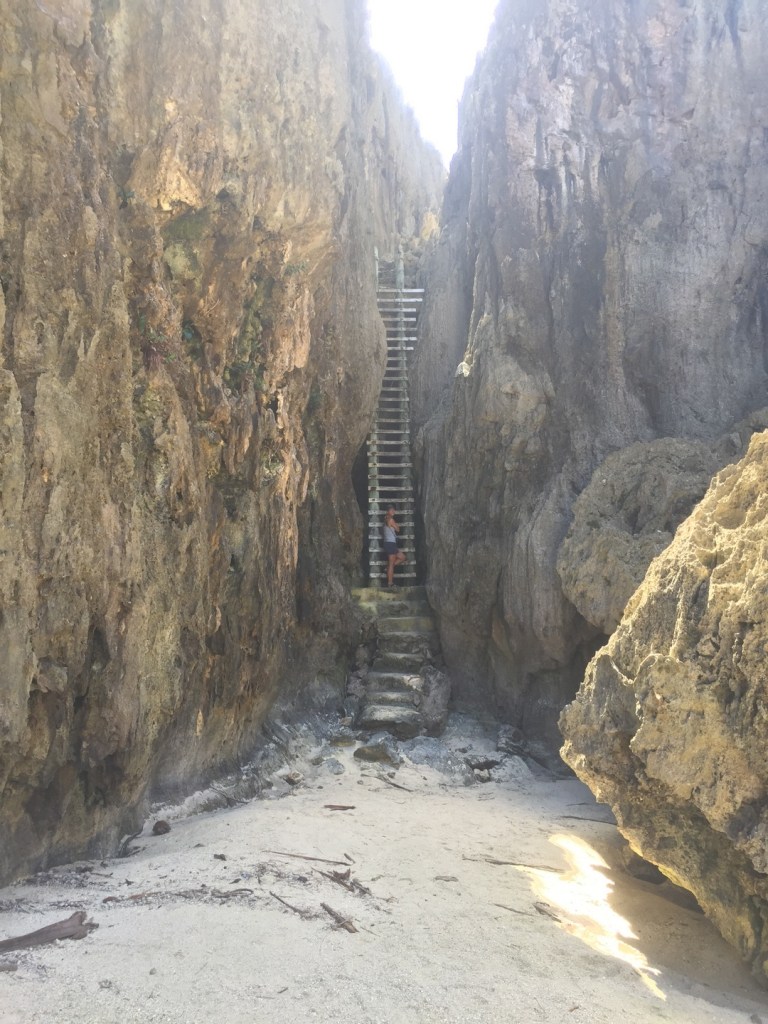
One of the first caves we visited was spectacular Avaiki Cave. This was the private bathing cave for the ancestor kings and site of the first canoe landing.Looking down in the crystal clear water. The beautiful colours were really incredible.People are not burried in a cemetary but along the road in a nice spot or in the gardens.During the WE we walked around the island visiting the different chasms leading up to the sea.We rented a car and visited most of the tourist attractions of Niue in 2 full days. A highlight was the walk in the Togo chasm ib the east side with its black coral pinnacles .A canyon leads to a small beach area with golden sand and coconut trees.The typical coastline in Niue with the limestone cliffs.the ladder that leads into the canyon near Togo Chasm
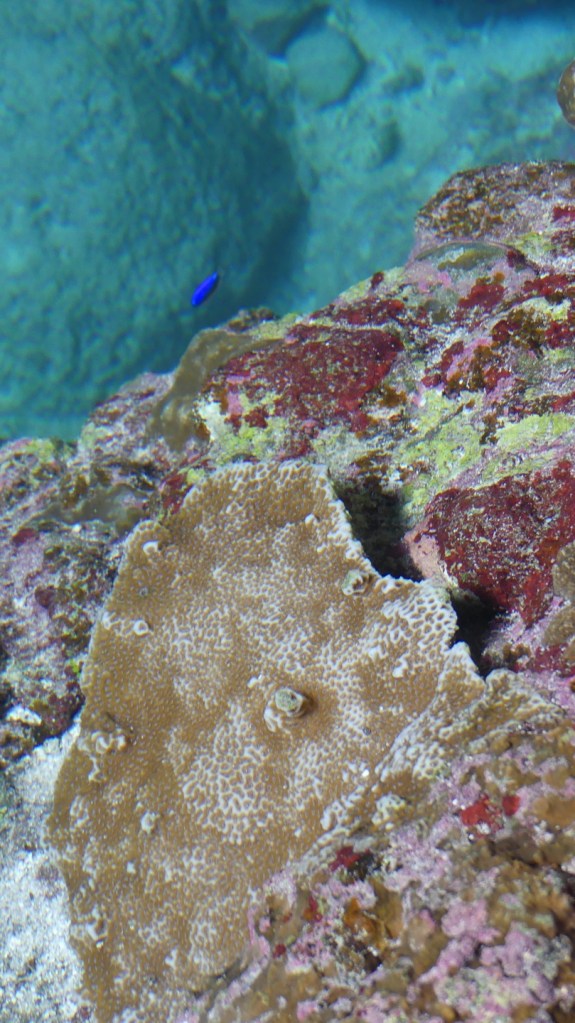
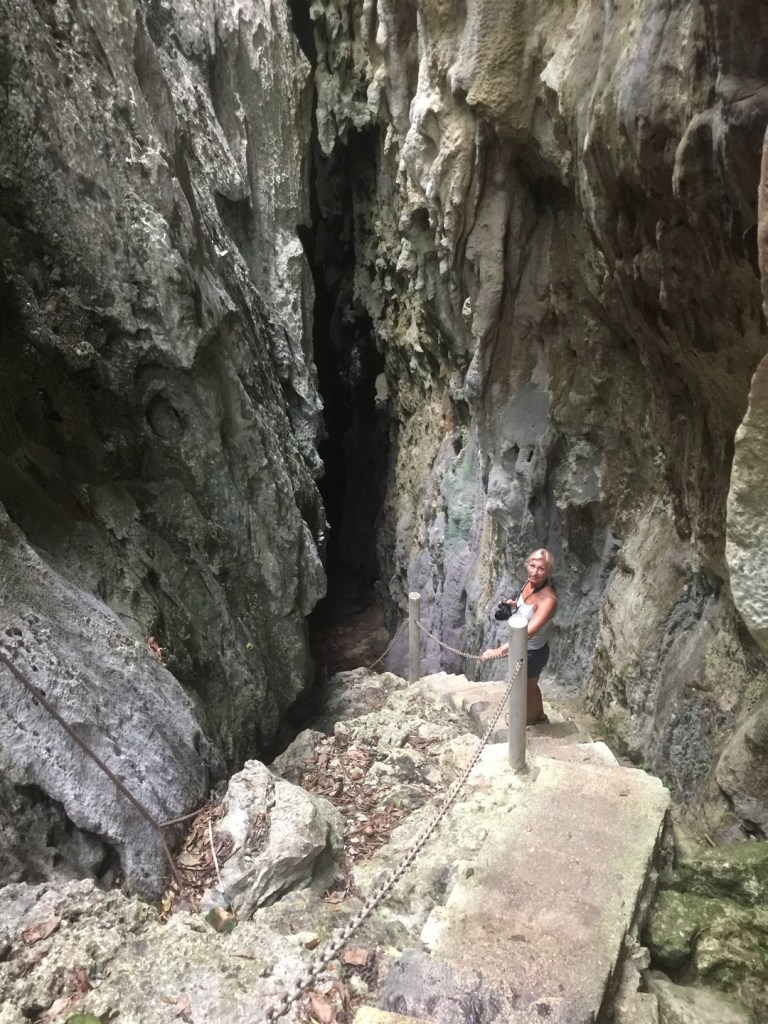
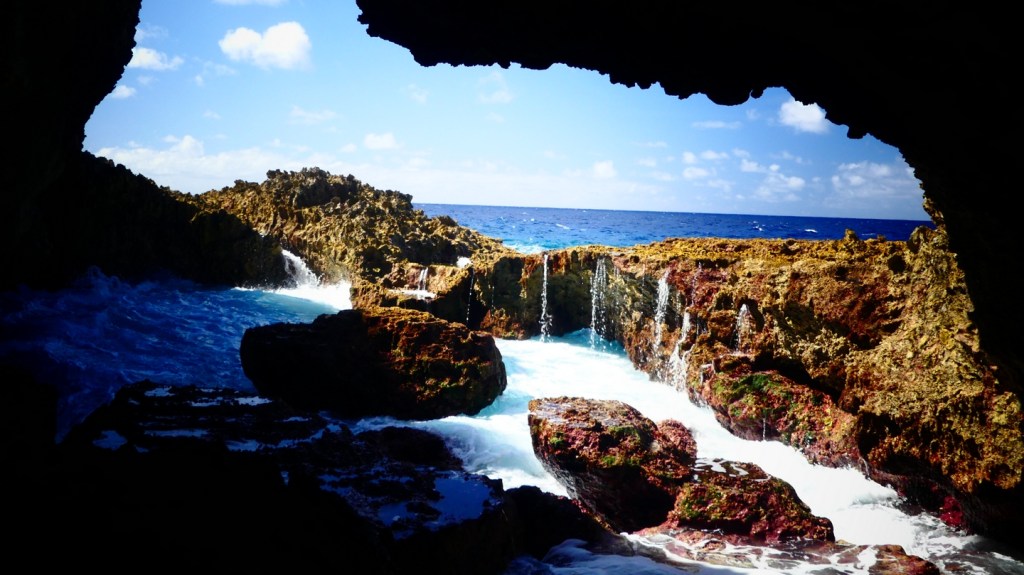
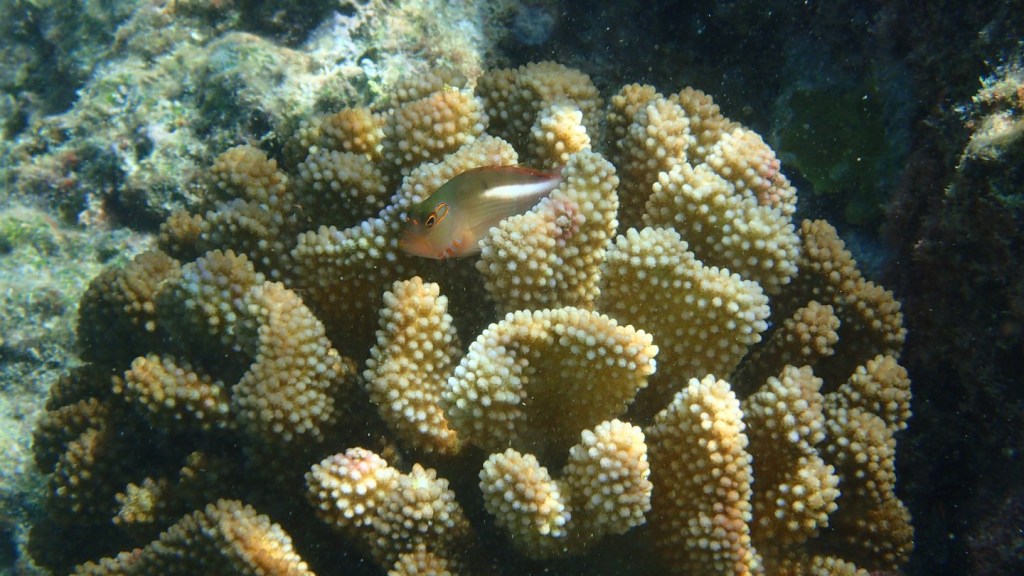
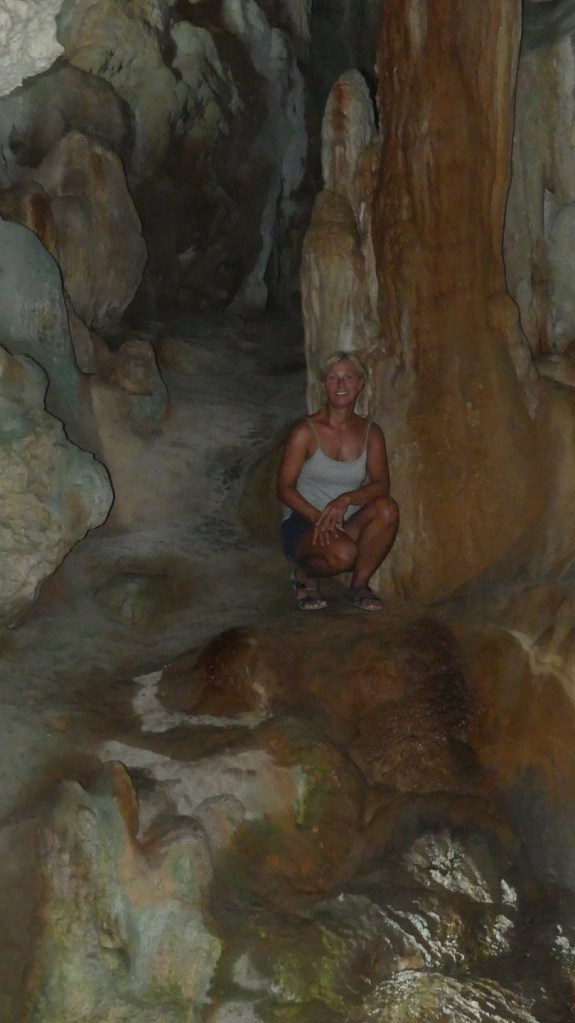
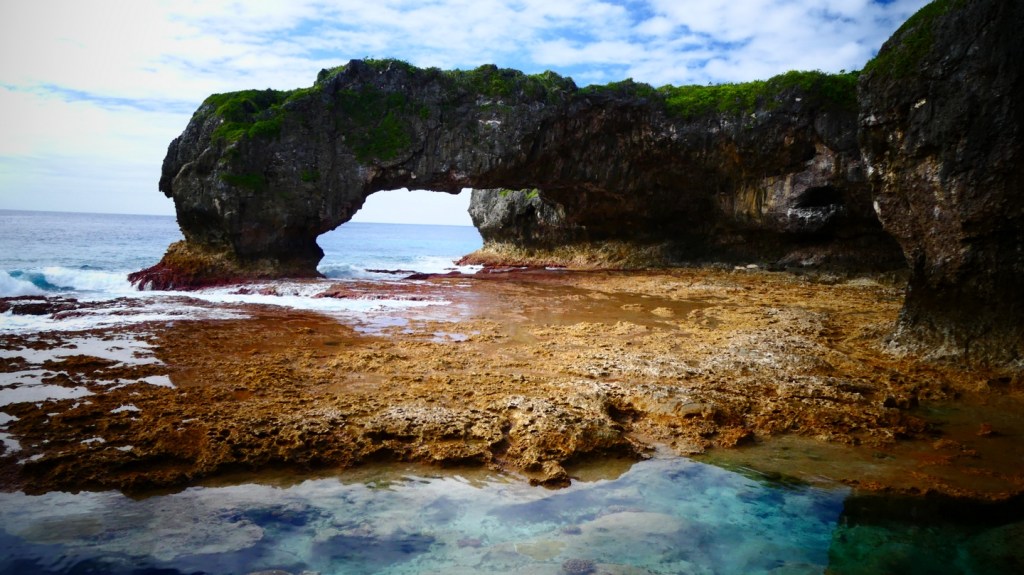
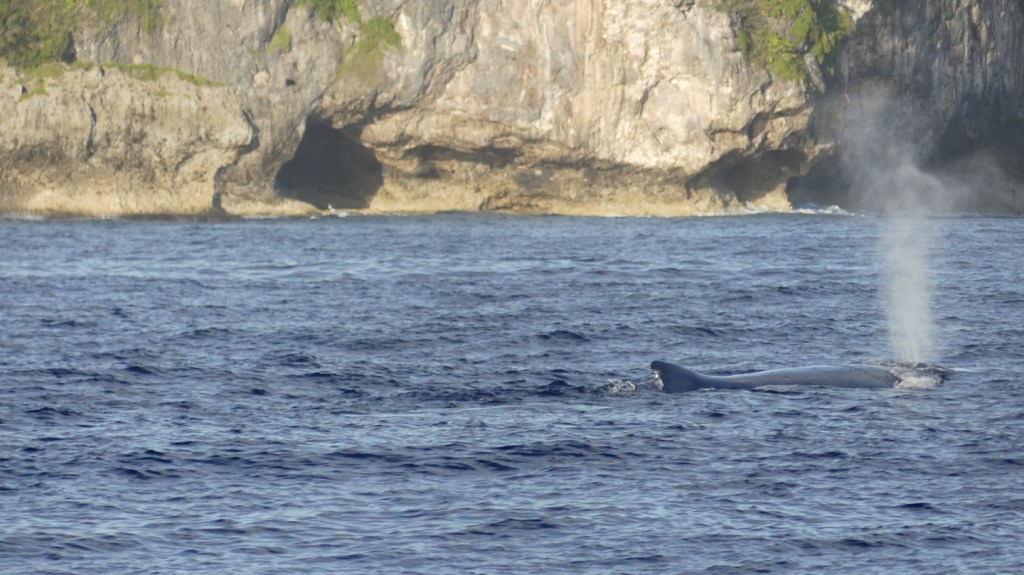
Anapala Chasm, 155 steps to a fresh water pool which was used by the local people to get their waterPalaha cave: looking from within the cave to the ever restless sea.The Limu pools were great for a swim and snorkeling.An Arceye hawkfish in the clear waters of the Limu pools.Corals in the Limu pools. It is so great to just hang in the water and look at these underwater aquariums.Beautiful colours in the limestone cave near the Talava arches.A rock in the limestone cave, such beautiful colors…The Talava arches.Having fun with our fellow cruisers, Nijad and Milike from “North” (Turkish boat) in the anchorage of Alofi.A whale in the anchorage at about 30M from the boat. We are a little early in the season to see a lot of the humpback whales who migrate from the cold waters of Antarctica to Niue and Tonga to have their babies and mate. The top of the season is during August and September when you see a lot of baby whales.We hope to see more whales in the Kingdom of Tonga, our next stop…
After one full week in Niue the winds changed and made the anchorage very rolly. Time to leave for Tonga. We dropped our mooring Friday July 14 after checking out and paying our departure tax. We really enjoyed the friendly people of Niue and its beautiful caves and chasms.
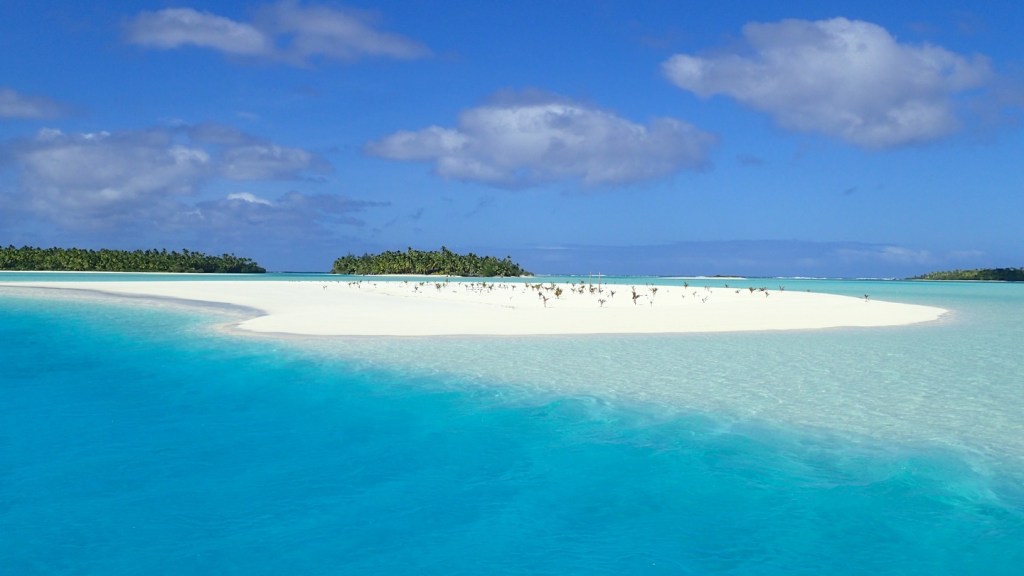
Before leaving Aitutaki we decided to participate in a lagoon cruise and yes the sun was out so we could admire the different shades of blue of the lagoon and it’s motus. We visited Akaiami motu, once a refueling stop on the famous Coral Route in the 1950’s-60’s for waterplanes on their route from New Zealand to Tahiti. We had a barbecue lunch on One Foot Island, awarded one of the leading beaches in Australasia region. We did some snorkeling but were disappointed after being spoiled in the Tuamotus. The lagoon cruise is definitely a must if you want to see all aspects of Aitutaki.
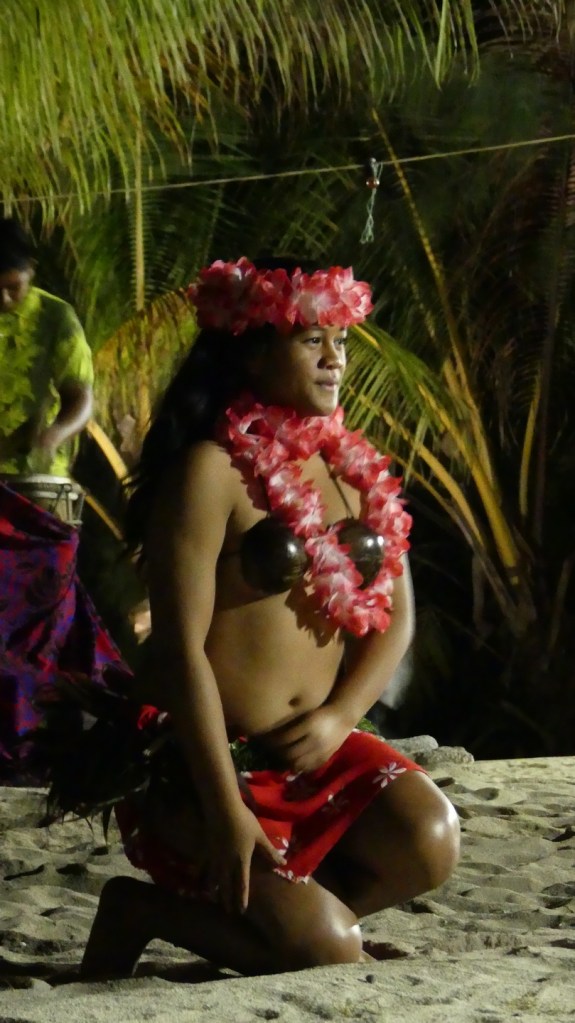
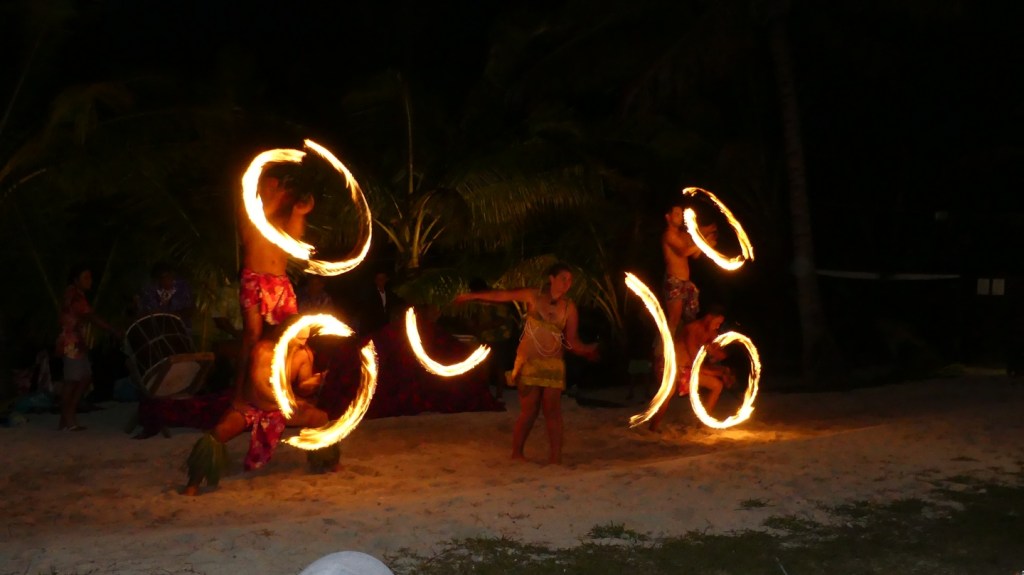
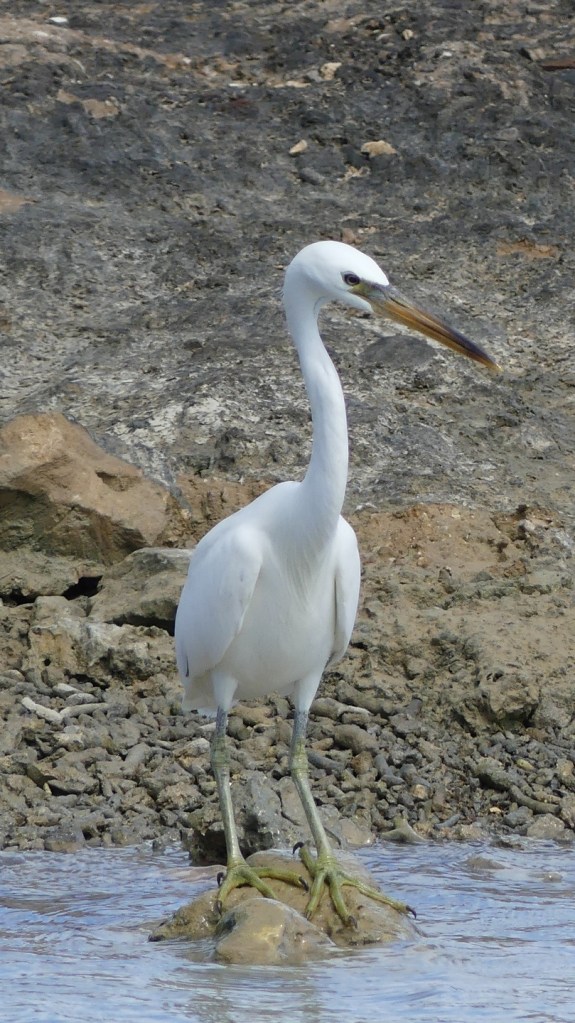
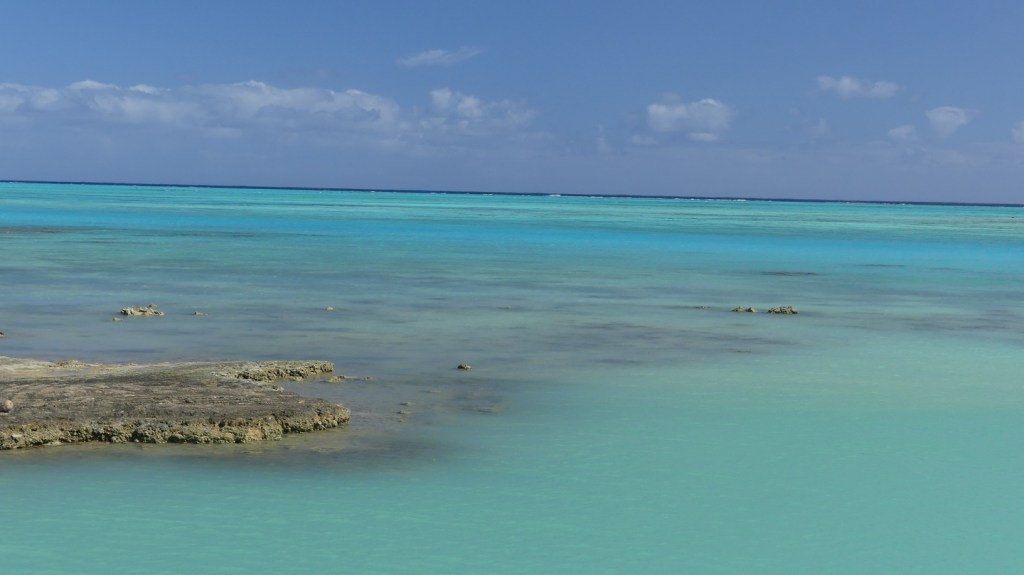
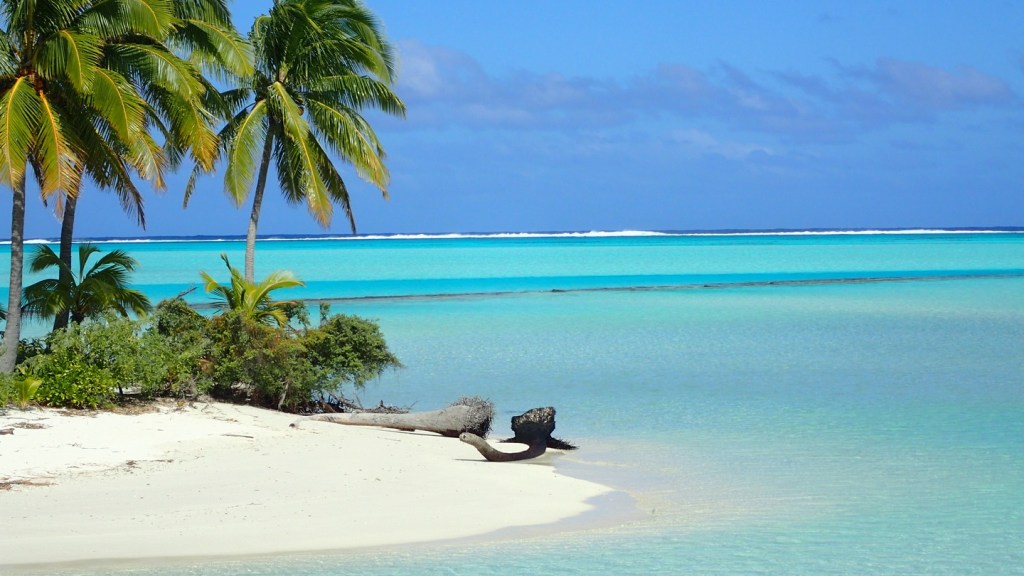
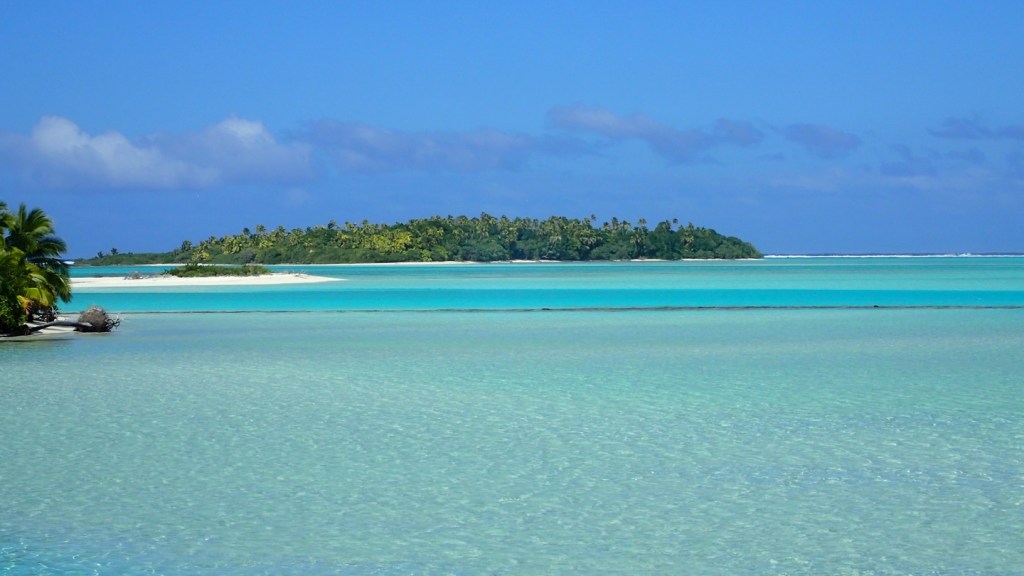
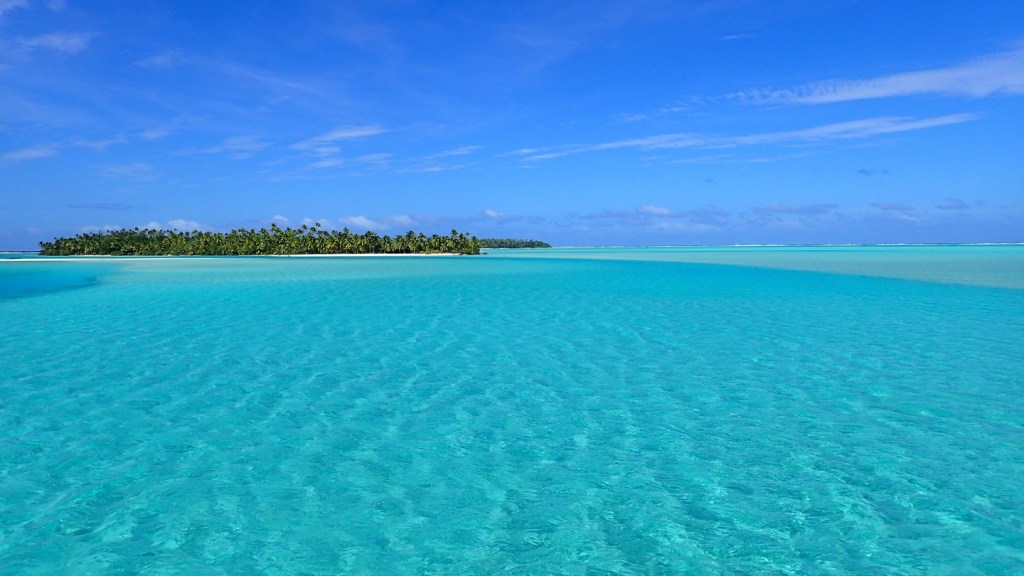
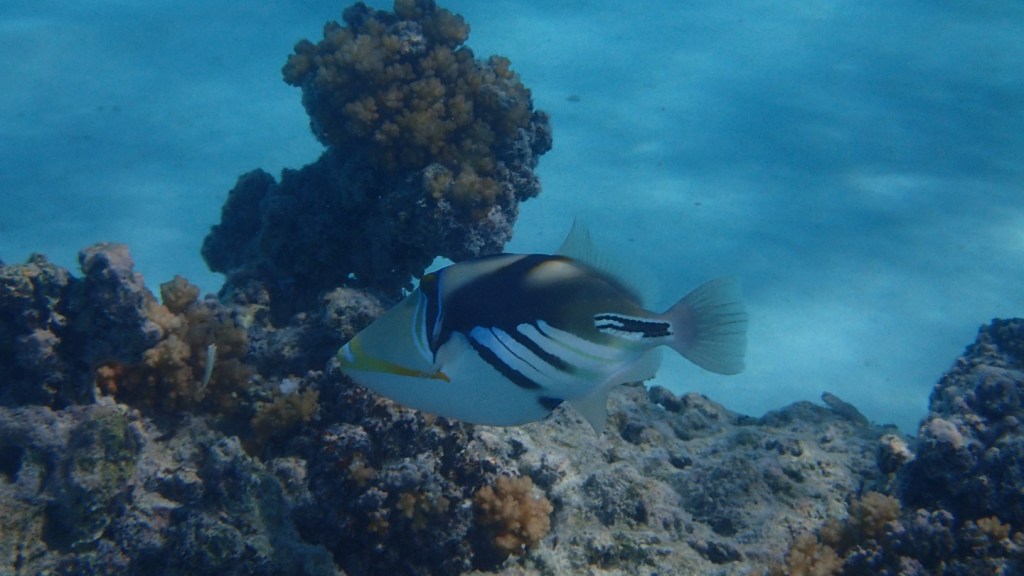
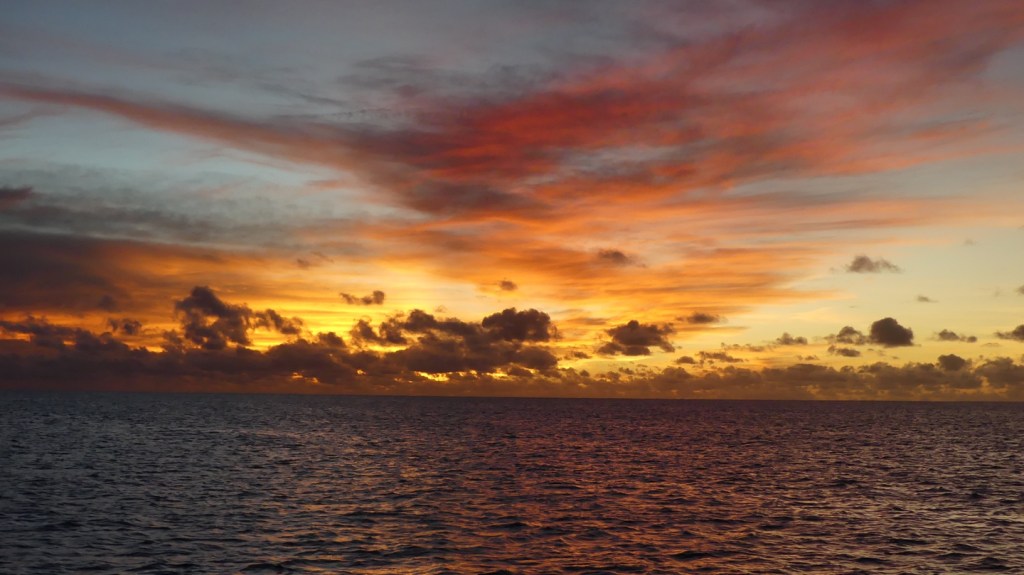
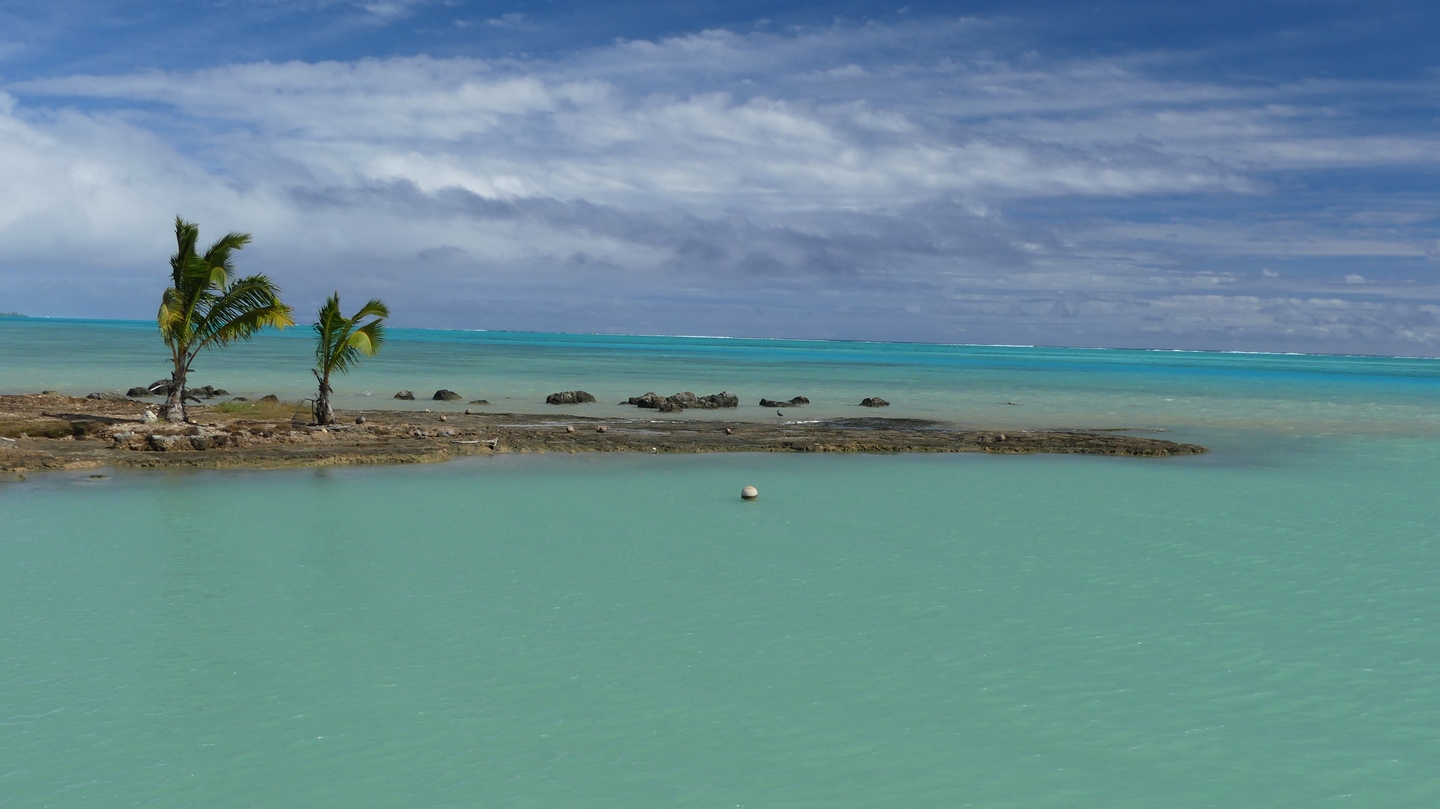
We booked one evening at a resort for a typical Cook dance performance.I was amazed by the way they handled the fire.Our daily visitor in Aitutaki, the reef heron.The lagoon of Aitutaki on a sunny day.cruising the Aitutaki lagoon on a beautiful day with all the shades of blue…View of “one foot island” where we had a lunch barbecue.I do not think it can get more paradise-like.The snorkeling was not so great compared to what we have seen in the Tuamotus but I did manage to take a picture of the White barred triggerfish. You see them a lot in French Polynesia but they are very fast…We could walk from the sand spit to One Foot island.Last beautiful sunset in Aitutaki, time to leave for Palmerston.
June 25, Sunday , we checked the weather and the wind was good so it was time to leave for Palmerston. Bill’s wife (whom we met in the visitor centre) asked if we could take “something” for her family to Palmerston which we gladly accepted. This “something” turned out to be 16 cartons with bananas and papayas and 4 more bags with watermelons, a suitcase, and a bag of candy … a good thing we have a catamaran and lots of hull space! Two days and 236NM later we arrived at lunch time in Palmerston and took one of the moorings guided by Bob Marsters.
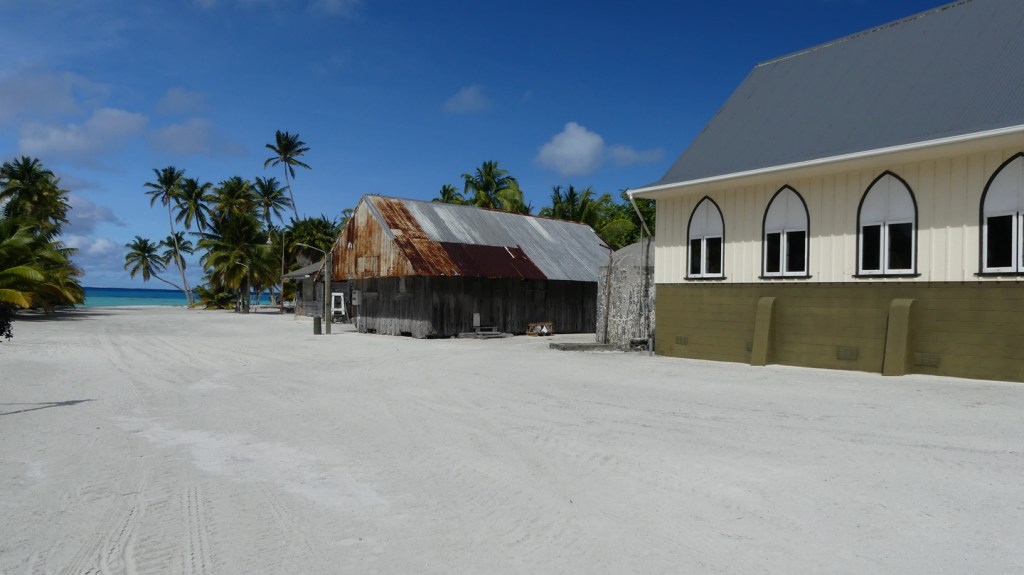
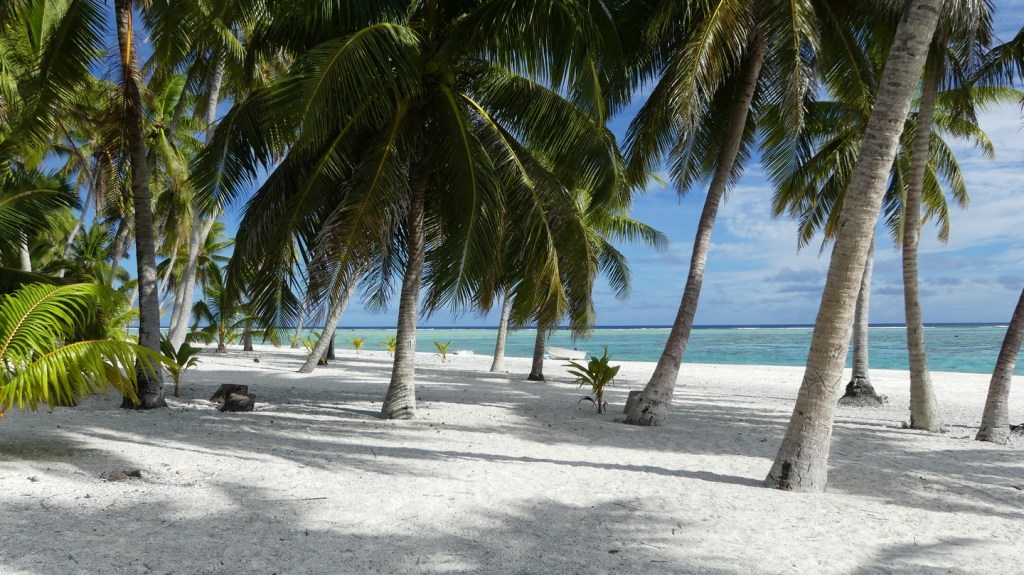
The streets in Palmerston with a view of the original house of William Marsters (next to the church), still standing after several cyclonesView of the beach of Palmerston. Every morning somebody will sweep and makes sure the fallen leaves and dirt is collected.
The history of Palmerston is unique. In 1862 William Marsters from Lancashire settled here with his 3 wives and 26 children. He divided the island and motus into sections for each of the 3 families with strict rules of intermarriage. Today 58 people are living on the island all connected somehow to William Marsters, except for some people employed by the Cooks Government (nurse and teachers). The island has no airport and the supply ship only comes when it is profitable to come by, so once every 2-3 months. Since 2015 they have 24hr electricity supplied by a solar power station sponsored by the Cooks government. Before that they only had a generator who supplied 6hrs electricity in the morning and 6hrs in the evening. There is internet and one TV channel since 2014, so life is changing….
The welcome was incredible. We were invited into Bill’s house for lunch and after saying a blessing we had rice, fish, lamb, corn and tarrot root. For dessert there was ice cream. Not only the first day but every day we were invited for lunch prepared by Bill because his wife was in Aitutaki with one of their daughters, Caroline. The other children, Juliana (16), Ngariki (14) and the youngest son (10) ate after returning from school around 2-3PM. Ngariki gave us a tour of the island, showed us the school (15 children between 6-18 years old), the infirmary with an enthousiastic nurse from Fiji, the wreck from the Riri and the old cemetary. There are no paved roads on Palmerston but the sand roads are raked clean on a daily basis. No cars but at Bill’s house they had 2 motorcycles and we did see one quad…times are changing. There are no stores on Palmerston and thus everything has to be ordered from Rarotonga to come with the supply ship. Every house has serveral huge freezers to make sure they have enough food till the next ship arrives. Most of the families live from fishing. They sell their fish (mostly parrotfish) to hotels and cooperations in Rarotonga for about 15NZD a kilo. But they remarked that there is less and less fish to be caught…is this temporary or a trend? They are aware of the climate change and see more and more coral bleaching because of the warm water. The population of Palmerston is aging. A family with 9 children had just left the island a couple weeks before. Although Palmerston is for some a paradise I can fully understand that for others (especially youngsters) this is too limited and they move to NZ, Australia or Rarotonga in search of a “better” life. A lot of them do come back for visits or to grow old.
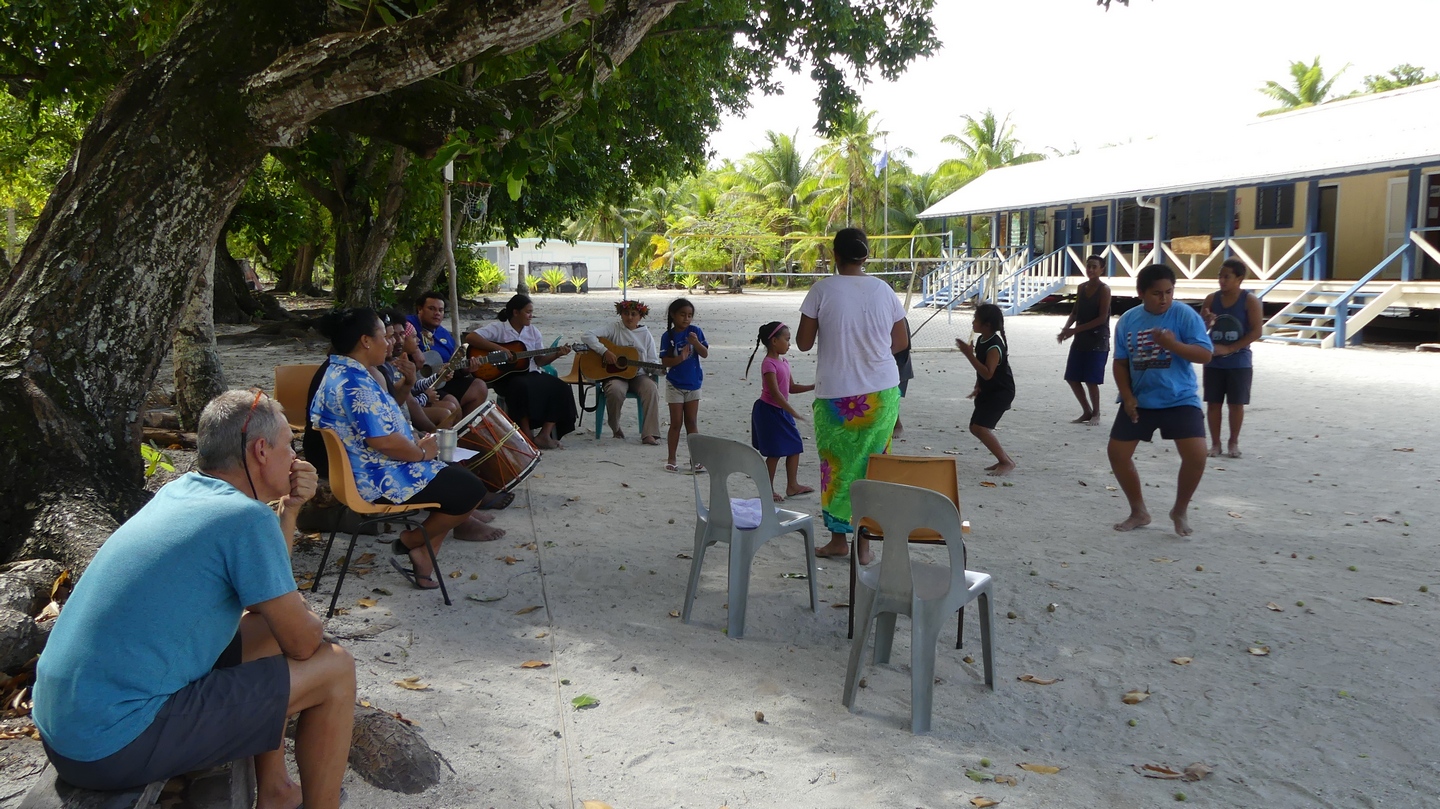
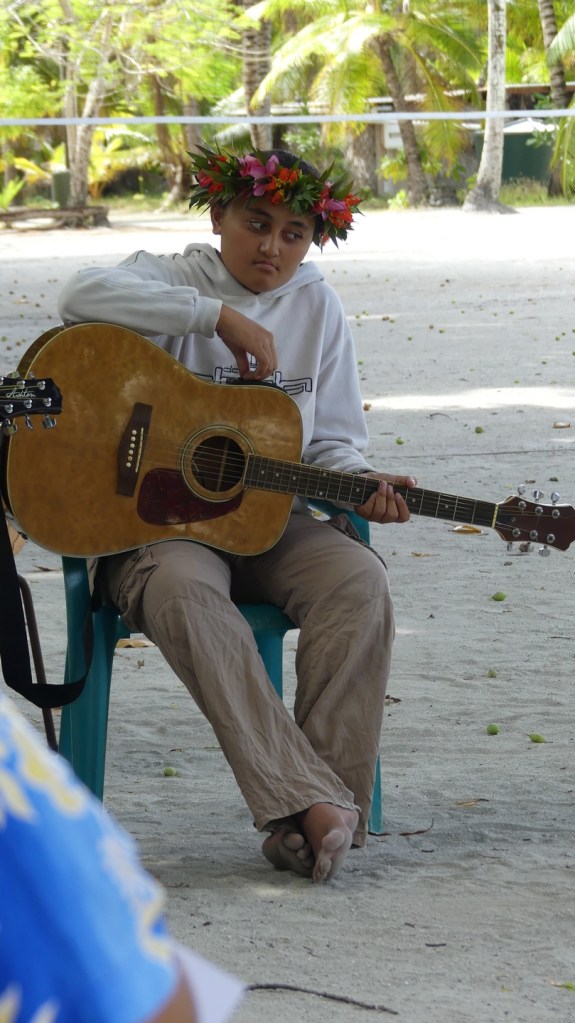
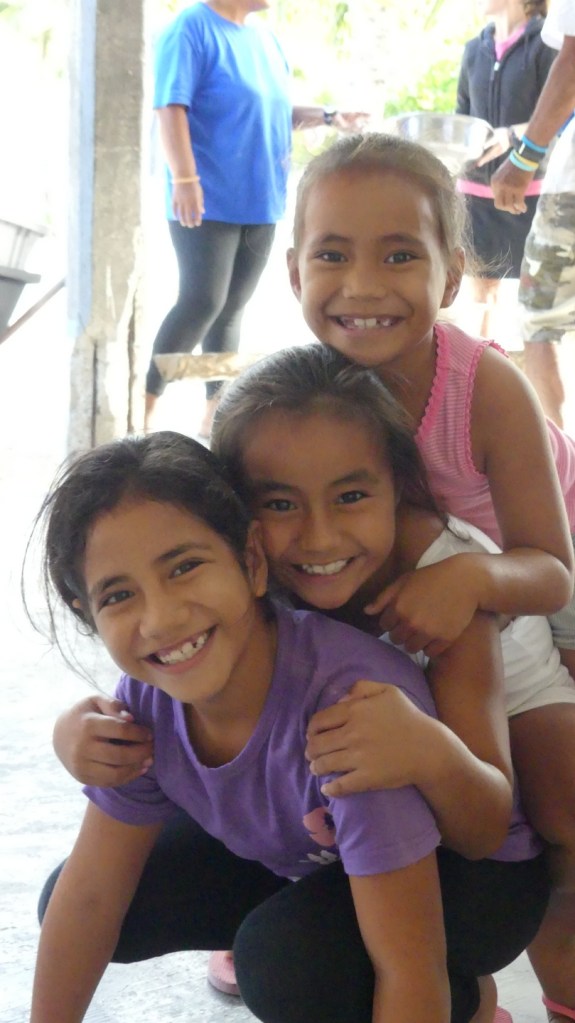
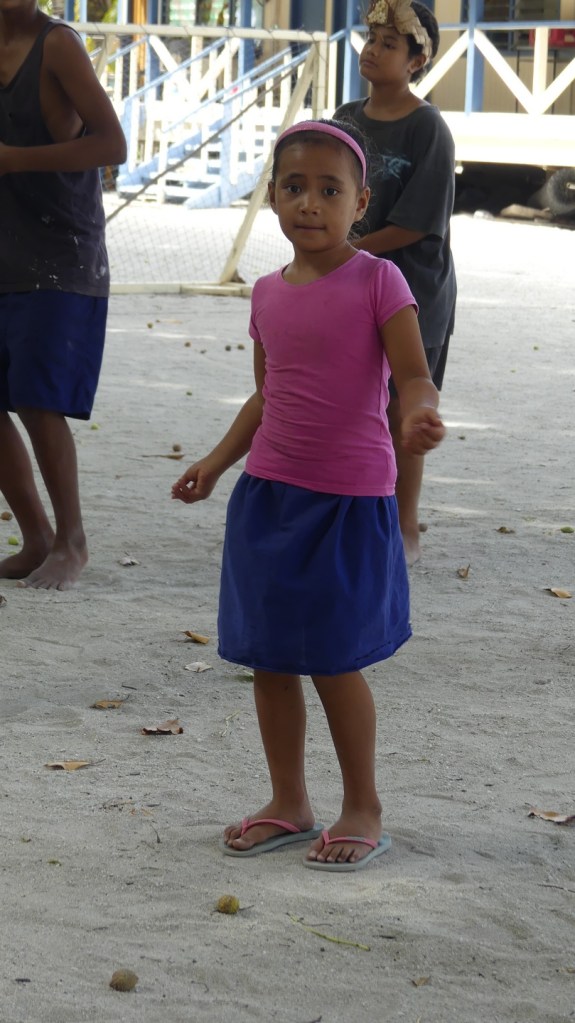
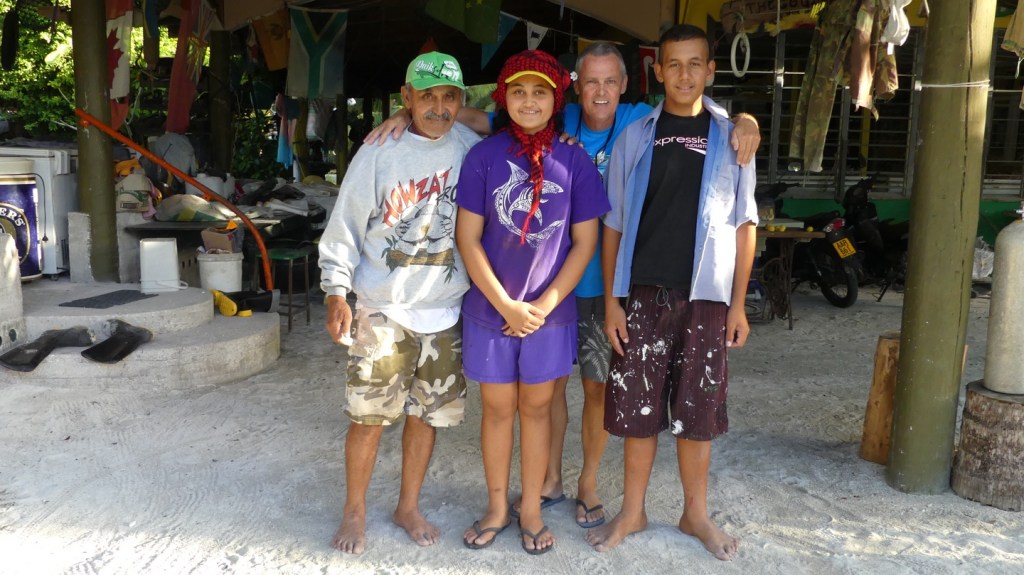
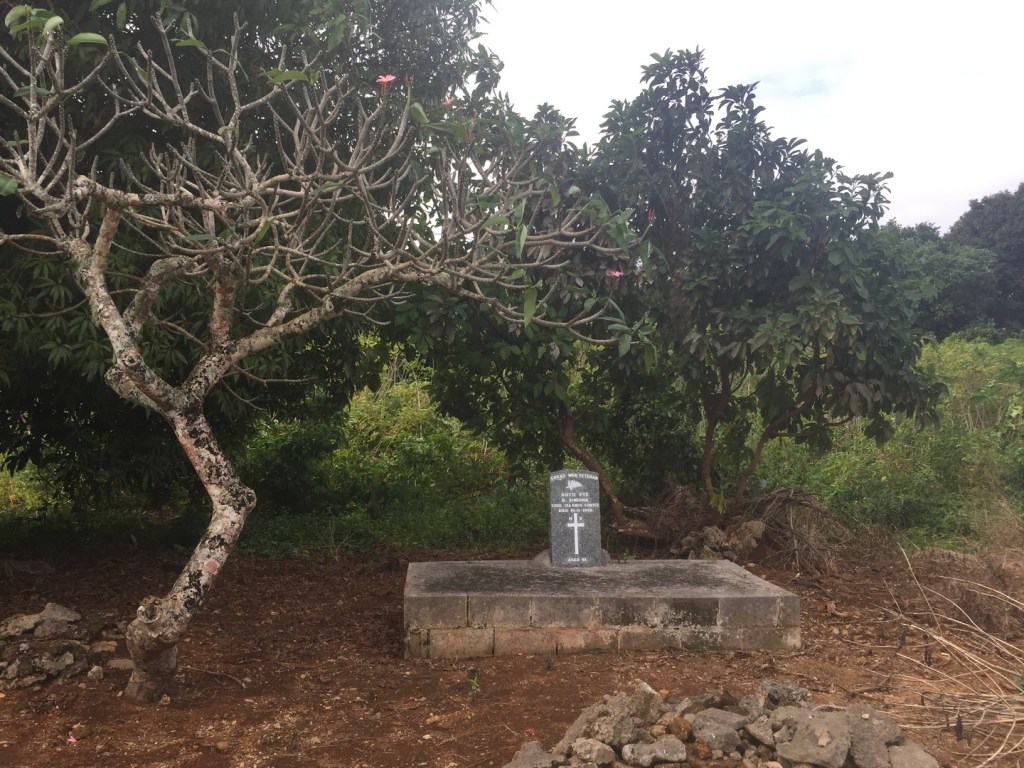
The little but well supplied “infirmary’ of Palmerston.We are so happy we met with the teachers Josh (US) and Melissa (South Africa). Their contract ends in December in Palmerston. I hope they stay in contact and let us know where their next assignment will be.The grave of the founder of Palmerston, William Marsters.Picture of the primary school, from age 6 to 10.Juliana, on her 16th birthday, playing the guitar at dance practice.The happy girls from Palmerston.Dance practice at the school.Bill Marsters (left), next Juliana (16), Stefan and Bill’s son Ngariki (14).A last picture before leaving with Bill and his family. His wife and one daughter were in Aitutaki.
The unconditional generosity and “do good” attitude of the Marsters (In Flemish we say “doe wel en zie niet om”) is so remarkable that this short stop of 4 days will be fondly remembered.
On Tuesday June 13, we decided to leave Bora Bora and make our way to Maupiti as a possible stop on our way to Aitutaki. Only when we got there around 4PM the swell from the south was about 2M and breaking waves across the pass made it, in our opinion, too dangerous to enter. Once entered we also were not sure how easy it would be to leave Maupiti again and we wanted to get to the Cooks. So we continued sailing… The sea became very rollly during the night and with waves of about 3M, winds of 15KTS I was getting sea sick. My body was not used to this anymore. I had not taken anything because I was sure I would be able to do without. I guess not. After being really sick I decided to take one of the pills just before going for my 3HR sleep and sure enough I woke up feeling much better. I continued to take them every 12hours till we got to Aitutaki and felt fine. Hopefully I can get to Palmerston without one.
“waiting” for the wind to pick up in Bora Bora Kai Mai Marina with free wifi…Enjoying the “waiting” in Bora with Happy HourLunch at Bloody Mary in Bora. Another celebrity name they can add to their list!The captain getting diesel, 310L at .78cents (tax free). Still 240EUR though.
We arrived after 4 days of sailing on Saturday morning around 8AM but had to “heave to” twice during our trip so we would not arrive in the dark at the pass. We were not sure if we should enter right away since we knew it was low tide and the water was leaving the lagoon at a rapid pace. The Captain did not want to wait another couple hours so I went upfront ready to drop the anchor in case it was needed and we pushed Sanuk against the current of 5KTS into the lagoon. Our depth meter said “0”, a good thing Stefan did not mention this while going in or I would have flipped! We are now anchored in the little harbour of Arutanga in a depth of 2M and tied to 2 palm trees. We have been here a week and no other yacht has arrived here. This is definitely not an easy pass to navigate through.
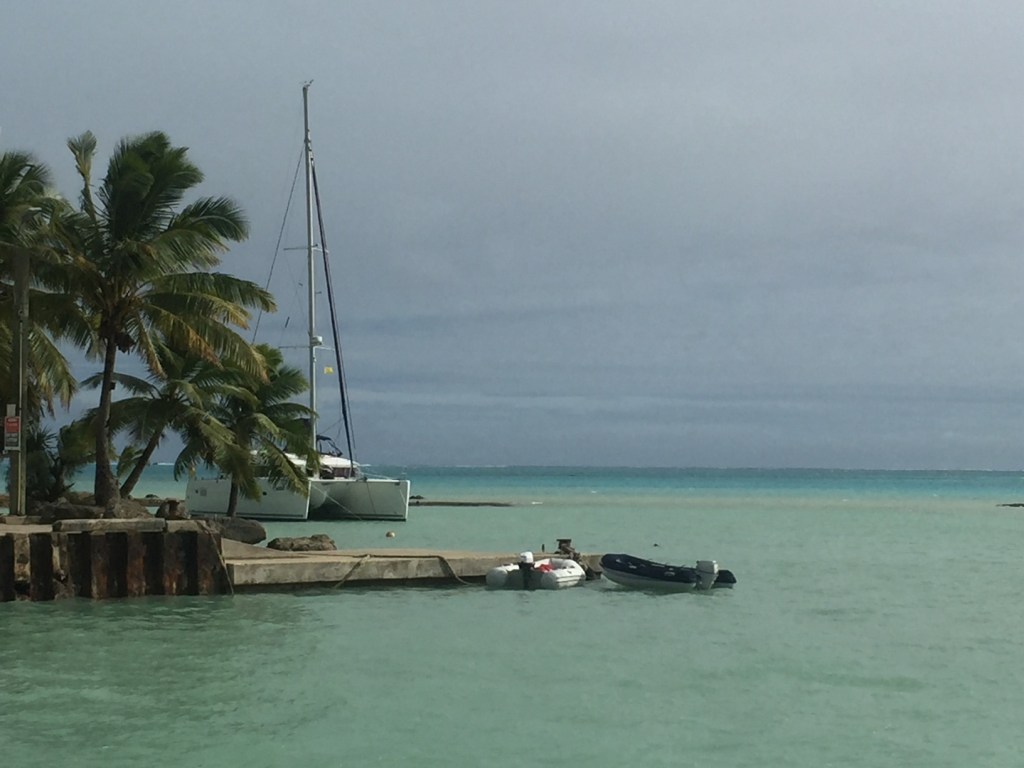
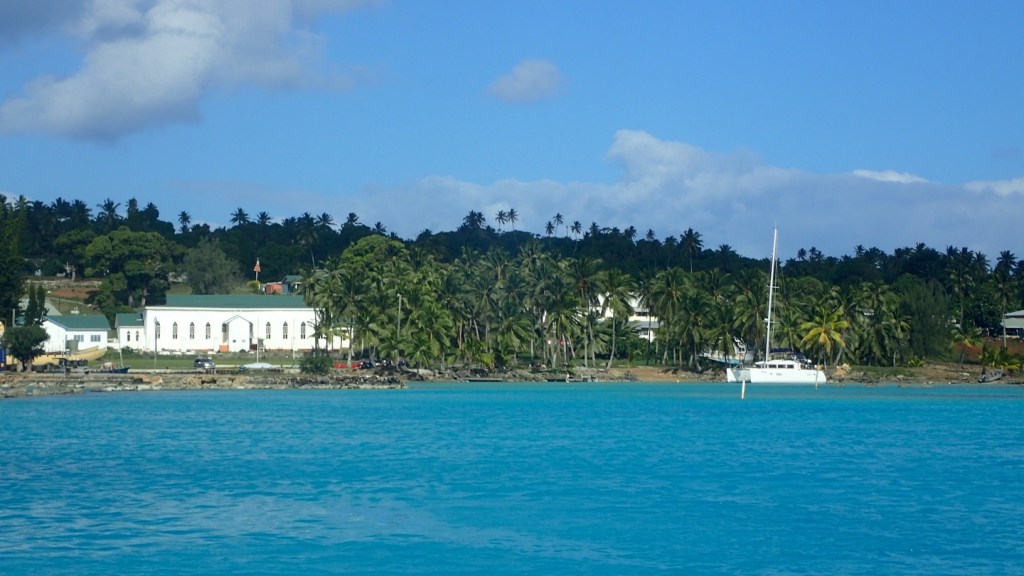
Sanuk anchored in 2M deep water in the little harbour of Arutanga, the main village on Aitutaki. About 2000 people live on the island.
Aitutaki is an “exclusive” tourist spot mainly for Australians and New Zealanders looking for a winter break. In June 2010 the island was nominated “the world’s most beautiful island” by the founder of the Lonely Planet Guides. Unfortunately this week the weather has been grey and rainy till thursday. Not fun when you are only here for the week in an expensive hotel.
Most of the Cook Islands (15) were discovered by Captain Cook, hence the name but the first European to set foot in Aitutaki was Captain Bligh in 1789 with the Bounty, just a couple weeks before the mutiny. The Cook Islanders are polynesian and the main language is Cook Island Maori but they all speak english with a heavy NZ accent. The Cooks islands are independent since 1965 but affiliated with New Zealand for defense, foreign affairs and finances. Cook Islanders are NZ citizens.
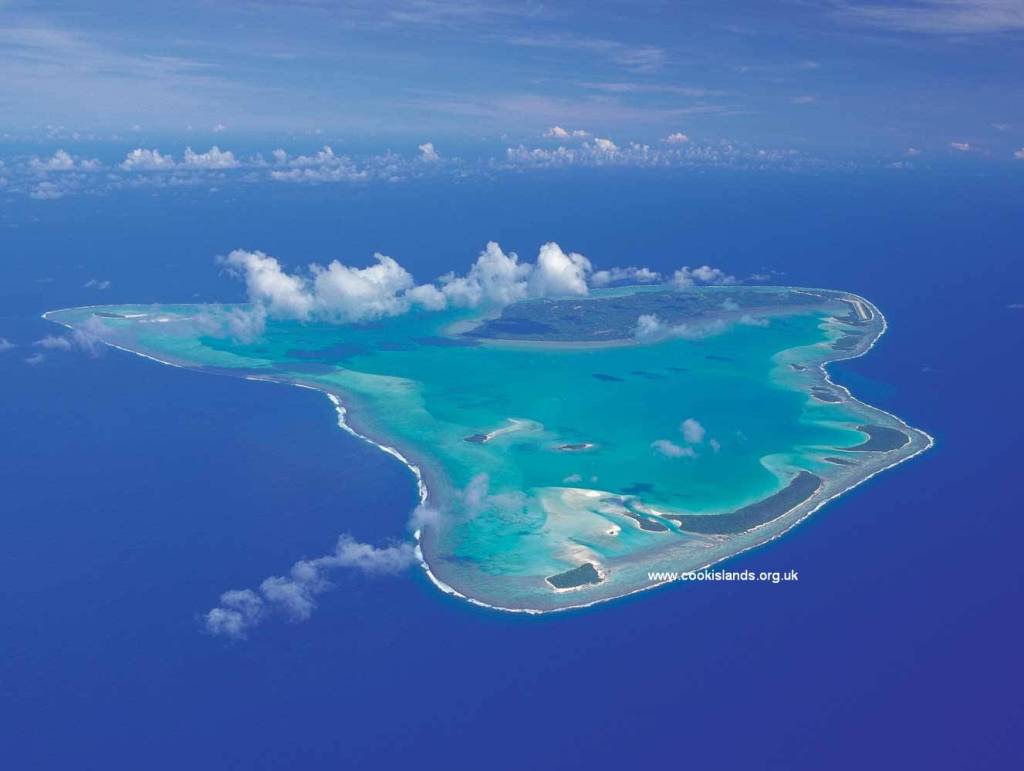
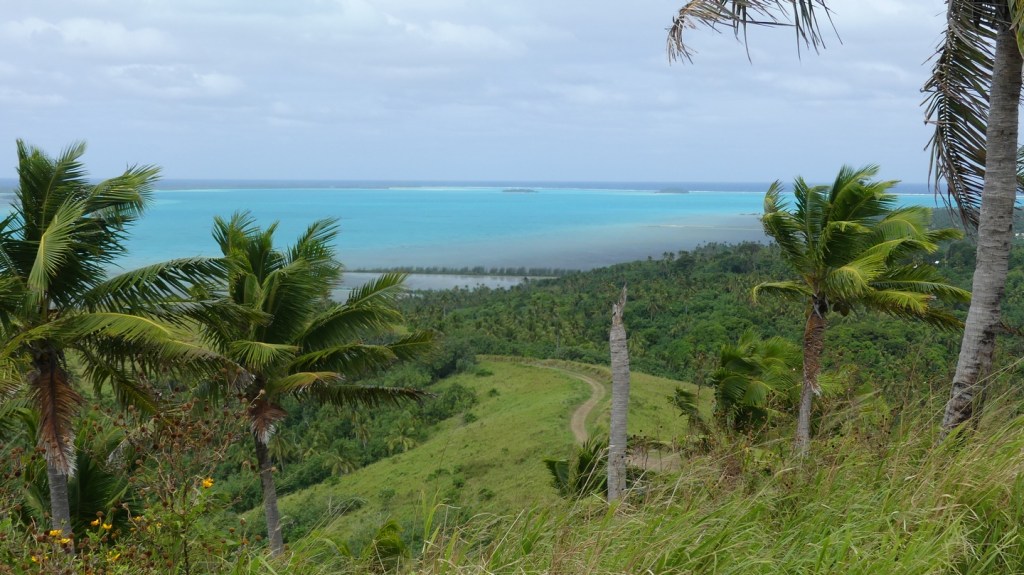
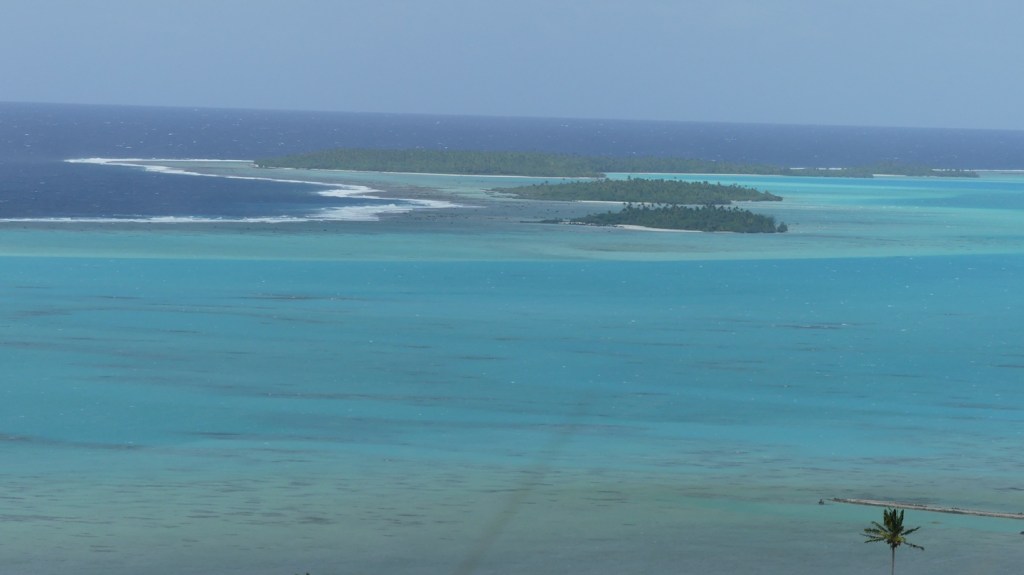
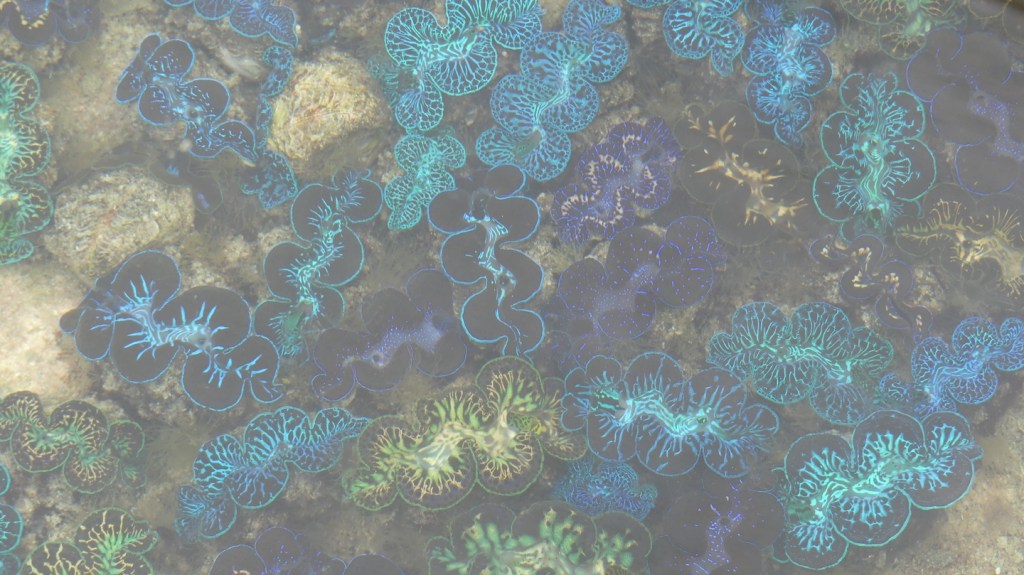
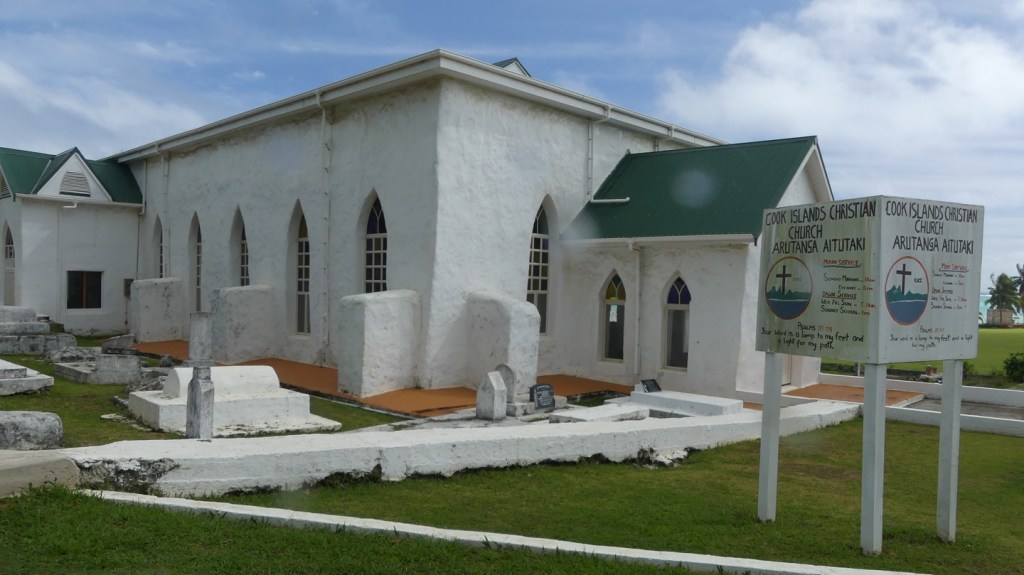
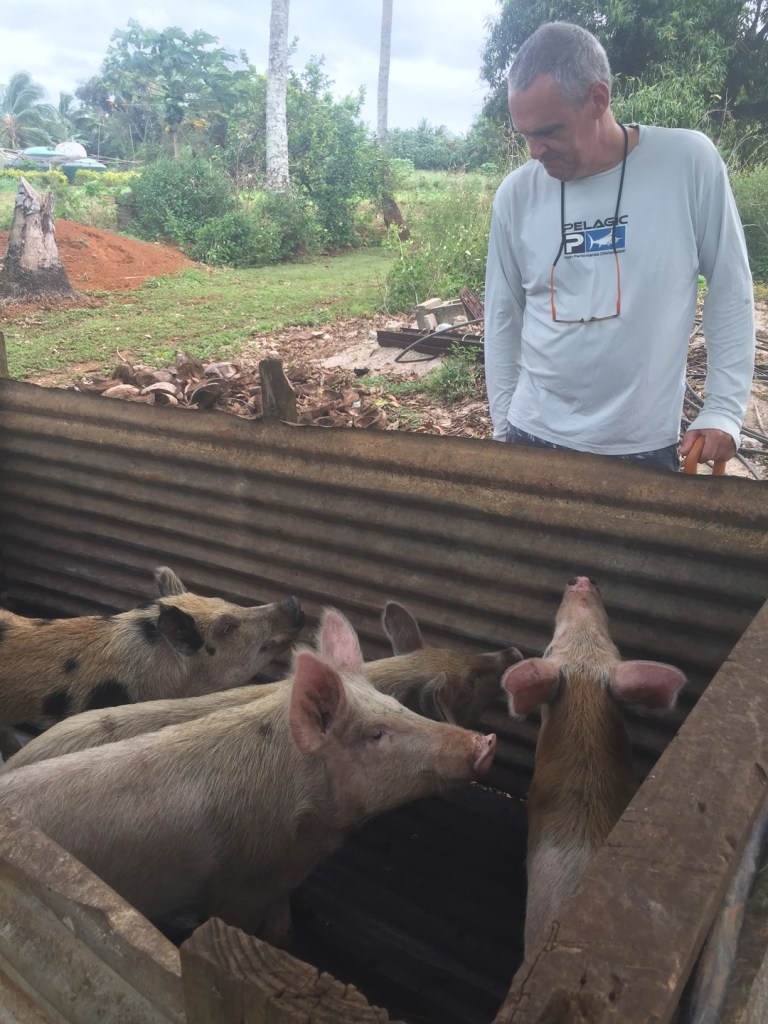
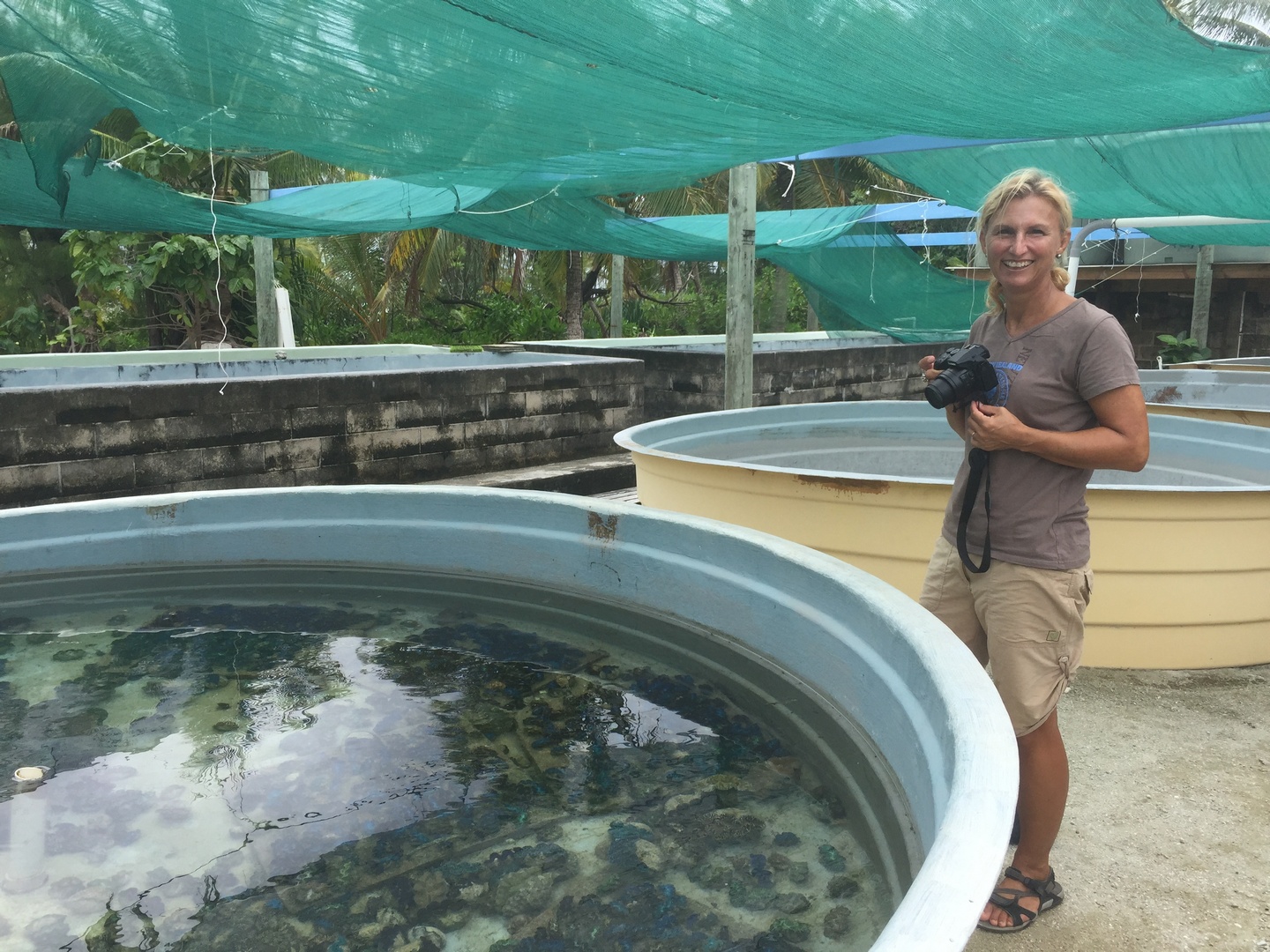
Aerial view of Aitutaki. Picture from internet. We are on the far side in the middleWe hiked to the highest point on the island, 124M, Maunga Pu, to enjoy the beautiful view on the lagoon.There are about 15motus in the lagoon. Kite surfing is very popular on the island.We visited the Aitutaki Marine research centre, they protect the colourful clams from the lagoon.They are eaten by humans, some fish and turtles.The Cook islands Christian church is the oldest one in the Cook Islands and was built in 1828.No dogs allowed on the islands but pigs everywhere.No cemetary on the island but graves along the road and in the gardens.Enjoying a very good evening dinner at Cafe Tipuna with our feet in the sand. We got there by bicycle after being lost for 15min in the complete dark. No streetlights or moon…View from the pass with Sanuk on the right and the first Cook islands Christian Church on the left.
While the weather was not so great we enjoyed walking and bicycling around the island. We even had to wear a sweater during the evenings. Yesterday we took out Fiipper to tour the lagoon but the wind and cold water (only 22 degrees) made us turn around. Tomorrow we have booked a lagoon cruise with a barbecue on “One Foot Island”. It looks like it will be a sunny day.
We have checked out today (Friday) since there are no custom officials working during the WE. We paid 220NZD (about 140USD) departure tax and anchorage fee of 5NZD per day included. In French Polynesia, part of the EU, we did not pay anything…
We vertrokken vanuit Bora Bora na een viertal dagen wachten op goed weer (lees: genoeg wind) om te vertrekken naar de Cooks Eilanden. Ilse had Aitutaki en Palmerston uitgekozen als twee aanlegplaatsen.
We vertrokken rond de middag, in de hoop om tegen de avond – voor zonsondergang – in Maupiti te zijn, waar we konden overnachten. Onze timing was goed, maar helaas maakten de golven het onmogelijk om in de pas van Maupiti binnen te lopen: de golven braken over de hele breedte van de pas. Op zee hadden we niet zoveel last van de golven, ze waren welliswaar 3 meter hoog, maar met een zeer lange golflengte, zodat je ze eigenlijk niet goed gewaar werd. Maar waar ze land ontmoetten wordt pas duidelijk hoeveel energie er in schuilt.
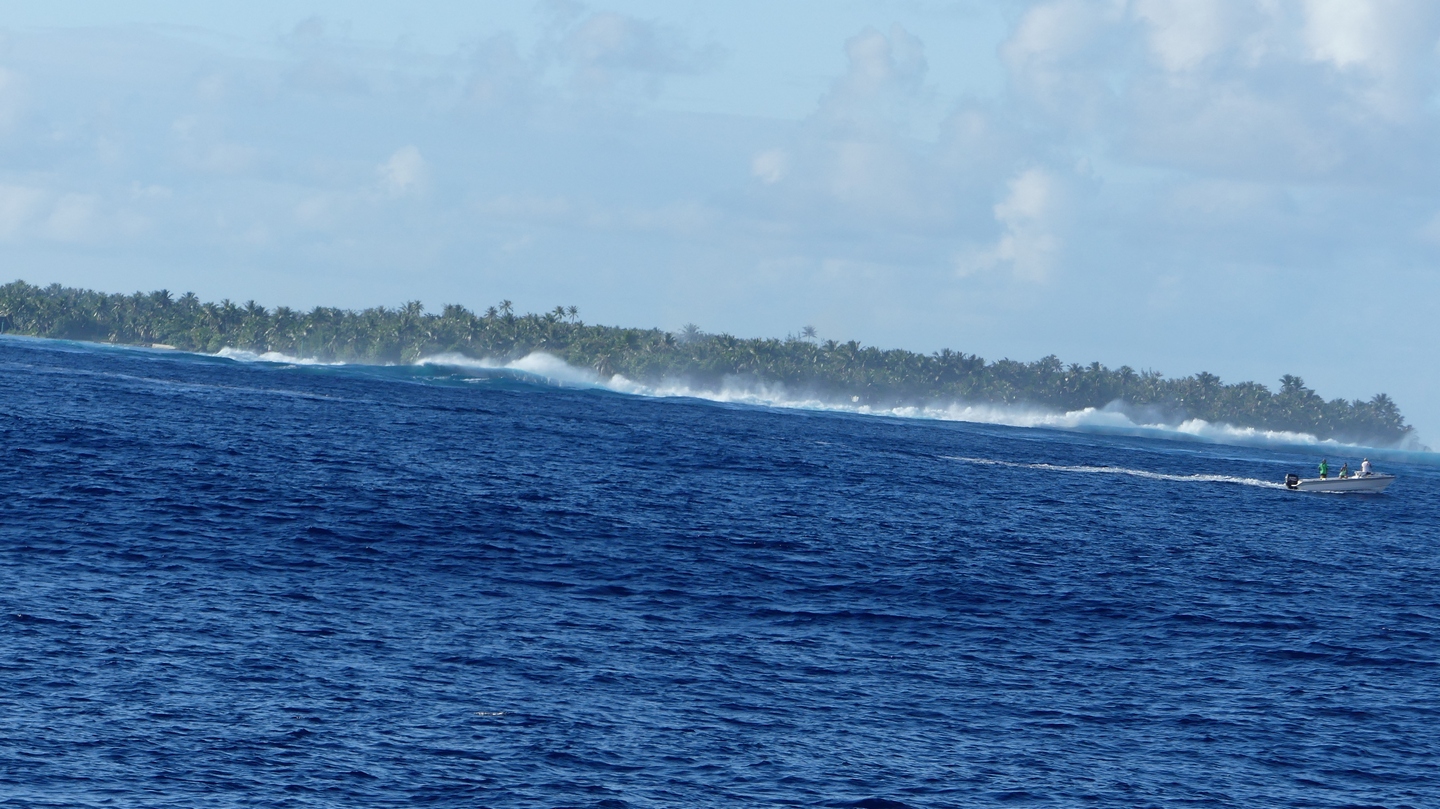
Ingang tot de pas in Moupiti, gezien vanop zee. Normaal is er een plaats waar de golven niet breken
Dan maar doorgevaren, we hadden immers reeds Maupiti bezocht met Katie en Karel in het najaar van 2016. Vooral ons snorkelen met de mantaroggen was toen een hoogtepunt. Ik had gehoopt dit nu te kunnen herhalen, of zelfs te kunnen duiken met de roggen, maar het zat er niet in.
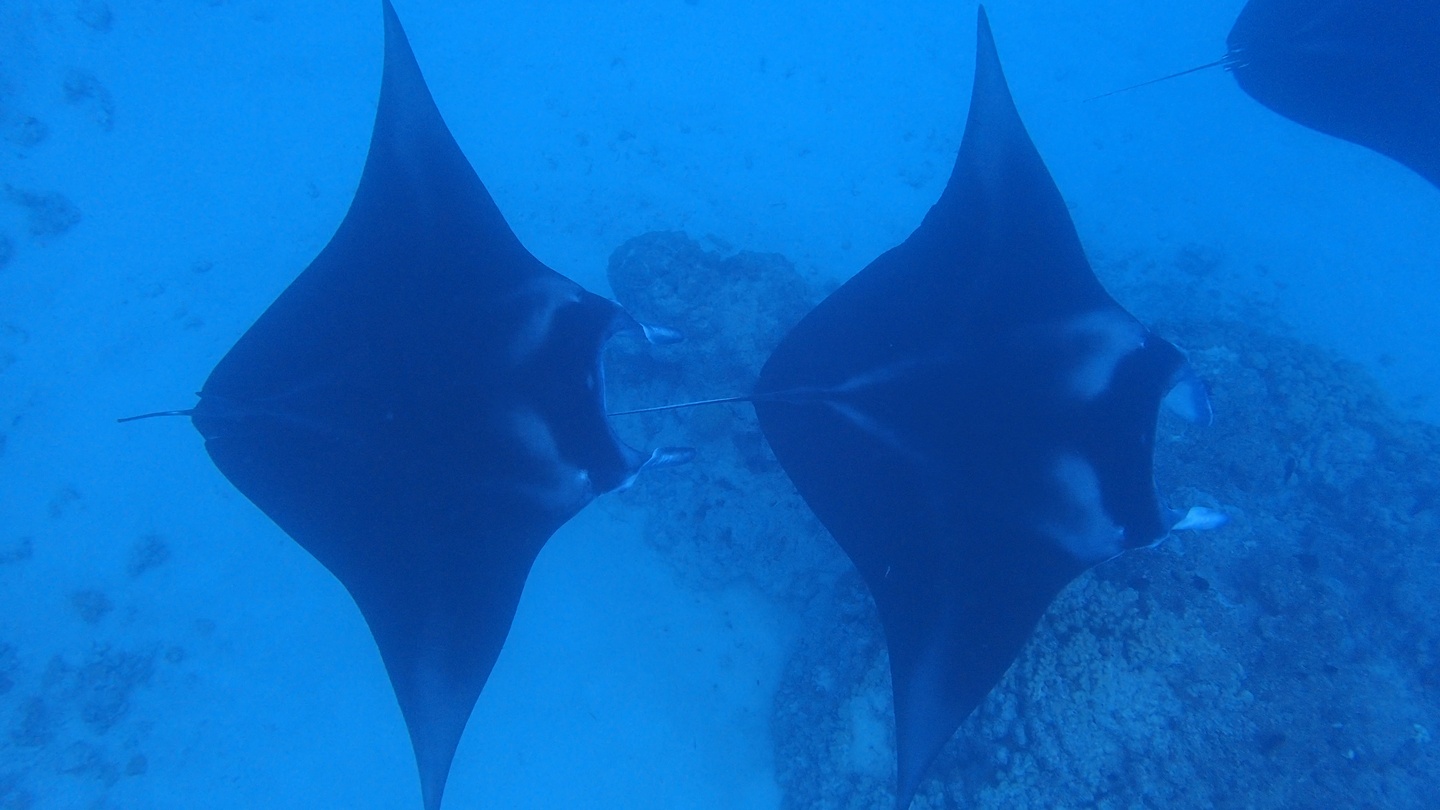
Vorig jaar in Maupiti: 6 reuze roggen die aan het ‘cleaning station’ kwamen aanschuiven om hun kieuwen te laten kuisen door de kleine visjes
We hebben vier dagen erover gedaan om de 600 mijl van Bora Bora naar Aitutaki af te leggen. Het weer was niet echt goed: continue bewolkt, redelijk veel regen maar gelukkig geen onweersvlagen. De combinatie van golven en bootbeweging zorgden ervoor dat zowel Ilse als ik last hadden van zeeziekte. We hebben ons dan ook een aantal uur geparkeerd op zee en samen een dutje gedaan, na eerst het licht van het voordek aangestoken te hebben zodat ons zeil van ver te zien was in de donkere nacht. Na dit en ook na het nemen van een anti zeeziekte pilletje gemaakt door Johan, voelden we ons allebei beter. De rest van de reis verliep voorspoedig en tegen 5 uur kwamen we aan bij Aitutaki.
Zicht vanop de boot naar het rif in de ankerplaats te Maupiti. 2 meter diep water, melkachtig maar vol met vis.
Deze pas is berucht in de stille oceaan: hij is heel smal, ondiep en lang. Enkel schepen met een diepgang tot maximum 2 meter (bij hoogtij) kunnen binnenvaren. Het getijverschil is hier tussen de 30 en 60 cm, naargelang de app die je raadpleegt. Sanuk ligt 1m20 diep, dus dat moest lukken. Het was echter laagij, het moment waarop de hele lagoon leegloopt langs de pas, en dus voor flink wat stroming zorgt. We hebben eens dicht voorbij de ingang van de pas gevaren om er zeker van te zijn dat er geen brekende golven waren, en zagen dat het er relatief rustig uitzag. Rond 8:00 zijn we dan binnen gevaren. Er stond ongeveer 5 knopen tegenstroom, dus we konden ons niet permiteren dat in de smalle pas (17 meter voor een boot van 7 meter breed) een van de twee motoren zou uitvallen wegens oververhitting. Ilse stond op de boeg om de donkerste en dus diepste plaatsen aan te duiden, haar hand op de bediening van de ankerlier om bij een kalamiteit snel het anker te laten vallen. Dat bleek echter niet nodig want we geraakten zonder kleerscheuren tot in de zwaaikom naast de haven. We smeten ons anker in 2 m diep water en spanden een touw van onze achtersteven naar een kokospalm, zodat we niet zouden ronddraaien want daarvoor was er geen plaats. Er hebben blijkbaar al ooit eens 3 boten tegelijk gelegen, maar ik vond het al best krap met alleen Sanuk.
Niet dat we ons hebben moeten zorgen maken: de 10 dagen dat we in Aitutaki waren zijn er geen nieuwe boten toegekomen. Buiten de pas, op zee lag het franse jacht Inspiration met Guillaume aan boord (zij hebben 2 m diepgang en moeten dus op zee blijven), en in de laguna naast de haven lag Cactus Island van een Australisch koppel (diepgang 45cm!) maar daar hebben we niet echt contact mee gehad.
Aitutaki dat is:
– 2000 polynesiers op een groen eiland van ongeveer 20km^2. Hoogste punt is 124 meter.
– geen enkele hond (bij wet), wat katten, varkens en geiten, en ontelbare kippen
– 10 kerken, maar geen kerkhof. De graven staan bij de mensen in de tuin of langs de kant van de weg.
– honderden fundamenten van wat eens een huis was, maar weggeblazen door de orkaan van 2010
– links rijden want hoewel onafhankelijk toch gealigneerd met Nieuw-Zeeland sinds 1965.
– wat BoraBora is voor de Europeanen, is Aitutaki voor de Nieuw-Zeelanders en Australiers: exotische resorts, prachtige natuur en heel exclusief $$$$
We kwamen de zaterdag toe, maar konden pas de maandag inchecken. In theorie moet je de hele tijd op de boot blijven en wachten tot ze tot bij ons komen, maar omdat we wisten dat het er hier nogal relax aan toeging hebben we de zondag toch een klein wandelingetje gemaakt. De maandag kwam de hygiene agent aan boord, we vulden wat papieren in, hij spoot verdelger in elke cabine en na het betalen van 16 euro konden we de gele vlag laten vieren en de Cooks eilanden vlag hijsen. Daarna bezochten we immigratie en douane. Pas bij het vertekken zal het hier duur worden: zo een 133 EUR als vertrekpremie (2 personen, 10 dagen).
Ondertussen zijn we donderdag en hebben we het hele eiland reeds afgestapt of gefietst. Het is een heel mooi eiland: nog heel veel ongerept groen, verzorgde wegen en de bewoonde delen hebben allemaal keurig onderhouden grasperken. De huizen zelf mogen er nogal rommelig uitzien, of enkel een restand van wat ooit een huis was, het gras is pico bello afgereden. Toch geeft het geheel een verzorgde indruk.
Leuke wandelpaden op het eilandBezoek aan een clam kwekerij: deze zeer kleurige beestjes worden sneller door de bevolking opgegeten dan dat ze kunnen gekweekt worden
Enkele dingen die ik opmerkte:
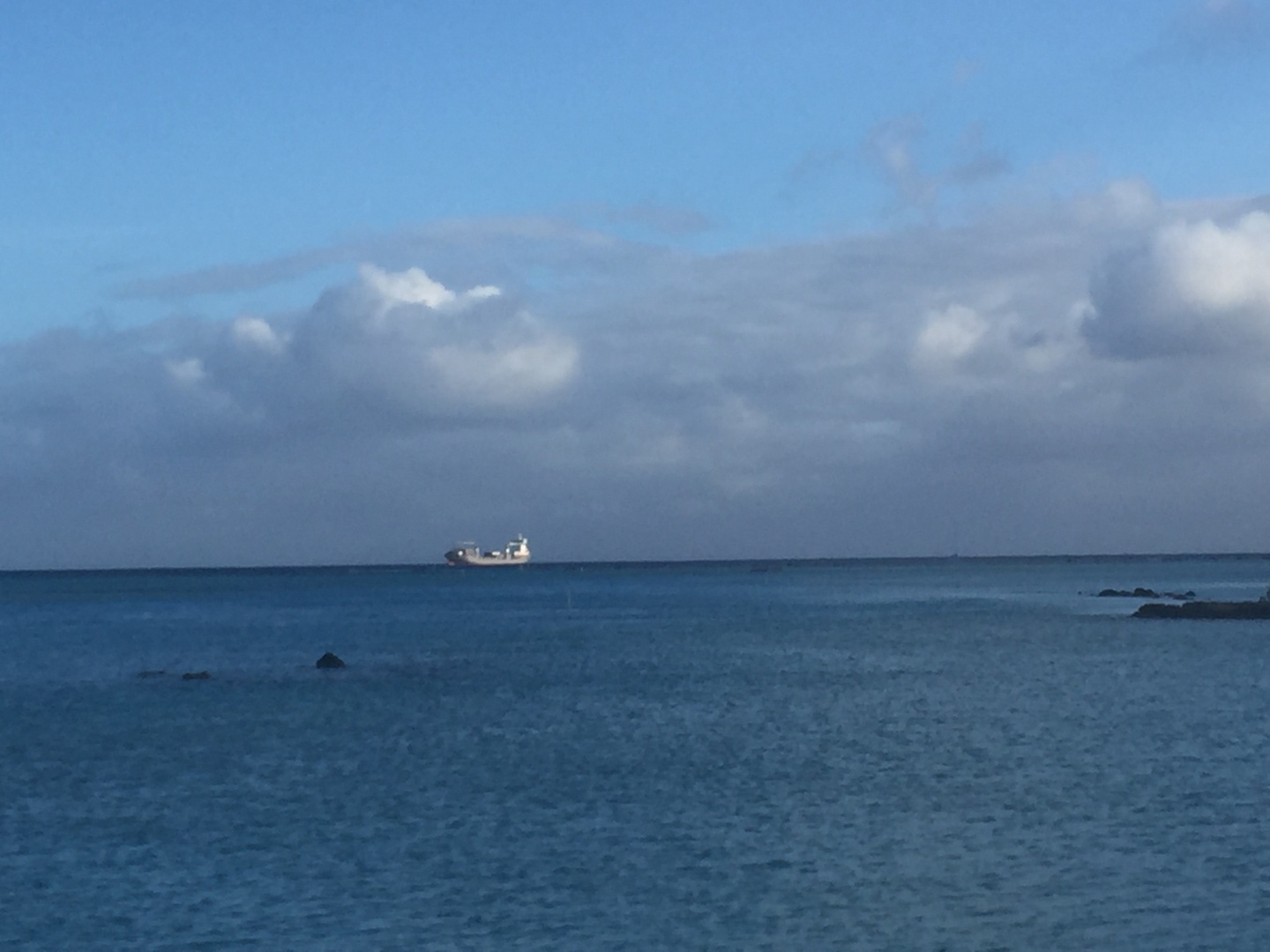
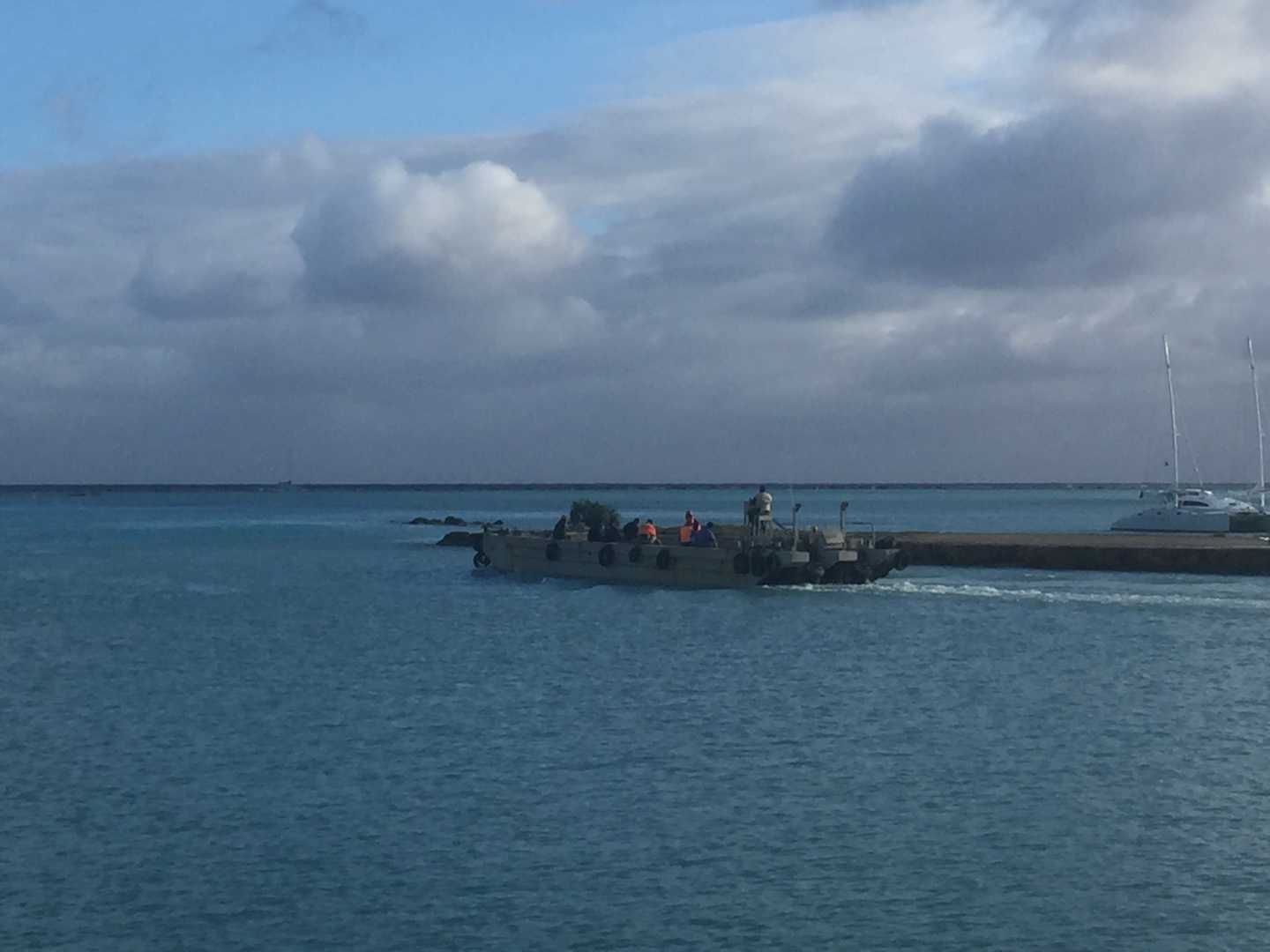
De maandag kwam er een vrachtschip aan met containers. Omdat het echter niet in de pas kan, en ook niet kan ankeren want te diep, blijft het dag en nacht traag rondvaren voor de pas. Ondertussen is er een platbodem schuit die heen en weer pendelt tussen de haven en de vrachtboot. Ze hebben er twee dagen over gedaan om zo een stuk of 40 containers te lossen…
Het vrachtschip ligt buiten de pas rondjes te draaien. Te diep om te ankeren
Het kost blijkbaar meer om een lege container terug mee te geven dan hem te houden: elk huis heeft minstens 1 container in de tuin staan, en er zijn huizen die gemaakt zijn van lege containers…
De platbodem navette van en naar het schip, 2 containers per keer
Het aanbod in de winkels is beperkt, en duur. Van europese goederen is geen sprake meer, en we herkennen de merken van Nieuw-Zeeland terug. De geldbriefjes zijn de NZ dollar, maar het kleingeld is eigen aan de Cooks Eilanden. Ze hebben hier een driehoekige munt van 2 NZD, maar er is dan ook geen enkele automaat op het eiland)
De mensen zijn heel vriendelijk, maar toch ook wat afstandelijk. Ik schat dat er zo een 1000 tal toeristen rondlopen op het eiland, blijkbaar zitten alle hotels hier goed vol.
Het is koud naar onze normen: het kwik daalt naar 23 a 28 graden, en het water is maar 22 graden niet meer! Soms lopen we rond op de boot met een lange broek aan, dat is al lang geleden. Ik heb al heimwee naar de 30 (lucht) en 26 graden (zee) van FP!
Het wordt nu een uur later donker (19:00) en klaar (7:00). We zitten nog in dezelfde uurzone, maar zijn alweer 10 graden opgeschoven naar het westen. We zitten nu op 19 graden zuid, 160 graden west.
Vanwege het wat tegenvallende weer, namelijk bewolkt en regenachtig, hebben we al wat tv-reeksen gekeken. Het vierde seizoen van ‘The Americans’ ging erdoor, en nu zien we begonnen aan The expanse. Gelukkig is het weer vandaag gekeerd. Het was zonnig en we hebben een tochtje gemaakt met Flipper op de lagoon, maar de zichtbaarheid in het water is heel slecht in de lagoon, zo een meter maar. Waarschijnlijk door de slijkerige bodem. Buiten aan de pas is het blijkbaar 100 meter, maar we gaan wachten tot in Niue om te gaan duiken.
En dat doet me meteen terugdenken aan ons vertek uit Raiatea naar BoraBora in FP: na 3 dagen gedraaid te hebben rond ons anker, had ik de avond voor ons vertrek al het vermoeden dat onze ketting wel heel kort geworden was. Waarschijnlijk rond een koraalhoofd gedraaid en dus ingekort. Inderdaad, de volgende morgen kreeg Ilse de ketting geen drie meter omhoog: muurvast. Het donkere water gaf ons geen kans om iets te weten te komen. Ik probeerde langs links te varen, langs rechts te varen, maar geen verschil, het losse eind ketting werd niet langer. Het moment om ons duikcertficaat en de duikuitrusting aan boord te laten renderen. Gelukkig had ik de duikfles in Tahiti nog laten vullen. Met enige terughoudendheid paste ik de niet gebruikte maar van excellente kwaliteit duikuitrusting aan: neopreen broekpak, veel te grote vest met BCD, duikbril, zwemvliezen, 3 kg lood. Na 10 keer controleren van de fles, het mondstuk en de vest liet ik me in het water vallen. Al drijvend tot vooraan bij de ketting, en dan langzaam langs de ketting naar beneden. Bij een diepte indicatie van 12 meter zag ik plots de bodem, en het probleem: er stond zo een blok koraal van 2 meter hoog en 1 meter diameter los op de bodem, met onze ketting eronder. Ik had genoeg gezien. Langzaam terug naar boven, tot aan het oppervlak en tot aan Ilse die gespannen stond te wachten. Een half uur later terug aan het roer en deze keer met een simpel plan: hard achteruit. Het bleek een goede strategie want de ketting kwam van onder de blok en onze problemen waren opgelost. Tien minuten later waren we op weg naar Bora Bora. Toch leuk als je een boot koopt met alles erop en eraan.
Twee biefstukes van 150 gram, mevrouw? Komt eraan. Mag het wat meer zijn?
We zijn gisterenavond hiet in Aitutaki naar een dans voorstelling geweest, iets wat we ook op Tahiti hebben gedaan met Emma en Seba, en in Moorea met Katie en Karel. Een hotel geeft een buffet met lokale gerechten en daarna wordt er door de lokale dansgroep een voorstelling gegeven. Het was een groot half uurtje wandelen en het was reeds pikkedonker toen we daar om 19:00 uur toekwamen. Langs de asfaltweg hebben we nog een graf gezien waarop kerstlichtjes een altijd veranderende lichtschow gaven (maar geen muziek). De prijs viel reuze mee: 40 EUR per persoon, wat een fraktie was van de FP prijzen. Maar het buffet was dan ook niet zo imposant: het varkentje werd niet uit een kookput in de grond opgegraven, maar in een kookpot opgediend. Het was er niet minder lekker om. Ik onthou de lokale versie van zurkel (taro), de rauwe vis (poisson cru), het krokante varkensvel, de kokosijscreme en de bananencake. En de Nieuw-zeelandse cider, dat was ook alweer eventjes geleden. Na het eten begon het optreden, met voor mij het immer impressionante tamtam geroffel en opzwepende gezang. Op een zengend ritme oscilleerden de heupen van de meisjes (het bovenlichaan doodstil), stampten de benen van de jongens in het rond, en waren de gezangen niet uit de lucht. We kregen ook een vuurballet te zien: onstellend snel vlogen de vuurballen door de lucht, kundig net het lichaam missend. Zoiets moet kapitein Bligh (die van de Bounty) ook voorgeschoteld gekregen hebben toen hij het eiland in 1782 ontdekte. En ik denk dat menige matroos hetzelfde als ik zal gedacht hebben: hoe kom ik heelhuids voorbij die krijgers tot bij die meisjes…
Enfin, het is ondertussen terug ochtend, de passie heeft plaatsgemaakt voor ons dagelijks ochtendtafereel: aan de kant, 10 meter van onze ontbijttafel, zijn gewoontegetrouw de witte en de zwarte reiger op zoek naar een hapje om de eerste honger te stillen.
June 6th, Raiatea in French Polynesia. We are at anchor just before the little town of Uturoa and are taking advantage of the reasonable internet to order parts for the boat and to update the blog.
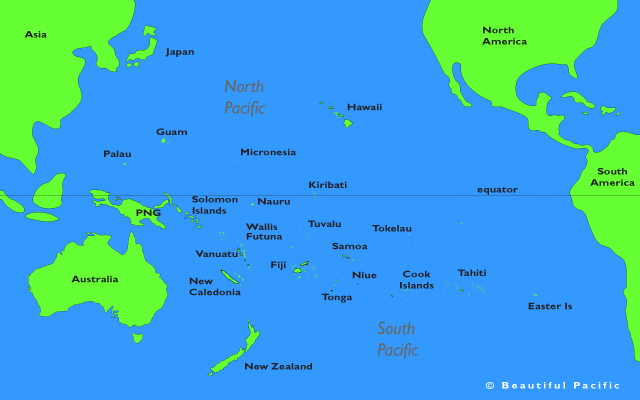
If all goes well we will sail from Bora Bora to the Cook islands, then Niue,Tonga, Fiji, New Caledonia to arrive in Australia early november.
We will sail tomorrow to Bora Bora to check-out of French Polynesia and to wait for a good weather window, looks like the 11th will be a good day to leave.
We arrived in French Polynesia a year ago on june 8th, after a 22 day crossing from the Galapagos. We enjoyed the culture, the people and the way of life in French Polynesia. Their smiles, although life is not always easy here, the flowers in their hair, the music everywhere, we will surely miss it. But we feel it is time to go and discover other beautiful countries and islands. Mauruuru French Polynesia, I feel so fortunate to have been here with Sanuk.
Partir, c’est mourir un peu,
C’est mourir à ce qu’on aime :
On laisse un peu de soi-même
En toute heure et dans tout lieu. (Edmond Haraucourt)
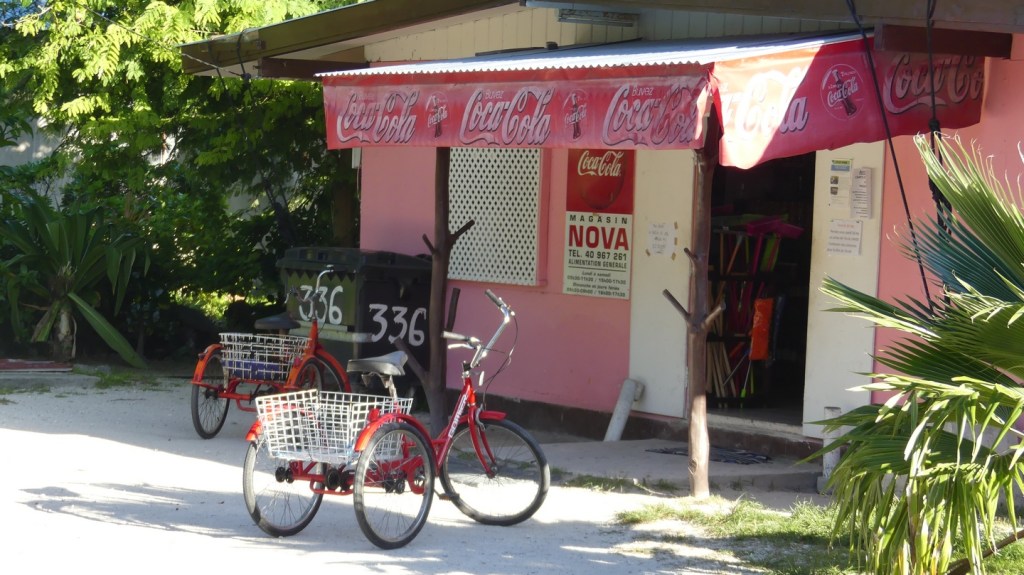
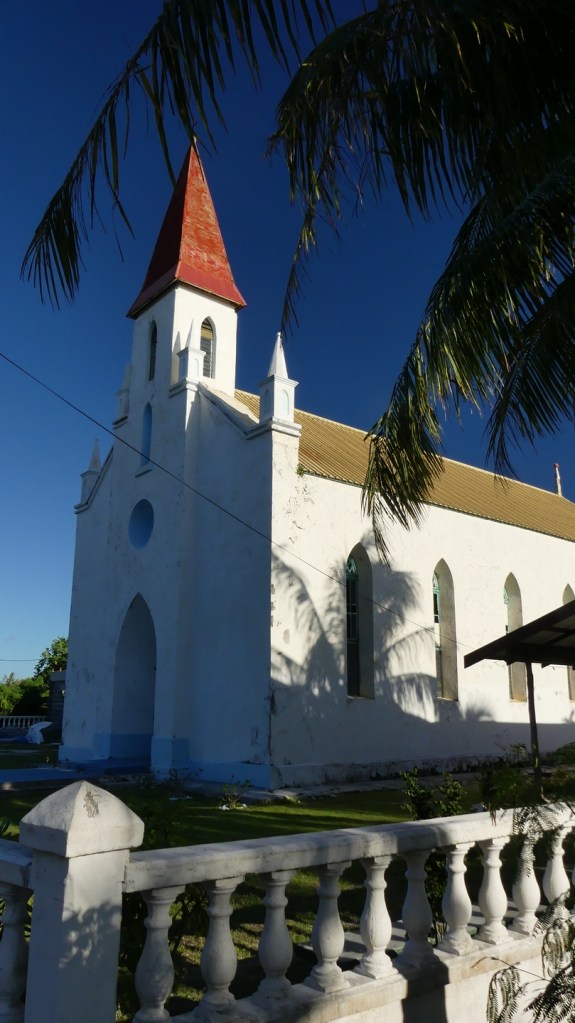
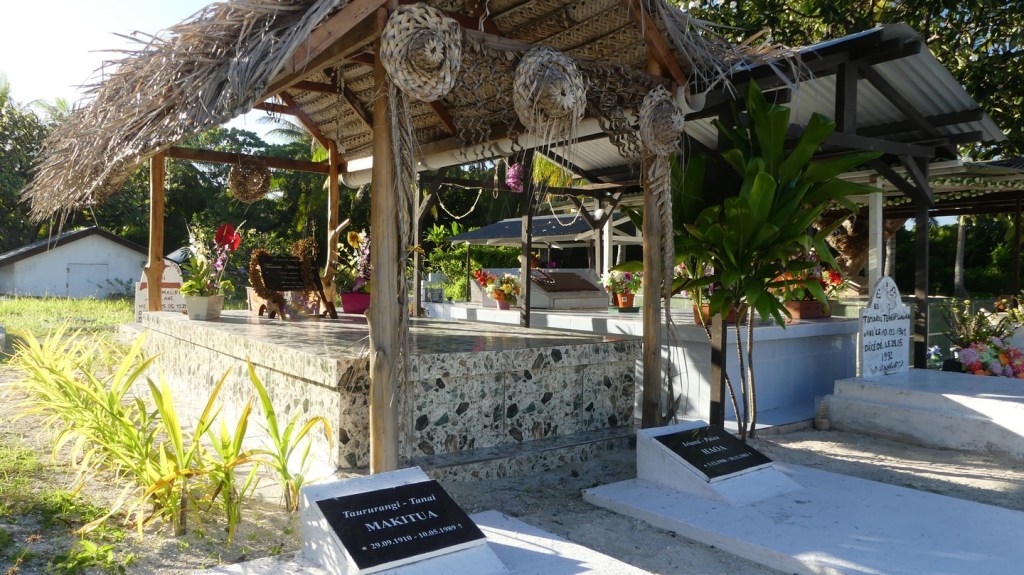
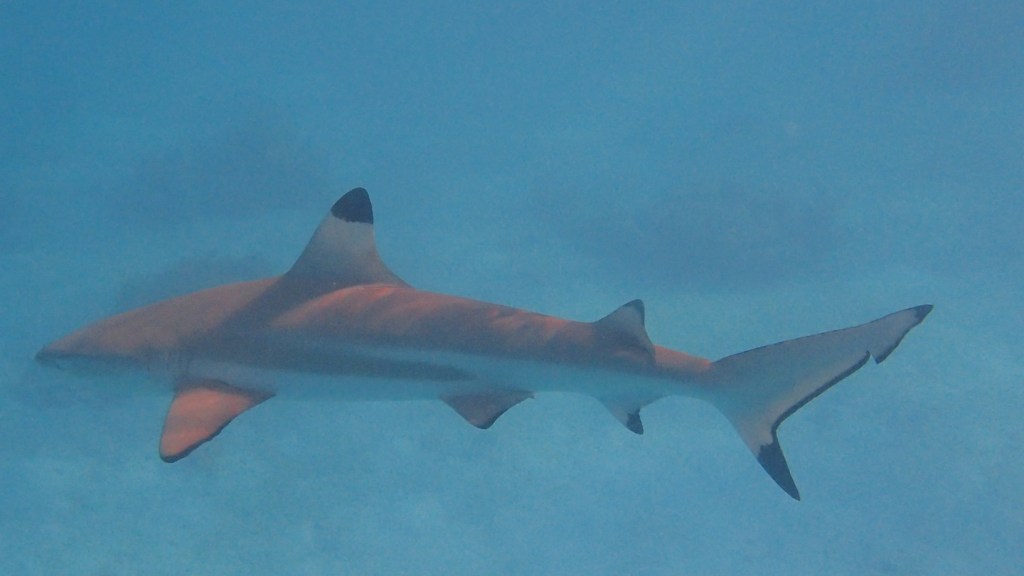
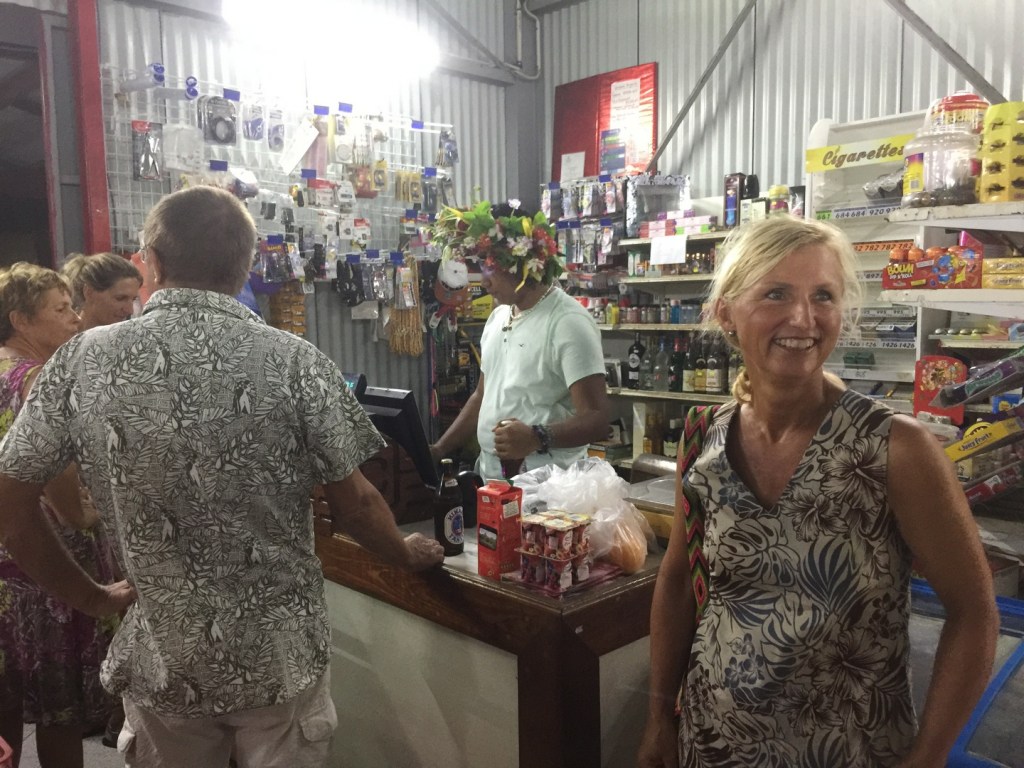
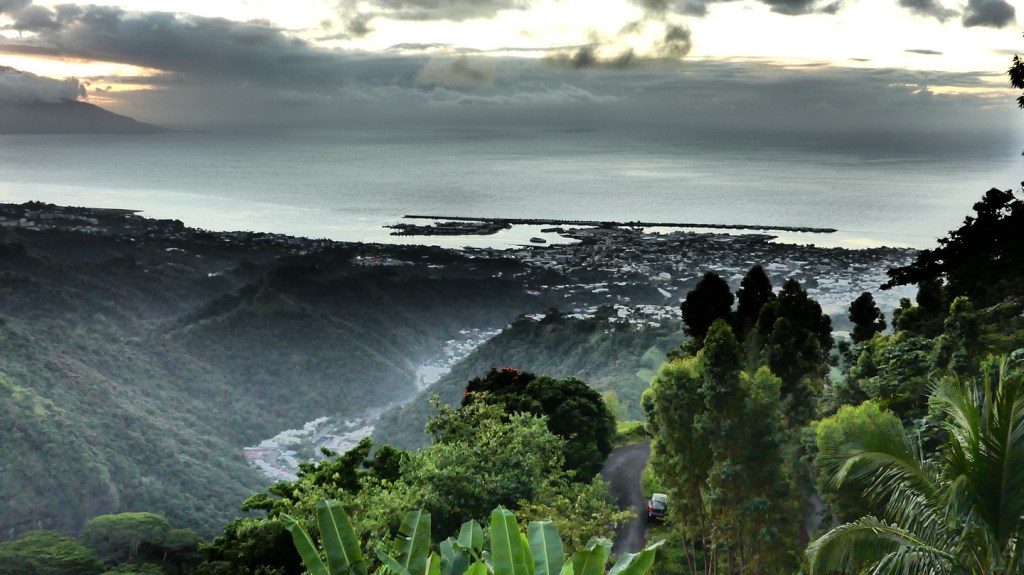
Before going to Tahiti we made a stop at Rangiroa, the biggest atoll of the Tuamotus. Supermarket in Rangiroa with the tricycles. They are frequently used on all the atolls in the Tuamotus.So happy we finally got our diving permit. We should have done it much sooner but now we will be able to dive in all the wonderful islands to come.Church in Tiputa village on Rangiroa.The cemetary in Tiputa with lots of flowers and frangipani trees. The Frangipani tree is said to be immortal, because flowers and leaves still grow even after being uprooted. That is why it is planted on all the cemeteries in French Polynesia.The blue lagoon in Rangiroa. We stayed at anchor for one night but it was very rolly.When we wanted to go snorkeling at the Blue Lagoon we were greeted by at least tens of black tip sharks. I did jump in the water but did not feel very comfortable with all those sharks around waiting to be fed.The interior of the supermarket in Rangiroa. At the cash register a man with a crown of flowers. Mahu (men-women) are part of life in French Polynesia where, at one time, families with all boys would raise the 2nd boy as a girl.Papeete Harbour seen from the Belvedere restaurant just after a rainy sunset.
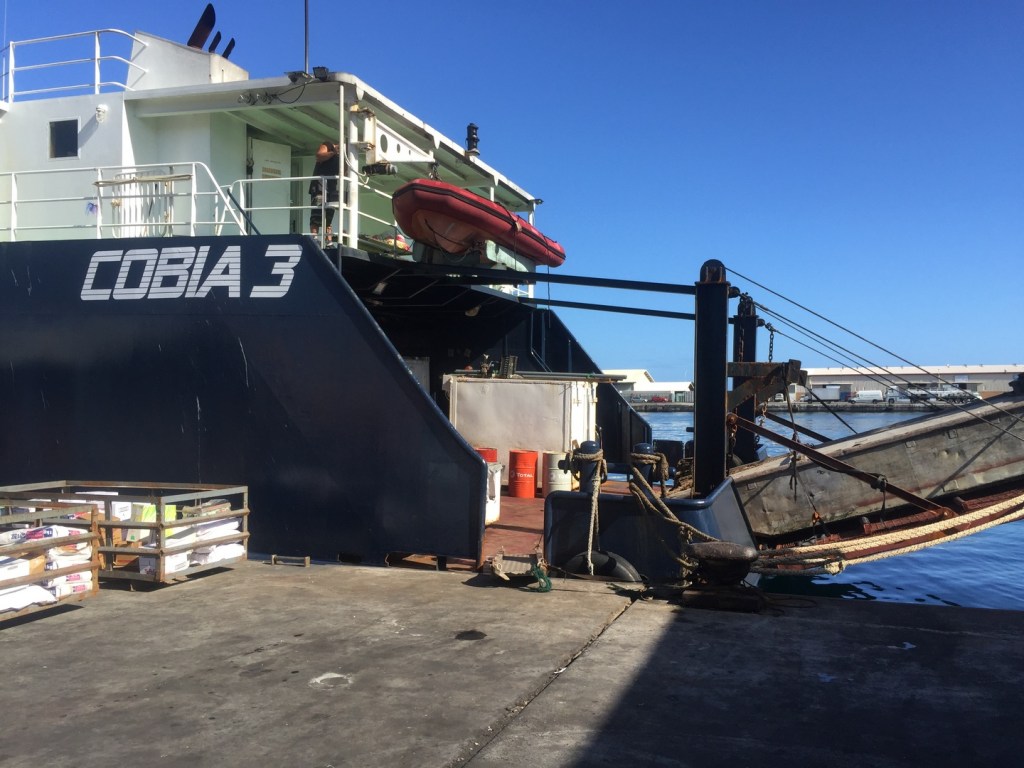
Wednesday May 3th in Apataki. It has been almost 2 weeks since we arrived with the Cobia 3 in Apataki and slowly but surely we are getting Sanuk ready for the water.
We left Auckland on Monday morning April 17th to arrive in Papeete on Sunday afternoon the 16th since we crossed the international dateline (IDL). The IDL is an imaginary line from the North Pole to the South Pole and demarcates the change of one calendar day to the next. NZ is West of the IDL while French Polynesia is East of the IDL. It was like going back in time and so we got to experience Easter sunday twice! When we will sail to Fiji we will again cross the IDL but then we will loose one day.
Stefan had arranged a pick-up at the airport from the hotel and indeed we saw our name on one of the many cardboards at the exit of the airport. What a nice feeling it was, back in 28degrees celsius, humid but I did not mind and lots of friendly faces with flowers in their hair. They were surprised when they saw our amount of luggage! No, we are not a normal tourist in Polynesia! We had 5 bags of each 23KG and 2 smaller bags of each 12KG…but the van was big and we got everything loaded. Papeete was like a ghost town since it was Easter but at least the “Roulottes” (foodtrucks) were open and we were happy to have dinner there. We decided on “Galettes et Crepes Bretonnes” :-)! The wait was soooo long (almost 3hours when we had eaten) but we enjoyed being in the atmosphere, watching the tourists and Tahitians enjoying their Easter with family.
The next day we decided to rent a car to get all the shopping done (only boat stuff and food 🙂 ) to take with us on the Cobia 3. Unfortunately all the stores were closed except for Supermarket Hamuta, they were open till noon, we got there at 11.30AM but they let us shop till 12:30 and they delivered everything to the Cobia 3 the next day . Luckily we also found the Carrefour open and got another 3 boxes filled with food… For dinner we met with our friends from Jambote, Simon-Pierre and Marine, who had just arrived in Marina Taina. It was so good to see them back and tell our stories ! Life is wonderful!
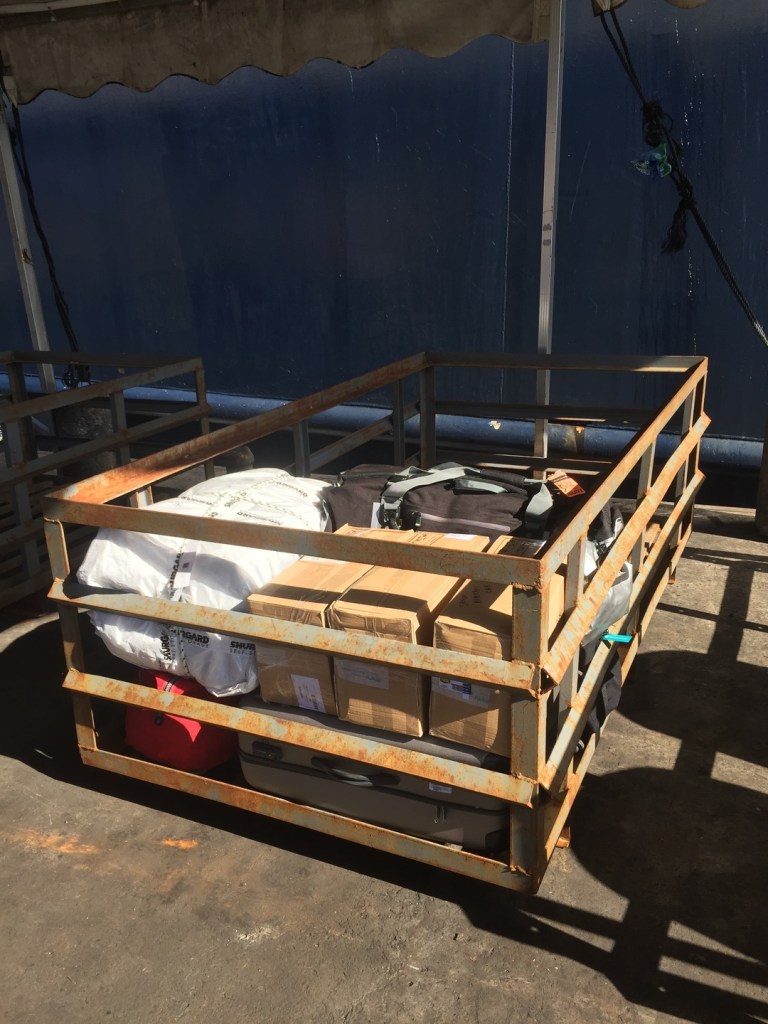
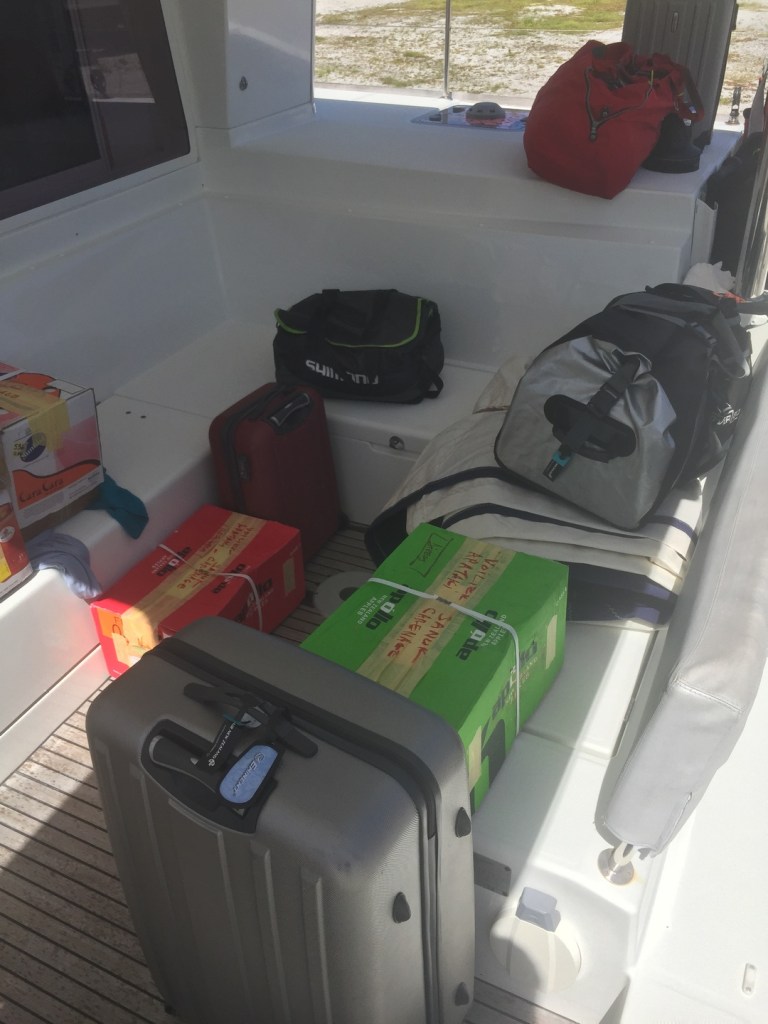
Important cargo for Apataki. All our luggage and boxes went into this crate for Apataki.
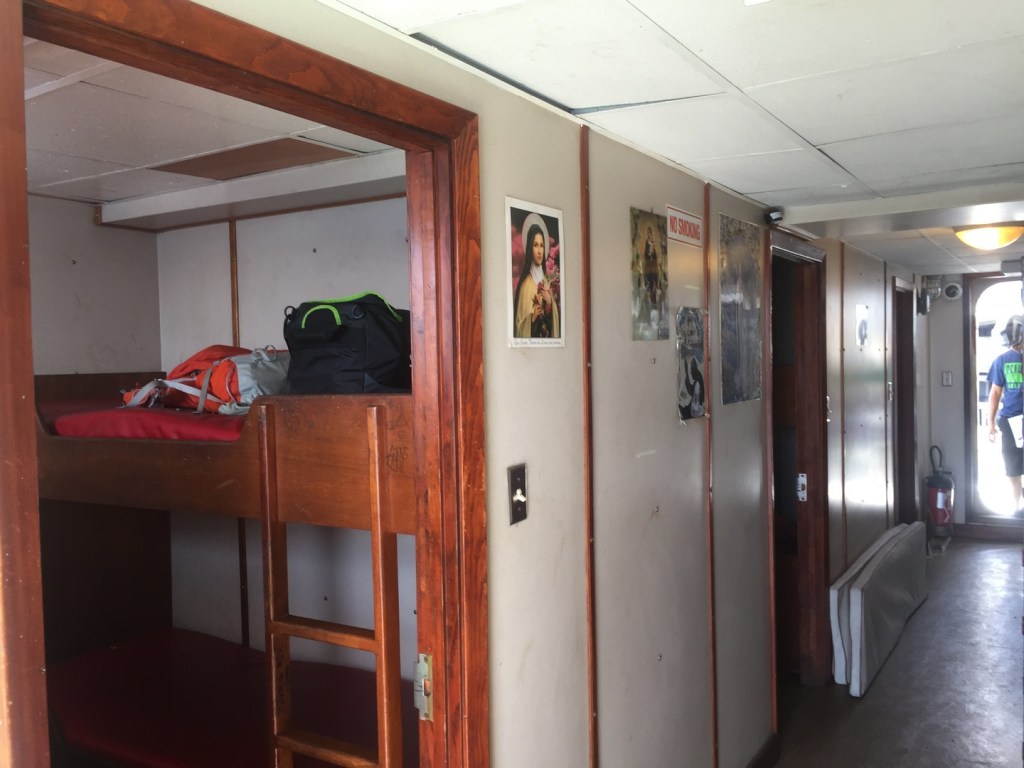
Not a luxury cruise but at least we have a bed. And Jesus!
We had made reservations for the Cobia months ago but were kind of nervous since we had not paid anything and did not know what time the Cobia would leave. Stefan left at 7AM to go check it out and sure enough at 7.30AM the office was open and our names were on the list!! We paid 7000XPF per person (about 70EUR) and were told to bring our luggage by 11AM. Stefan knew where to get all the things he needed so in an hour he had all the boat stuff and we could leave the hotel by 10AM with all our bags and boxes. We paid another 7000XPF for all our luggage. (more than 150KG!!). We put it in the crate for Apataki and left to return the car just in time! We had a couple hours left to spend in Papeete and by 2.30PM we had to be back at the Cobia 3. I could not believe how smooth it all went! This was great! The Cobia was definitely an experience! We had a bunk bed :-), but there was no real place to sit….so we could only lay down :-(, and the journey took 34hrs. Because of the high waves (4m) I got sea sick :-(, luckily after 8hrs I felt better! There is no food on the Cobia, you have to bring your own food and water. I was too sick to eat the croissants we had. The Tahitian we shared our room with offered 2 apples (they really share soo easily) and I was happy to eat those. We arrived at 2AM in the morning at Apataki village and I cannot say how happy we were to see “Pappie” from the Carenage waiting for us!! We loaded all our stuff in the pick-up truck from Alfred and left for their house in the village where also “mamie” was waiting for us. We took a quick cold shower and went to bed for the remainder of the night. At 9AM in the morning we loaded everything in Alfred’s motorboat and made the trip to the Carenage. We arrived soaking wet (from the waves) but happy to be back “home” and see Sanuk!
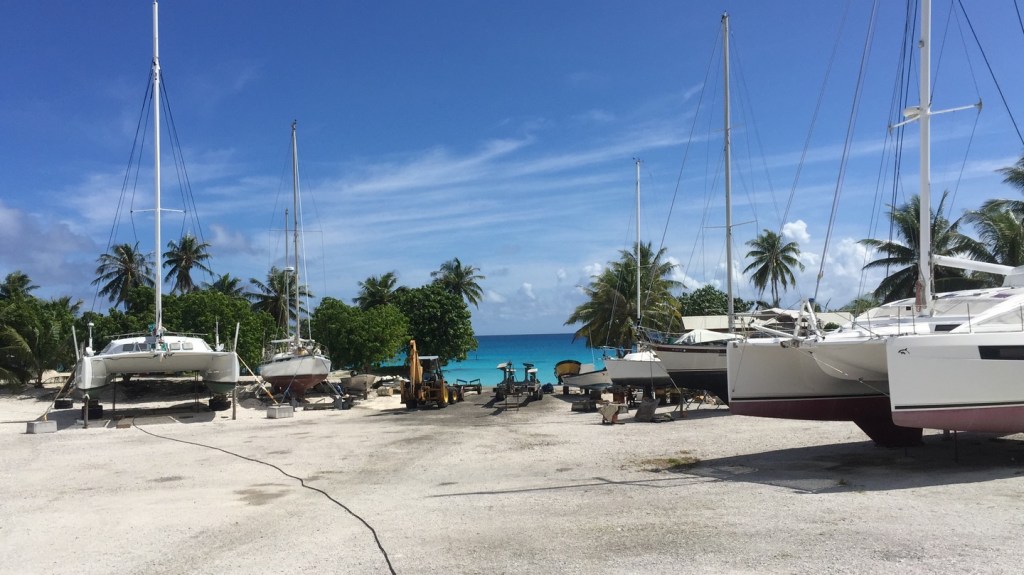
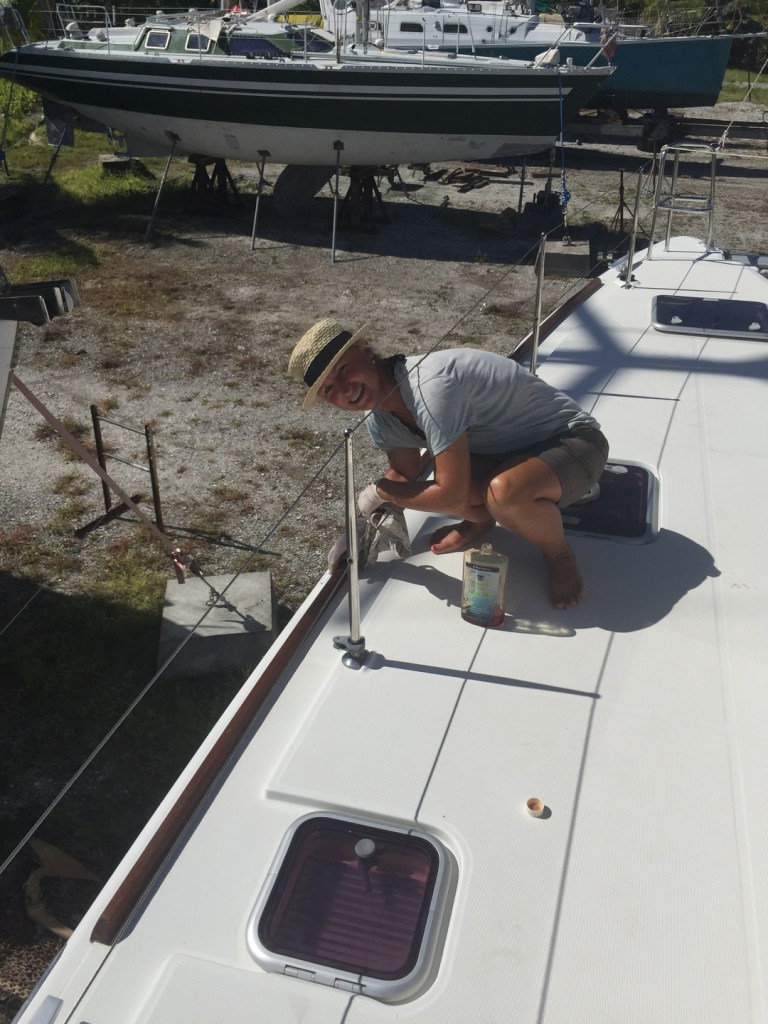
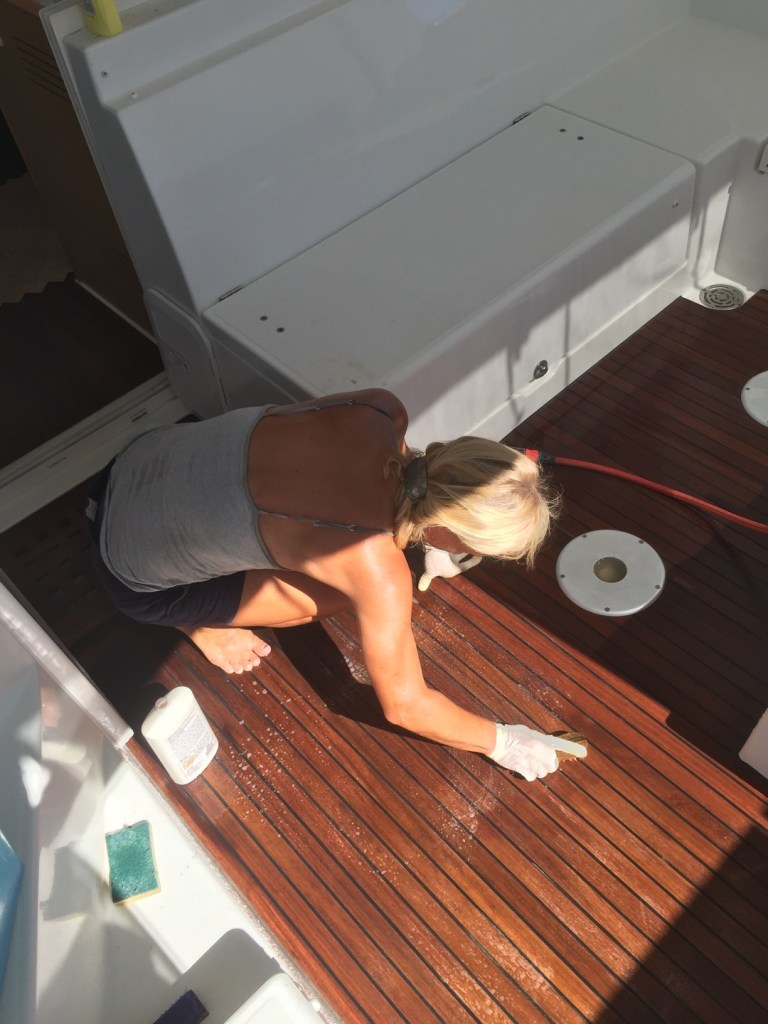
View from Sanuk on the carenage and the lagoon in the backCould not dream of a better place to have the boat out of the water.Now we only have to unpack everything ! Good to be back home.Cleaning and oiling the teak toprail.Scrubbing the teak floor.
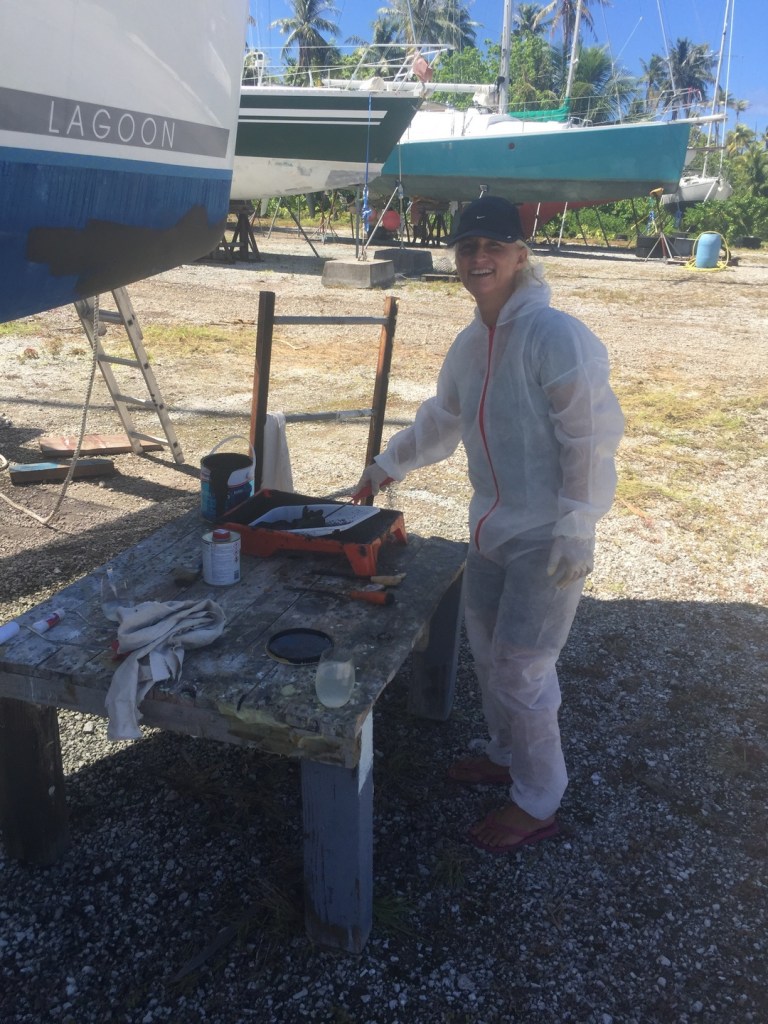
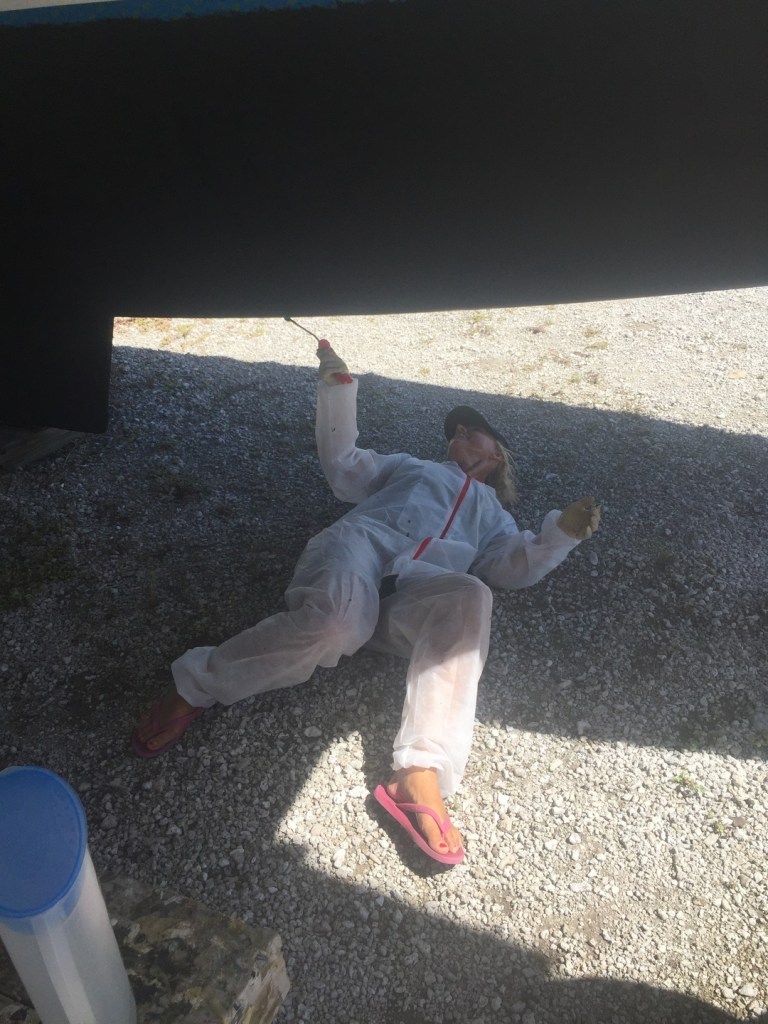
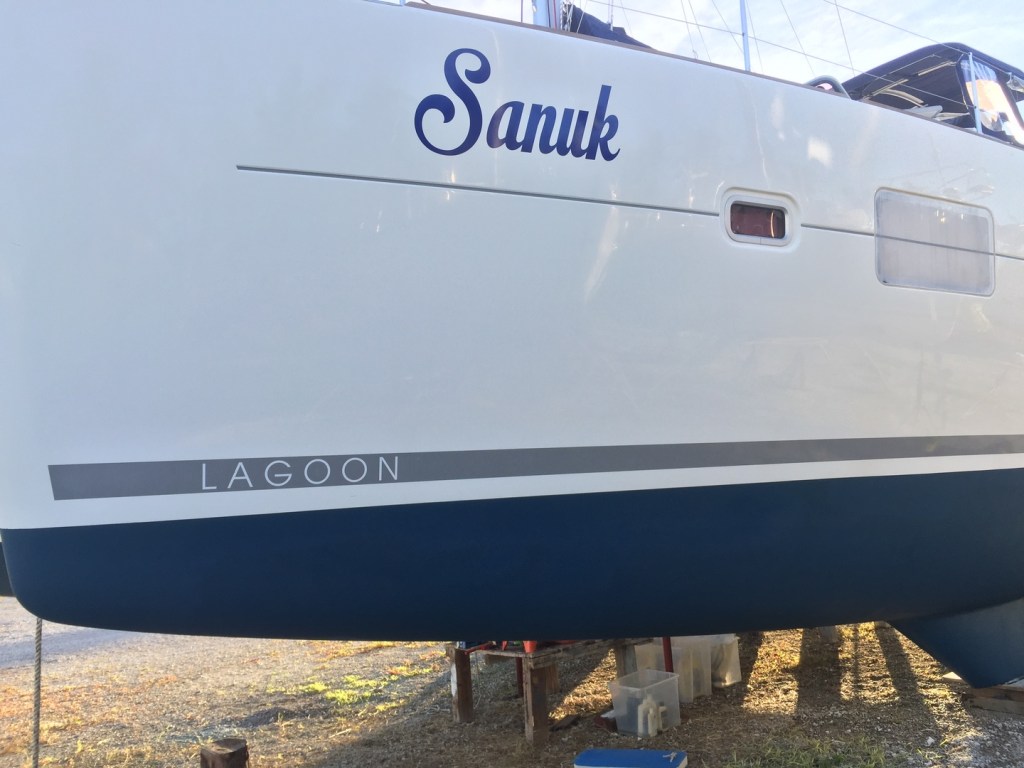
We have been busy fixing, painting, replacing, rearranging and socialising and hope now that we can get Sanuk in the water on May 8th or 9th. It is clear that a boat needs to sail and having it on the hard this long (almost 6months) is not so good. There was a corrosion on the connecting bar between the two rudders …..with patience, acid and oil they are now cleaned and like new and this solves also the steering problem we had before. The bottom is halfway painted, I am now waiting for an extra pot to arrive on the Cobia tomorrow. I should be able to finish the other half the latest by sunday. The Honda motor of Flipper had to be cleaned since we forgot to drain the gasoline when we left. It got sticky and plugged up the carburator. It sounded fixed but Stefan wants to test all the motors before going in the water. The oil from the generator is replaced, the trampoline is replaced with a new one, all the teak wood is cleaned and oiled, the chips in the gelcoat are fixed, and our fix it list is getting smaller.
Putting on a new anti-fouling coat on Sanuk’s bottom. Anti-fouling paint is important because this prevents the growth of mussels, algae etc on the hull. These growths can affect the performance or durability of the boat.
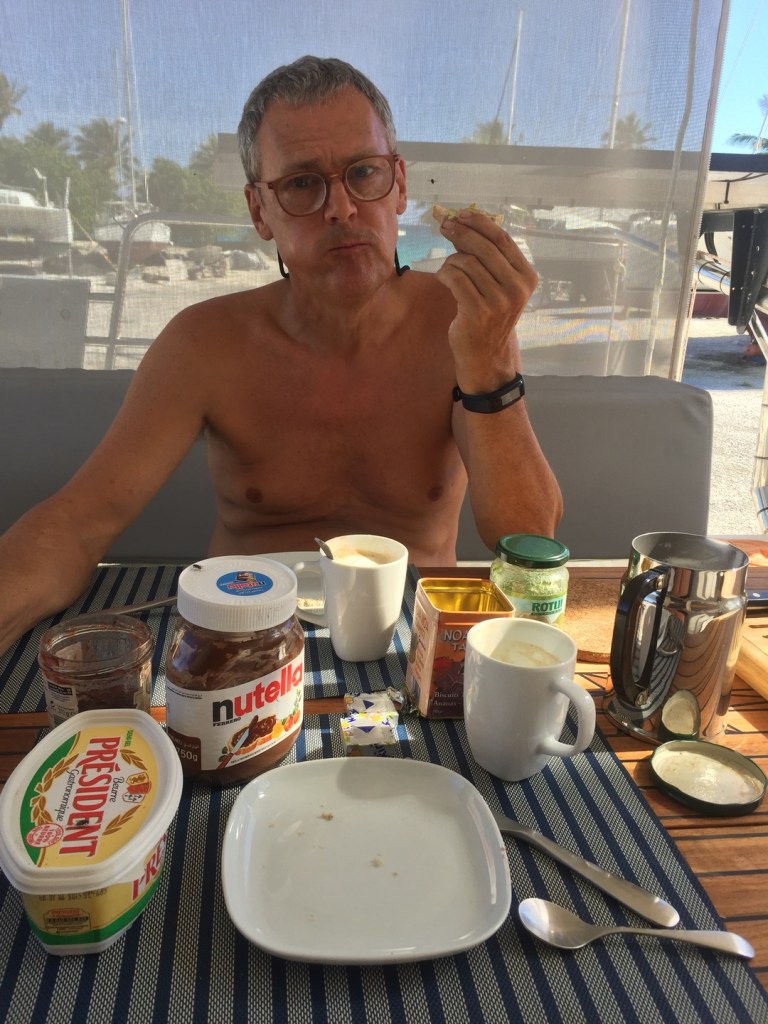
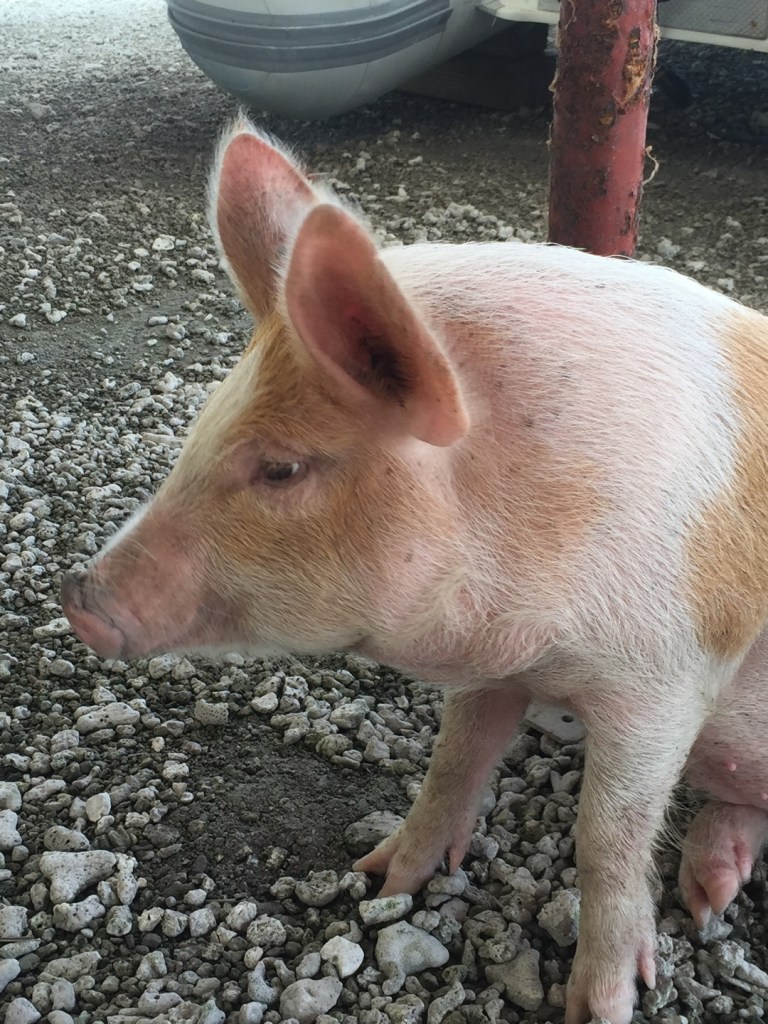
A job well done by the admiral :-).The captain at breakfast.Pua (meaning pig in tahitian) the mascot of the carenage. He behaved more like a dog than a pig. He could roam around the carenage freely until one day she ate “mamie’s” flowers…then he was to stay in his cage.
The hardest part was working in 32degrees celsius and high humidity (70%) so we had to make sure to get up as early as possible (still not my strongest point 🙂 ) and from 12 till 2PM it was siesta time. Too hot to eat but we are drinking liters of water! Luckily we have the sea close by and a shower (cold only) with unlimited water supply !
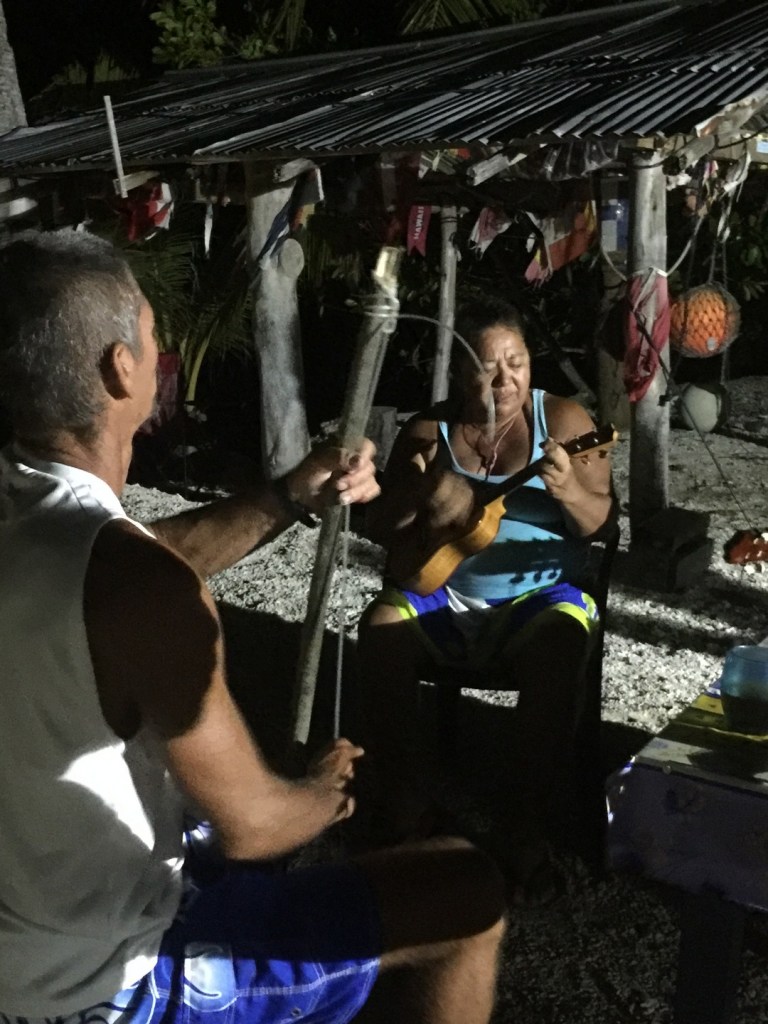
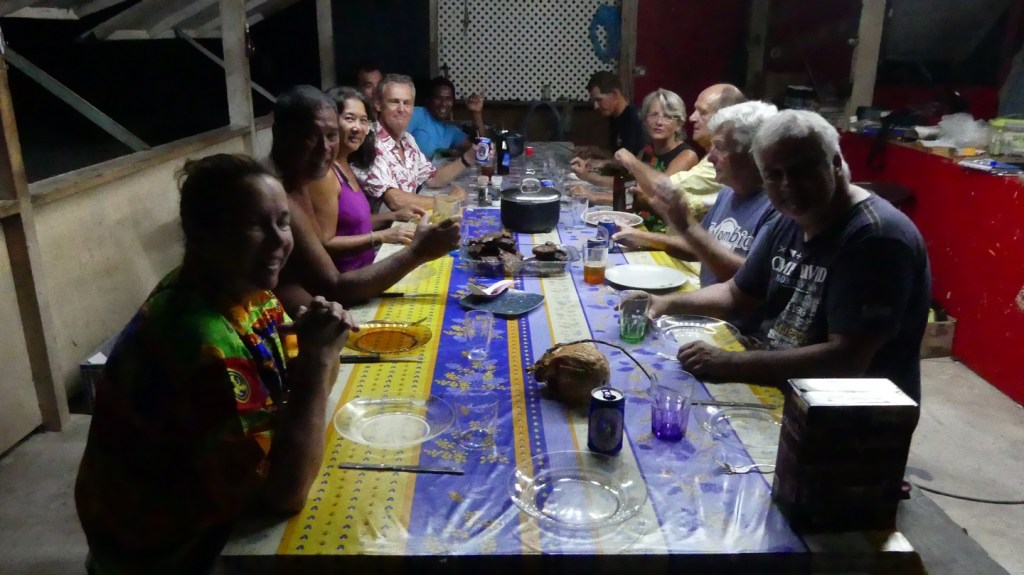
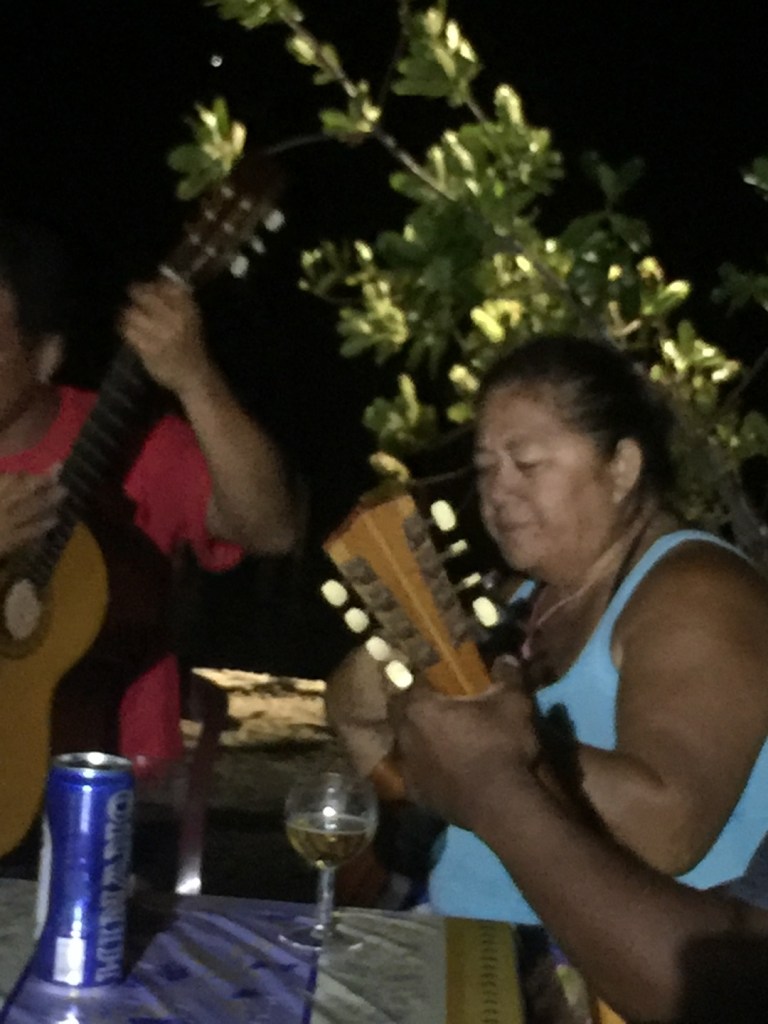
Gaston and Valentine from Anse Amyot came visit and were always ready for a party with singing and good food.Dinner with all the cruisers at the carenage. An international group from Mexico, France, Madagascar and Belgium.Valentine playing the ukulele and singing.
The people from the carenage are all very friendly and we have been invited a couple times to have fish barbecue with them. The fish is put ALIVE on the barbecue and there is rice and homemade sweet and sour sauce. Very yummy. The first time they played the ukulele and guitar and sang while we were having dinner under a starry sky! Does it get any better?
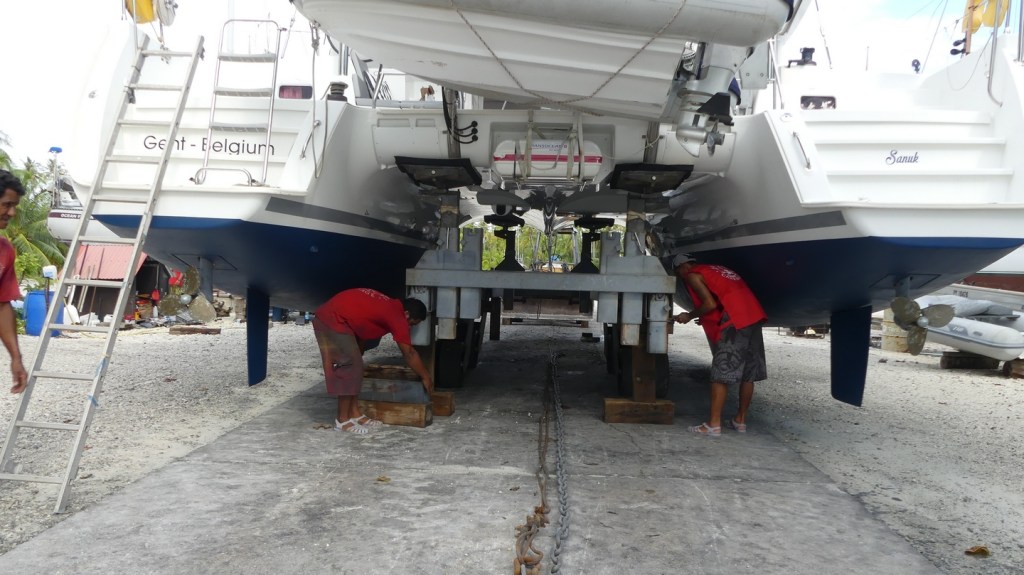
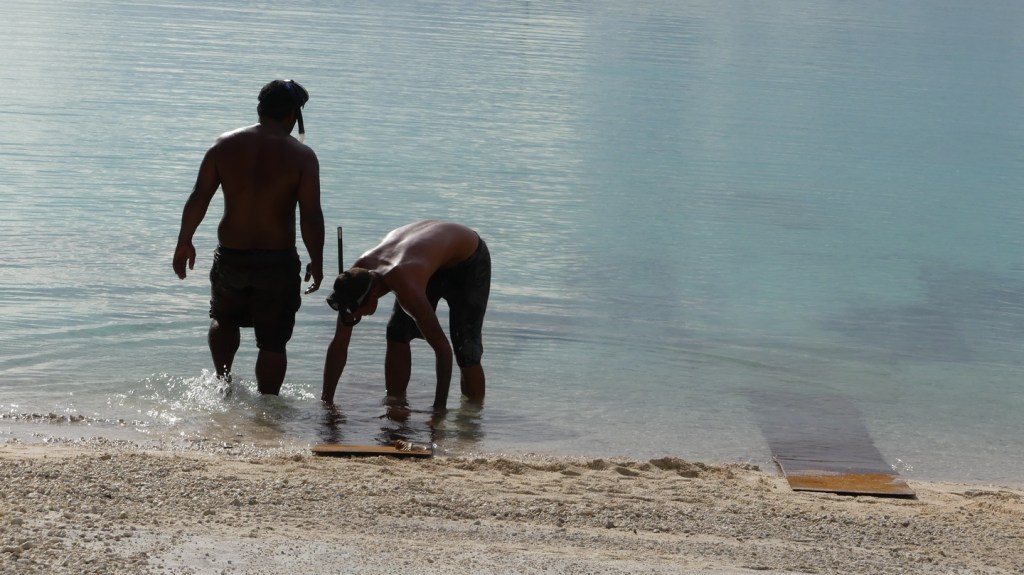
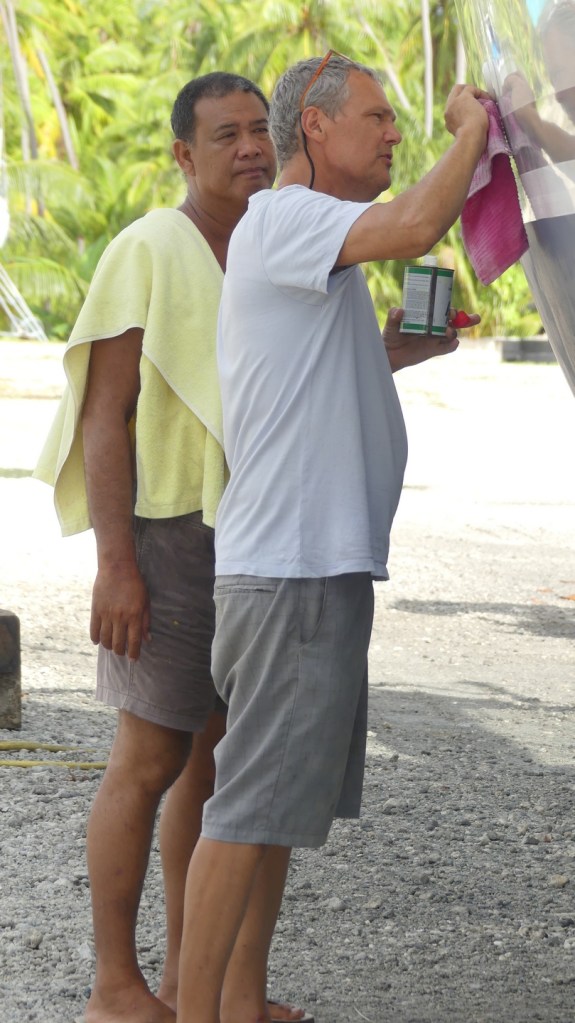
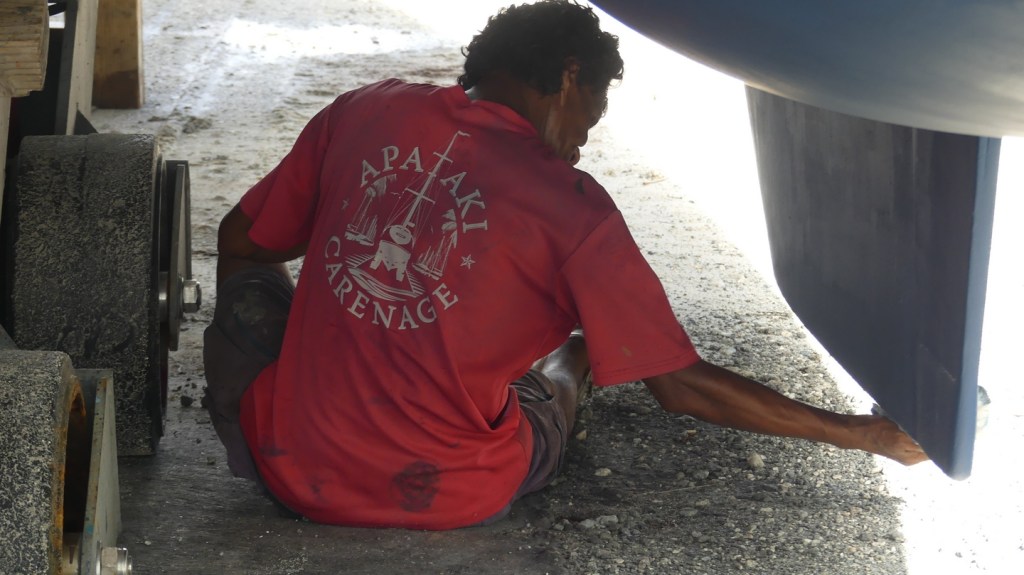
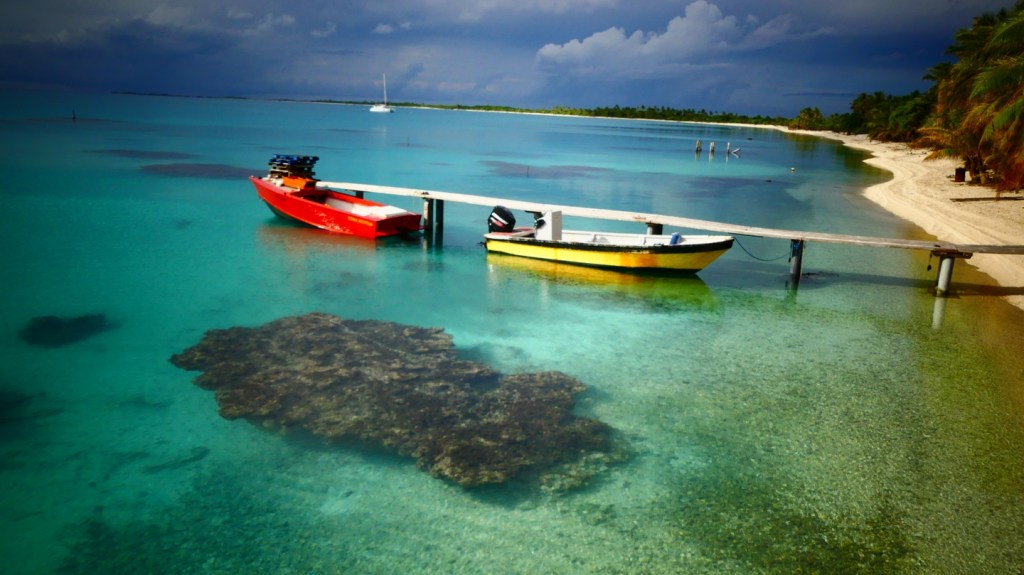
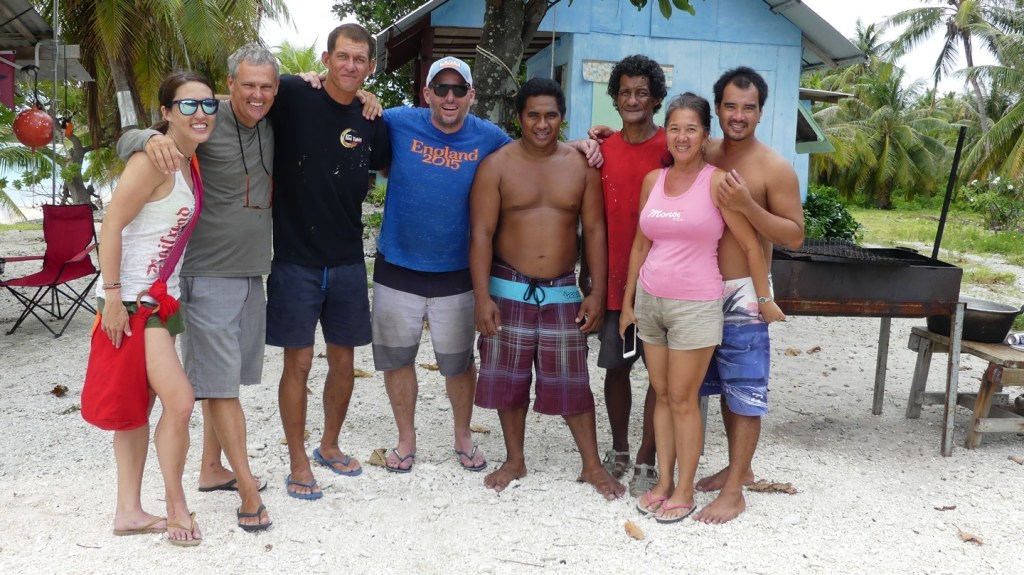
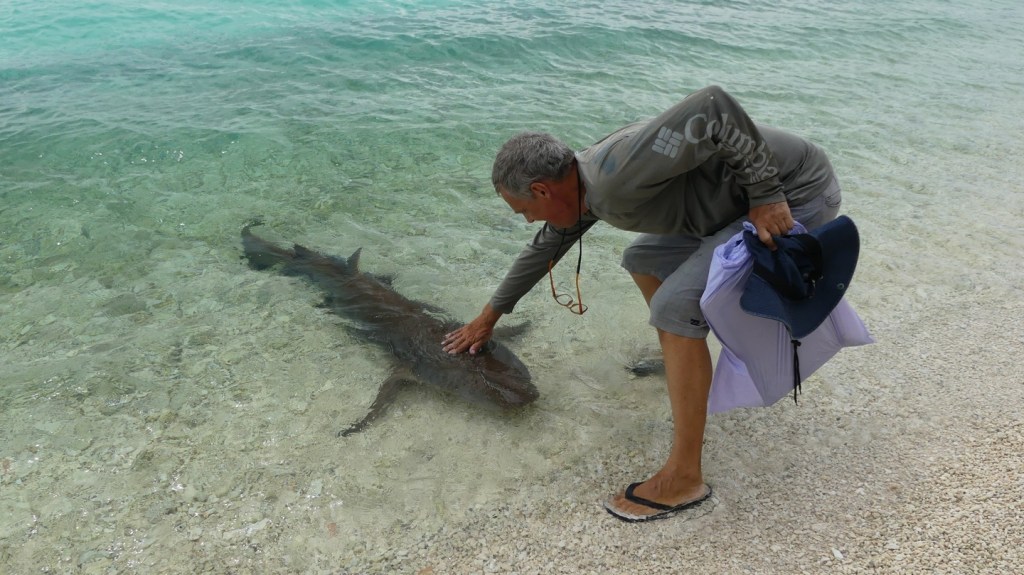
Getting Sanuk ready to be put back in the water. 15 Ton to be carried on the trailer is a delicate operation but Tony and his team know what they are doing.Also in the water there is preparation to be done.Alfred watching over Stefan while he is cleaning off the last piece of tape.Nini putting on some last minute anti-fouling under the keel.View from Sanuk, almost in the water.Saying goodbye to Ryan and Natasja from “Cheeky Monkey”. From left to right, Natasja, Stefan, Manu, Ryan, William, Nini, Tony and his mom Pauline.Stefan saying goodbye to the nurse shark. Watch those feet…


 Sanuk 2014-2018 travel stories