Sunday, March 14th, we are anchored in Balboa yacht club and decide to go with the watertaxi to land with Jacques and Annet who are taking a taxi to go to Panama city. We need to find an ATM machine since we have no USD left and check the price of the diesel for the boat. We were walking in the direction of the centre of Balboa in some run down neighbourhood when a woman told us we should not walk there without security. She went to get two policemen to go with us to the nearest ATM machine. The police called a police car and after 5 minutes we were taken by the police car to the nearest ATM. 🙂
Going in the police car.Now Stefan has to get in….
They wanted to take us back to the marina but we politely declined and walked back along the main road. We got diesel at 1.74USD for a gallon and left for Isla Taboga, which is about 2 hours of motoring, there was no wind and we were still in the canal.
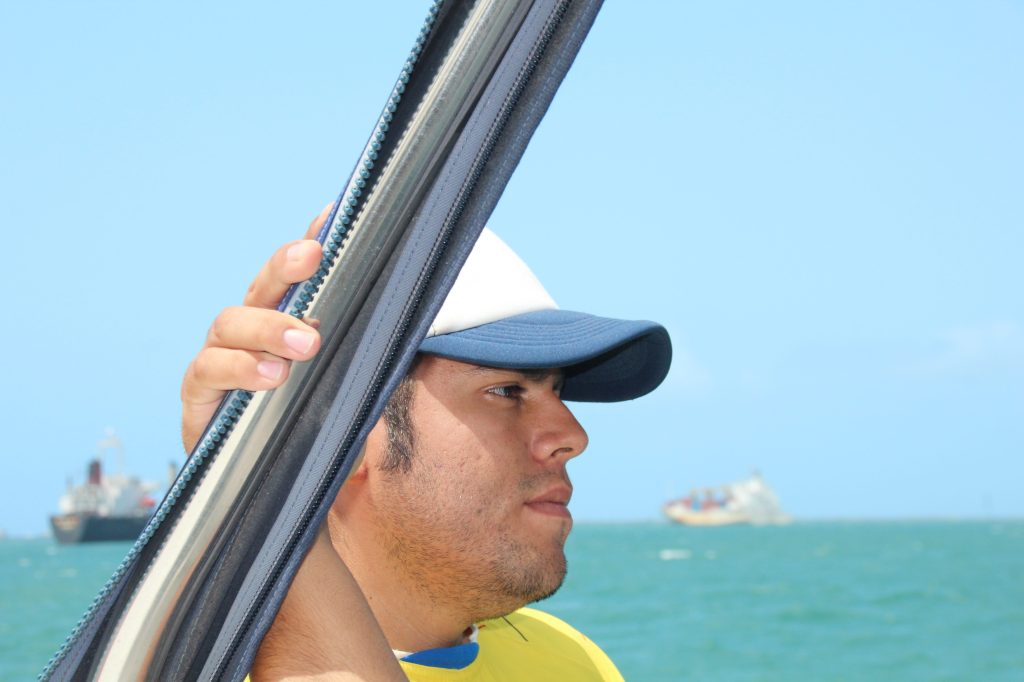
Leaving Panama city behind.Lange Wapper, a Belgian dredging ship is passing us on port side.We arrive at Isla Taboga at 4.15 PM. We see lots of seagulls, pelicans and boobies all diving in the water to get some fish.A lot more seagulls on the Pacific side…Sanuk is the 3rd boat from the left.Flipper moored at the floating dock with his new blue jacket.Arriving on Isla Taboga.View from the church on the centre plaza.A black vulture on one of the rooftops.Iglesia San Pedro was built in 1550 and apparently the second oldest church in the western hemisphere.Stefan at the altar while 3 people were praying out loud.The pelicans were everywhere.View on Panama Bay from the top of Taboga island (370 M). A walk of an hour which we did in 40 minutes because it was getting dark.
A colibri taking a rest on our boat.
Friday March 12th, early in the morning, after not such a good night sleep we are taking care of the final preparations for the transit. Jacques and Annet will be arriving around noon as well as our professional line handler and the fenders and extra lines. We clear the bill from the marina, David brings back Flipper with a new jacket and a rain catcher. It all looks good. At 1.30PM we leave Shelter Bay Marina for the “flats” where we will have to anchor to wait till the advisor comes aboard, this should be around 5 PM. There are 5 boats from the marina transiting the canal today and tomorrow.
Leaving Shelter Bay Marina to go to the flats.Huge fenders are on board.Our first advisor is the one on the right with blue t-shirt. He will go with us till we arrive at the Gatun Lake.Jacques and Annet from SV Panache, helping us out as line handlers.James, professional line handler, is last year student Electrical Engineer.
Finally we can leave for the canal at 6.15 PM, it is getting dark.
The Africaborg is the boat we will have in front of us in the locks. We will be tied to a yacht and another catamaran.Slowly going into the lock together with a yacht and catamaran.
Before going into the locks we are being tied on starboard to a yacht and catamaran. The yacht was in the middle which was not a good choice ! As we had more engine power we could steer better and soon enough the advisor on board of the yacht gave Stefan the go ahead to steer for the 3 boats. This was not so easy since we were not in the middle. But Stefan did a wonderful job together with the line handlers.
Line handler Jacques, in the locks behind the Africaborg.
We arrived in Gatun Lake at 9.30 PM where we had to anchor. Normally they go to a mooring but this is where they are now working on the new canal. The advisor had his dinner in the locks and left the boat once we were anchored. We had dinner after we were anchored, pineapple for desert and a cup of tea before going to bed. Tomorrow is another long day !
Saturday, March 13th 2016, upat 7.30 AM as the advisor could come as of 8 AM. Pancakes, bacon and orange juice for breakfast. Unfortunately the advisor did not turn up until 12 !
Frank our second advisor.
He was checking when we got a spot and apparently this would only be at 6 PM ! We still had to go 28 NM in the canal. He would try to get us in at 5 PM, so we were all happy. We had to motor at a speed of about 6 KTS to get in time at the locks which was a little frustrating since we had been waiting for so long. After half an hour it was clear the yacht could not keep up that speed and would never make it in time for the 5 PM passage. So back to 6 PM 😦
On our way to the canal, passing under the Puente Centenario.We arrived too early at the locks and at first had to motor around but Stefan proposed to moore on the buoy. Much better !The new bridge they are building as part of the new canal.This time we were in front of the big ship and the yacht went all by itself tied on four sides.
It is dark by the time we get through the Miraflores locks. We finally arrive at Balboa Yacht club to anchor at 8.30PM, another long day.
The day after, we are now in the Pacific ! So happy the transit is done !
The passage was really impressive although it was a lot of waiting during those two days. But to think that these immense locks were built in 1914 (when the canal was opened) is incredible. The French started building the canal in 1881 but after 25.000 workers died from yellow fever, malaria and dysenterie and the French went bankrupt, the Americans took over in 1904. The canal was finished in August 1914, at a cost of 375 Mio USD. The average toll to go through the canal is 50.000USD for our boat it was 800 USD, with agent fees, paperwork etc it came to 1500USD. Happy I do not have to go back 🙂
Tuesday,March 8th 2016 to March 10th we decided to pay a quick visit to Panama city. We really did not expect too much of it being such a big city but we were positively surprised ! We spent most of the time in Casco Viejo. They are working hard to renovate the beautiful old buildings. We think that 5 years from now this will have the same charm as Cartagena, maybe even nicer, if they take the right decisions. Our hotel was located at the Cinta Costera (coastal belt) which is a new green space where you can walk or bycicle from downtown to Casco Viejo. Panama City was founded in 1519 but the city was destroyed in 1671 by the English pirate Henry Morgan.Three years later the city was reestablished 8km southwest now known as Casco Viejo.
Fishing boats in front of the new Panama City, skyscrapers.Panama flag in the fishing marina.Typical street view in Casco Viejo.Many beautiful buildings on little plazas.Colonial architecture in Casco Viejo.
The cinta costera which goes from downtown all the way into Casco Viejo.Panama City skyline taken from Cinta Costera.Iglesia de San Jose, this church protects the famous Altar de Oro the only relic saved after Henry Morgan destroyed the city. The priest had painted the altar in black in order to save it from the pirates.Not all houses are renovated yet.Little by little all houses are renovated to their original splendour.Catedral de Nuestra Senora de la Asuncion built between 1619 and 1626 is the best preserved building.They were setting up panels to start renovation on the catedral.Selfie with Panama City skyline.On one of the passes of the Cinta Costera after a nice dinner in downtown.
Today, March 15th, we are on the other THE OTHER side, in the Pacific Ocean ! I am so happy ! It were two long days with a lot of waiting…but more about those days in the next blog. I first have to go back to Porvenir where I left last blog.
Friday, February 26th, 2016, we left Porvenir at 7.25 AM because we had to sail about 60 NM and wanted to make sure we arrived in Portobelo in daylight. It was a cloudy morning and thus the reefs are difficult to see, Porvenir is surrounded by reefs ! Luckily we had the charts from Eric Bauhaus but still we did change our mind about going through two reefs because it looked too narrow. After about 45 minutes of motoring we finally made it to sea and could raise the sails. It was a great sailing day ! The sun came out and we were able to do about 7-8 knots with 20 knots of wind. We arrived in Portobelo bay at 3 PM. Lots of boats were already in the beautiful bay. Columbus discovered “Puerto Bello” in 1502. The city of San Felipe de Portobelo was founded in 1597. Portobello has a rich history as it was once the spot where all the gold and silver conquered by the Spanish was shipped to Sevilla Spain. Needless to say this attracted a lot of pirates and thus Portobelo was guarded by 3 forts ( UNESCO protected). Fuerte San Jeronimo, Fuerte Santiago and Fuerte San Fernando located on the other side of the bay. Although they are protected by UNESCO there is no entrance fee and it seems nothing is being done to keep these sites maintained. I am not sure what the obligations of Panama are once a site is UNESCO protected. Portobelo was first attacked in 1602, then in 1671 by Henry Morgan and in 1679 by the English and the French. The city was destroyed in 1739 by Admiral Edward Vernon and rebuilt in 1751. We learned later that much of the fortresses were dismantled to build the Panama Canal as many of the larger stones were used in the Gatun Locks. We also visited the Real Aduana de Portobelo, a two-story Royal Customs House which was built in 1630 to serve as counting house for the king’s gold. All the gold and silver was stored here until it could be placed on galleons and sailed to Spain. There is a museum in the building but we never managed to visit as it was always closed. In the Iglesias de San Felipe there is a statue of the Black Christ, lots of people over the WE stand in line to worship and see the statue. Portobelo has a lot of charm although a lot of poor people as well. It so much fun to learn about history this way, not a dull moment 🙂 We were happy to be back in civilization. We had not seen a car in 3 weeks and we had internet 🙂 ! We caught up with emails and chats and left Portobelo early monday February 29th for Shelter Bay Marina.
The many cannons at Fuerte San Jeronimo in Portobelo. San Jeronimo was the largest fortress to protect the bay.On the steps in the Real Aduana of Portobelo.The Real Aduana in Portobelo.Fuerte San Jeronimo in Portobelo.Fuerte San Fernando on the other side of the bay. Because of the beautiful setting in nature this is an UNESCO heritage site.Fuerte San Fernando.Fuerte San Fernando.Fuerte Santiago.Fuerte Santiago in the left corner.Iglesias de San Felipe with the black Christ statue inside.The black Christ statue devoted by many. Apparently on October 21 thousands come here to pay tribute to the black Christ.In the museum of the Real Aduana they keep different robes for the Christ. Famous people (Salsa star Ismael Rivera) donated these.A bronze cannon from a sunken galleon with Spanish coat of arms and date of manufacture 1617.
Monday, February 29th, 2016, did not know it was a leap year, we left Portobello at 8 AM for Shelter Bay Marina in Panama. We wanted to meet up with our Canadian friends, Bill and Cathy, before they go through the canal later that day. Another great sail and we caught our last fish of the Caribbean Sea, a little mackerel. We got in the marina by noon. It was a tight spot they gave us to dock the boat as the marina was almost full but Stefan did very well. Later during the week we had to take out the boat two times to test the motor and although I am always nervous motoring in tight quarters, Stefan is really getting good at it ! 🙂 Shelter Bay Marina is a nice marina located at the entrance of the Panama Canal and surrounded by woods. It has a small swimming pool and restaurant ( where you need a lot of patience) and so it was the perfect spot to get the boat ready for our long journey to Galapagos and Marquesas. We had internet (although very slow at times) on the boat and managed to keep up with mails and update our blogs. A lot of reading had to be done about the Las Perlas Islands (next stop) and Ecuador since we had no internet anymore after this stop. We arranged the canal transit for March 12th and were happy Jacques and Annet from SV Panache were willing and interested to do the transit with us. They will be leaving for the Netherlands from Panama City right after the crossing. We made a quick visit to Panama City for 2 days and were charmed with Casco Viejo. They were rebuilding lots of beautiful houses and we think it will become prettier than Cartagena if they make the right decisions. We never felt unsafe in the city. We got a taxi driver from Colon to come and get us back at the hotel and did all our supply shopping for the coming months in Panama. There is just more to choose from in the supermarkets in Panama. We bought for 700 USD worth of groceries….this should last till we get to the Marquesas, early June 2016.
Last mackerel caught in the Caribbean sea ! It was yummie on the barbecue.Leaving Shelter Bay Marina for the transit of the canal.A white headed capuchin monkey on our visit to San Lorenzo nature park near the marina.A turkey vulture in San Lorenzo park.View on the Chagres river from Fuerte San Lorenzo.The remains of Fuerte San Lorenzo.The Kinkayou not always so harmless, they bite if played with.Stefan at Fuerte San Lorenzo.A walk under the bamboo in San Lorenzo park.Stefan was laughing at me because I was hiding under the tree from the pouring rain!Two of the 4 carts provisioning in Panama city. You can see the DUVELS Stefan was very happy with ! They are kept for special occasions 🙂Bags of groceries stacked outside waiting to be stored in a dry place somewhere on the boat. The hardest part is to remember where everything is stored one week later.
February 11th, 2016 the sail to Puerto Perme did not start out very good as the winds were blowing from the north, on the nose and the sea was confused…We had to tack into the wind and this proved to be more difficult than expected. We did not manage to move forward so that the coast guard from Sapzurro came to make sure we were not in trouble. We reassured them that we were OK and confirmed we were sailing to Panama over the radio. Once we were out of the zone with the confused seas we were fine although the waves were still high and the skies were grey. After 6 hours of sailing we were happy to arrive at Puerto Perme with a bit of blue skies. There was a Columbian supply boat already there and they were all amazed we arrived with this “mal tiempo”. We did not think it was that bad, but nevertheless were happy to anchor safely in the bay.
Guna Yala territory. We started all the way on the bottom of the map and sailed over a period of 2 weeks to Porvenir at the top of the map, which is about 100 miles.
The Guna Yala is an indigenous province in northeast Panama and is home to the Gunas (Indians). The capital of the province is Porvenir. An archipelago of 365 islands is around the coast, of which 36 are inhabited. They say, an island for each day of the year.
Guna Yala flag.The Revolution Flag from 1925 during which the Guna Indians fought the ruling Panamanian authorities, whom were attempting to force the Indians to adopt Hispanic culture by military action. During this revolution the Guna Yala territory seceded and operated as the short-lived Republic of Tule. Following mediation by the United States the Guna re-united with Panama. The Gunas with the support of the Panamanian government, created an autonomous territory called the Guna Yala district which they would rule themselves.The Gunas at the supply boat where they can get vegetables but also order chairs etc. from the mainland. This boat came from Columbia but there are also boats from Panama.A Guna family which came to visit on the boat. Unfortunately the girl did not wear their typical dress. They came to sell bananas, coconut and a bracelet.
Typical Ulu, dug-out boat. The Gunas go everywhere with these in any weather !Collecting a 10 USD anchor fee. They first wanted 20 USD but during our visit of the village they had said 10 USD so we refused to pay the 20 USD. Stefan made good by giving fishing line and a hook. The women do not like to have their picture taken but here the man wanted the picture…The woman is wearing the typical mola (blouse) and a red scarf on their head. They have beads around their wrists and ankles.The streets in a typical Guna village. A lot of the houses have small solar panels (see in the back of the picture)Happy and proud with his homemade kite.Typical street in the Guna village.The villages were always clean and built with respect for nature.A lot of the Guna indians will have to move to the main land if the water level continues to rise. There are already moving plans for some islands.As a visitor you are not allowed to take any coconut as they all belong to someone. Even the ones on the ground cannot be taken.Gunas are very curious and when you arrive with your boat they always paddle their ulus to come and see.A Guna with plantains.Not always all happy faces. Big sister taking care of the little ones.A luxury toilet in stone instead of in wood, on isla Tigre.More typical village streets.Life is good in the Guna village. Definitely no stress here!A Guna flag and a revolutionary flag (with the swastika).The molas, form part of the traditional outfit of a Guna woman, two mola panels being incorporated as front and back panels in a blouse. In the Guna’s native language, “mola” means “shirt” or “clothing”. The mola originated with the tradition of Guna women painting their bodies with geometrical designs, using available natural colours; in later years these same designs were woven in cotton, and later still, sewn using cloth bought from the European settlers of Panamá. The price for a mola ranges from 10 USD to 60 USD.The full costume traditionally includes a patterned wrapped skirt (saburet), a red and yellow headscarf (musue), arm and leg beads (wini), a gold nose ring (olasu) and earrings in addition to the mola blouseNot all islands are inhabited. Although even on this small island, Corgidup, there was one hut ! Dup means island in Guna language.When we arrived in the Hollandes Cays the sun was finally out and the colours of blue were just incredible. Far away you can see the waves breaking on the reef. We anchored in crystal clear water !The Coco Banderas.With Cathi and Bill from Calgary, Canada enjoying a meal on the beach of Barbecue island (Morodup). We sailed together till Hollandes Cays and met them briefly in Shelter Bay Marina. They will have sailed around the world when they reach Calgary in July. They are now headed for Galapagos and Hawai. They had such great stories !Stefan with his Code Zero sail. So great when there is not a lot of wind. Hope to have more pictures when we sail the Pacific !Ready to check-in at Porvenir with all the boat documents, passports and cash dollars. For 2 people and a boat, 500 USD. We had to help out some french who thought they would be able to pay with Euros or credit card but only dollars are accepted in cash. Luckily we had enough USD left to change to EUR.
I really enjoyed the Guna Yala although I missed the blue skies from Colombia. It was very difficult to take pictures from the women in traditional dress as mostly they do not want you to take any pictures. Some will ask 5 USD to have their picture taken. I wonder if the Guna Indians will be able to keep to their strict traditions with more and more tourists visiting these villages. It is such a fine balance to profit from the tourist money but also to keep the youth interested in this remote life. The sailing was not always easy but we learned a lot about navigation through reefs which will help in French Polynesia.
We visited the following villages : Anchucunda, Carreto, Suledup, Mulatupu, Ustupu, Bahia de Gollondria (Alligandi), Niad, Isla Tigre, Tiadup, Hollandes Cays, Corgidup and Isla Porvenir. Next stop is Portobelo.
Today, Monday, February 29, 2016, We are in Shelter Bay Marina, Colon, Panama, right before the canal entry ! We left Santa Marta January 29th, a month passed by so quickly. I will try to give the highlights from this past month with lots of pictures.
We sailed from Puerto Velero to Cartagena on January 31,2016, anchor was up at 6.30 AM. We sailed about 10 hours and arrived at 4.20PM . It was great ! We had more tuna for dinner. Stefan had caught a tuna between Santa Marta and Barranquilla.
Stefan in a good mood (but missing a party) because we are finaly sailing again and we had a nice sail to Cartagena.View from the boat. Anchored just in front of Club Nautico with the city of Cartagena in the background.Leaving the harbour of Cartagena, on our way to the Islas Rosario.
Monday, February 1, 2016, we left Cartagena at 9.30AM and arrived in Peninsula de Baru at 1.40PM. Baru is part of Islas del Rosario. See below a map with the Rosarios.
On Tuesday February 2, 2016 we left Bari in the afternoon for Isla Grande. Only one hour later we arrived there.
The road on Isla Grande. No cars, only bycicles, donkeys or on foot.Shopping on Isla Grande. Typical street…The toilets are on the right. Plastic bottles are being used to decorate the walls of the toilets.
On Wednesday, February 3rd, 2016 we sailed to Tintipan Island part of the San Bernardo Archipelago.
Another beautiful anchorage at Tintipan…We arrived on the deserted beach and it was full with falcons.A couple tamed little parrots part of the local bar on the beach.On our way with the dinghy from Tintipan to Santo Cruz el Islote, beautiful scenery…Hostels built in the water. This must be paradise.Empty private summer home. There are 3 vacatiion periods in Colombia : Christmas, January and Semana Santa. During those periods all of these islands are full of vacationing Colombians.
Public telephone on Santa Cruz del Islote. No need to stand up the whole time 🙂Its significant population compared with its small size (approximately 0.012 km²) results in it being the most densely populated island on Earth!Streets on Santa Cruz del Islote.
On Thursday, February 4, 2016 we sailed for about 7 hours to arrive on Isla Fuerte at 5 PM. We were just anchored in a small bay lined with beautifull vacation homes when a motorboat approached us with 4 people on board. They wanted to know where we were from and if we wanted to have a drink and dinner with them ? They lived in one of the houses lining the bay. We hesitated at first, surprised with this nice invitation but agreed after we would first clean up ourselves :-). This is how we met Russ ( US) and Patricia (Colombian) and their friends (Joe and Sue ? ). We had such a great evening, and wat too much to drink !
Friday, February 5th, 2016, the next morning we were invited for breakfast and a tour of the island.
On our way to the beach through the centre of the island. No cars, no motorcyles, you can only get around with donkeys, bicycles or on foot. Really great.Town center.Patricia organised a massage on the beach for me. Does it get any better ? 🙂Russ (right) and Joe (left) visiting our boat, captain Stefan in the middle.Sue on the boat.Patricia, the perfect hostess !In the evening we were invited again, together with about 15 young people, who are renovating a hostel on the island, to have dinner and drinks. Russ and Patricia were perfect hosts. We had a wonderful time meeting all these people and Russ is a good cook.
After the party, Russ and Patricia wanted us to take all the food that was left after their 2 month stay in Colombia since they were leaving for the US the next morning. We went back to the boat happy and loaded with food, 2 large plastic bags ! Thanks so much Russ and Patricia !!!! We hope to see you both in Belgium.
Saturday, February 6th, 2016. We reanchored the boat a little further in calmer waters and had another nice walk on the island.
A good thing we cannot take a donkey on the boat, this baby one was so cute 🙂View from the boat.The hostel which the young people were renovating. Most of them were dutch but also some Australian and US guys.A great lunch on the beach with our feet in the sand and a nice breeze to stay cool. This is getting close to paradise 🙂
We left that night at 5.40PM to sail to Sapzurro, a nightsail of about 12 hours we had calculated. The sailing went so fast, with high waves that we arrived at 5 AM Sunday, February 7th, 2016 just before the bay of Sapzurro. Because it was still dark, we had to “park” the boat before the bay for 1.5hours. We were both so tired that we managed to sleep each about 30 minutes ! We sailed into the bay around 7.30 AM and were happy to drop the anchor and go to sleep :-). We were now still in Colombia but right on the border with Panama.
We arrived back in Santa Marta on Saturday January 16th at 9 PM packed like two mules, carrying a huge suitcase, an even bigger box and two carry-ons. We had 15 kg over the allowed weight limit in our suitcases and box! Luckily we checked in early and no questions were asked or fees were assessed. We had a hard time finding a taxi who could fit the box. The box was finally put in the trunck of a cab and tied with ropes to prevent it from falling off since the trunk could not be closed. Unfortunately we forgot to take pictures….
Sunday, January 17th, the marina was filled with 33 sailing boats from the world ARC (Around the world Ralley) and it was clear that the marina did its best to please them! The bathrooms and showers were cleaned more often, the garbage was now collected in bins, we all received a free copy of the Columbian Cruising Guide…. We got up early and immediately started to clean the boat. The water that came off the boat was black! It took us a full day to get back organised and have the refrigerator filled but it felt good to be back :-).
This is what the boat looked like when we came back…
Monday, January 18th, we started planning our time left at Santa Marta. We decided we would leave the marina around the 27th since we had paid up till then. We still wanted to visit Bogota and Pereira (coffee region also part of UNESCO world heritage).
Wednesday, January 20th, the sailboats from the ARC did not leave today because there was too much wind to leave the harbour, about 30 KTS. We spent the aperitive with Andy and Gina Hilton from “Into the Blue”. They were one of the vessels participating in the ARC. They ARC started at Saint Lucia the 6th of January and 10 days later they were at Santa Marta, it took us 3 months….They will sail around the world in 16 months and thus only spend a couple days in each location. You get a taste of many things but everything is rushed. They were with their 3 children and two girlfriends on board so in total 7, sailing for 16 months together ! That will definitely be a challenge ! They were all pleasantly surprised by the friendliness of the Columbian people. After the 16 months they will definitely be able to say where they want to spend more time and sail at a more leisurely pace. We were happy we could leave the next day to Bogota and explore more of Columbia.
Thursday, January 21st, leaving Santa Marta at 7 AM to catch a bus to go to the airport of Barranquilla. When we got there our plane was delayed because of the bad air quality above Bogota airport. It was already 3 PM when we arrived at the hotel. We immediately left for the city centre, walking… it was only 5 KM… only we forgot we were now at an altitude of 2600m! My heart was not really cooperating, it was only much later we realized that the altitude was making us really tired. Bogota is the 3rd highest capital in South America, after La Paz and Quito.
Beautiful graffiti on our way to Bogota centre.
Stefan in front of one of the many Trans Milenia stations in Bogota. The TransMilenio is a bus rapid transit system which is a cheap (1800COP, about .50USD) and efficient way to get around in Bogota. It is almost like a metro but with buses. About 2.2 Mio people use the system daily.
At first, we were not so impressed by the city and were disappointed. The next day though we could appreciate the city better. There are 8 Mio. columbians living in Bogota! The second day we visited the Gold Museum, the Botero Museum and the National Museum.
We spent 2 hours at the Gold Museum ! The collection is amazing and with an entrance fee of 3000 COP (1USD) this is definitely a must see in Bogota.This would be an excellent Valentine present….just thinking ahead.Stefan at the entrance of the gold museum. He’s happy I did not insist longer to get the neklace at the museum store. (Stefan says: but she did get the earrings)Botero museum: One happy family but for the angry child…Typical Botero painting.Stefan on the plaza de Bolivar.Catedral Primada de Colombia on the Plaza Bolivar.One of the many streets in Bogota.
By the time we got out of the National museum we were both beat from walking around the city…. The TransMilenio was packed and on top of it we took the wrong one. When we finally got near our hotel we ate chicken wings for dinner and watched two episodes of Homeland season 5.
Saturday, January 23rd we went to Zipaquira (49KM north of Bogota) by bus. The main attraction in this small town is the Salt Cathedral which is a catholic church built in the tunnels of a salt mine at 200 meters underground.
Stefan admiring the cross made from halite, the cathedral is 25 meters high.
Although it is all very impressive I found it on the border of being “kitsch”.
The main square of Zipaquira.I enjoyed the little town more than the salt cathedral.
Happy to have spent a day away from the hustle and bustle of the city we returned back to Bogota by 6 PM. Our faces were sunburned being so high and close to the equator ….
Sunday, January 24th, we had to get up early because we travelled by bus to Pereira (Zona Cafetera) about 357 KM. We left with the bus at 7.30 AM and finally arrived in Pereira at 4PM! Already happy we were not returning by bus but by plane ! The Finca hotel we stayed at (Finca Ilusion) was a winner !
Pereira by night taken from our hotel room balcony.Finca swimming pool. The location was really perfect.
Monday, January 25th, breakfast at Finca Ilusion.
View from the breakfast table.
A woodpecker but not sure what kind…dad I will need your help in identifying this one.Bay-headed Tanager ? Not sure…Bay-headed tanagerBlue-grey Tanager, or “azulejo”
I could sit for hours and just watch all the different birds coming for breakfast, but at 8 AM we were picked up to have a mountain bike tour in the Santuario de fauna y flora Otun Quimbaya.
Together with our guide next to a “Chiva” bus. At this point we could hear the Red Howler monkey but could not see them. They make a howling sound as if the wind is blowing…Enjoying the stop…When we were returning after an uphill a female monkey and baby crossed the road – too late for the camera but this second one followed. Stefan was fast enough to get him before he disappeared in the trees.
In the afternoon we visited Don Manolo’s coffee plantation. It was really a great day. The family at the coffee plantation was so friendly and so dedicated to their product.
Only the ripe beans can be collected. This is a secure process and only done by hand in Colombia, mostly by women.Parchment coffee. This is the stage just before the coffee is roasted. The coffee is sold by the producer in this way. For every 100KG of plucked berries there is 12KG of parchment coffee.The Baranquero.Hector (Don Manolo’s son) and his wife taking care of our order.After a perfect day a swim in the pool with a view of Pereira. Tomorrow it is a full day of flying and bus trips to get back to Santa Marta and Sanuk.View of Pereira, city of 600,000 columbians
Tuesday, January 26th, a full day of travelling to get back to Santa Marta, with 2 delayed flights and an accident on the road from Barranquilla to Santa Marta, it was 8 PM by the time we got to the boat.
During all that travelling I read two books from Gabriel Garcia Marquez :
Memories of my Melancholy whores and No one writes to the Colonel. I enjoyed both very much but it is a style of writing that not everybody appreciates.
Friday, January 29th, we are finally leaving Santa Marta, direction Panama. We will not have internet for the coming weeks but you can follow us by clicking on the menu “Where are we” We have food to last for the coming month 🙂
Stefan is so afraid we will not have enough food on the boat since there are almost no stores in the upcoming locations! We provisioned in Santa Marta.
Just before we left for Belgium, on the 26th of December, we spent 4 days in Cartagena de Indias.
December 19th, we left at 12.30PM by bus to get to Cartagena at 5 PM just before dark. I had made reservations in a hotel just outside the old city walls, in the Getsemani district. A 10 minute walk to the historic centre. Getsemani is the up-and coming neighbourhood of Cartagena. Before, this was a barrio known for drugs and prostitution.
Plaza de la Santisima Trinidad at Getsemani with Christmas decorations.same Plaza de la Santisima Trinidad during the day.plenty of nice graffiti on the walls at Getsemani.more graffiti….
During our visit we wandered through the streets of the historic centre and visited the Gold museum.
Pre Columbian gold earrings with filigree at the museo del oro in Cartagena.Pre Columbian urn at the Gold museum in Cartagena.Wandering through the streets of Cartagena.…more colorful houses…View of one of the streets from atop the old city wall.
Stefan got a columbian hat at one of the many street vendors at the Plaza de Bolivar. (Bargained down from 20000 to 10000 COP, i.e. 3$)Ilse with a statue from Botero (famous Columbian artist) at plaza Santo Domingo in Cartagena. Stefan could not keep his hands to himself.We also visited Castillo San Felipe de Barajas just outside the walled city.A huge Columbian flag on the walls of the Castillo San Felipe de Barajas. In the background the chique quarter by the sea, Bocagrande.At night, with 25 degrees Celsius, we were reminded that Christmas was coming…Ilse in front of la puerta de reloj, the main entrance of the walled city.Bocagrande, apartment buildings, time-sharing and hotels.Street with Christmas decorations in Getsemani.Time to drink a cocktail in one of the Getsemani streets on our way to the walled city for dinner.
We left Cartagena on the 23rd of December happy to have visited the oldest city founded by the Spanish in South America and part of UNESCO world heritage.
vanwege de snel verslechterende gezondheidstoestand van mijn vader gaan Ilse en ik een onderbreking inlassen. We vliegen terug naar België op 26 december voor een paar weken. De boot blijft bij tante Marta op onze terugkeer wachten.
Dear readers,
because of the rapidly detoriating health of my father, Ilse and I are interrupting our trip. We are going back to Belgium on december 26th for a couple of weeks. The boat is patiently awaiting our return in the marina of Santa Martha.
After returning december 9th from Tayrona Park we made the reservations to go to “Ciudad Perdida”. We hesitated a long time if we would take the 4 or 5 day trek. The tour agency made it easy to decide as they said we only had to decide on day 3 of the trip if we would do it in 4 or 5 days, the price stays the same even if you do it in 6 days.
At 9 AM on december 13th, a jeep from the tour agency came to pick us up at the marina and dropped us off at the hostel where our group would leave. We learned that we were 18 in our group, but with 2 guides, a spanish speaking one “Jhohan” and one that spoke english “Miller”. The group were backpackers from all over the world between 25-35 years young :-). We left with 2 jeeps to Machete (aka El Mamey) , about an hour drive from Santa Marta.
Town of Machete. All tour companies gather here to leave for the ciudad perdida. Stefan and I were impressed how well organised everything is, considering the complicated logistics.Orange-winged amazone, one of the many parrot species living in Colombia, and this one in Machete.Our group of 18 was made up of Belgians, Australians, Germans,Canadians, Columbians, Dutch and American. Really great to hear their stories.Mist over the Colombian mountains.A picture can never do justice to this mesmerizing landscape.A Kogi family. The boys and girls both wear a dress and have long hair but the boys have a “mochilla” (bag over the shoulder) and the girls have a necklace. The Kogi all wear only pure white cloting. They say that white represents the Great Mother and therefore the purity of nature. When the boys turn 16 they get to wear a tunic.
The first day we walked about 4 hours, most of it moderate climbing. We reached the camp at about 5.30PM, time for a quick cold shower and dry clothes.
We were lucky we never had to sleep in hammocks. The hammocks were also covered by mosquito nets.
Wake-up call at 5.30AM december 14th, time for breakfast with eggs, toast and fruit ! The second day is apparently the hardest, so we need to eat well !
The views are incredible. The pictures do not do them justice.
Our 2 guides. Miller at the left and Jhohan at the right. They both did a wonderful job. You could tell they were proud of their country.
Those who arrive first have a spot to dry their clothes, the others have to be more inventive.Flower of the malanga (Elephant’s ear) plant. When the flower dies the indigenous people know the root is ready to eat.Kitchen at one of the campsites. The food we got over the 4 days was really good considering they have to bring up everything by mule or horseback..The area is now completely safe but was at one time affected by the Colombian armed conflict between the Colombian National Army, right-wing paramilitary groups and left-wing guerrilla groups like National Liberation Army (ELN) and Revolutionary Armed Forces of Colombia (FARC). On September 15, 2003, ELN kidnapped 8 foreign tourists that were visiting Ciudad Perdida, demanding government investigation of human rights abuses in exchange for their hostages. ELN released the last of the hostages three months later. It is only since 2005 that visits are allowed to the Lost City.Two young Wiwa indians. They are one of the 4 groups of the Tairona people : Arhuacos, Cancuamo, Kogi (largest) and Wiwa. Tayrona means “sons of the tiger”.Kogi village.Kogi family. The little ones always ask for “dulce”. There are about 18000 Kogi Indians.A typical Kogi hut.One of the many orchids in the forest.Jefton from Australia and Elizabeth from the US at one of the campsites taking a break.Insects are everywhere, especially mosquitos (Ceci n’est pas un mosquito).The Kogi have many characteristics that define their culture. For example, all Kogi men receive a “poporo” when they come of age. The “poporo” is a small, hollow gourd that is filled with “lima,” a type of powder that is made by heating and crushing shells to produce lime. The men also continuously chew coca leaves, a tradition followed by many indigenous tribes to connect them to the natural world. As they chew the coca leaves, they suck on the lime powder in their poporos, which they extract with a stick, and rub the mixture on the gourd with the stick to form a hardened layer or crust. The size of this layer depends on the maturity and the age of the Kogi man. Kogi men and women all carry traditional bags across their shoulders. Only women are allowed to weave the bags. Many of the things carried inside a bag are secret and known only to the owner. When two Kogi men meet, they use the customary greeting which is to exchange handfuls of cocoa leaves.Stefan and I noticed already in Tayrona Park the particular smell, the thick smell of jungle, It’s almost like dipping your head in a compost bin and breathing in deeply: sweet and tangy and full of life.One wingside of the 89’98 butterfly (Diaethria phlogea or Diaethria euclides phlogea).The other wingside of the 89’98 butterfly. Stefan calls this the BP/Q8 butterfly. Some people spend days in the forest trying to take their picture. We got very lucky.
Typical Kogi girl with necklace. The Kogis believe that girls are conceived at night (moon) and boys during the day (sun).Flora in the colombian jungle.The Lost City. Ciudad Perdida was found in 1972, when a group of local treasure hunters found a series of stone steps (1200) rising up the mountainside and followed them to an abandoned city which they named “Green Hell”.In the early 1970s, a local guaquero (meaning ‘grave robber’), Florentino Sepúlveda, and his two sons Julio César and Jacobo, were said to have stumbled upon an ancient city in Colombia’s Sierra Nevada after climbing a flight of over 1000 stone stairs from a riverbank. Another source states that the guaqueros were hunting for tropical bird feathers when they stumbled upon the deserted city. There was treasure to be found in the abandoned city, and Sepúlveda wasted no time in looting the site. News soon spread around, attracting other guaqueros who wanted a share of the wealth. As a result, deadly fights broke out between rival gangs for control of the site. The guaqueros would come to dub this site as the Infierno Verde (meaning ‘Green Hell’). Today, however, this site is known as Ciudad Perdida (meaning ‘Lost City’).Ants constantly at work…Ciudad Perdida was built 650 years before Machu Pichu.
Happy to have found the Lost City! It is not about the destination , its the journey that counts 🙂




 I really enjoyed the Guna Yala although I missed the blue skies from Colombia. It was very difficult to take pictures from the women in traditional dress as mostly they do not want you to take any pictures. Some will ask 5 USD to have their picture taken. I wonder if the Guna Indians will be able to keep to their strict traditions with more and more tourists visiting these villages. It is such a fine balance to profit from the tourist money but also to keep the youth interested in this remote life. The sailing was not always easy but we learned a lot about navigation through reefs which will help in French Polynesia.


 Sanuk 2014-2018 travel stories